Blue Whale
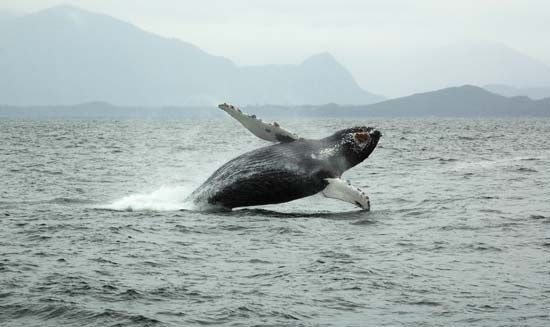
Blue whales, which belong to the suborder of baleen whales, produce sound by blowing air through a U-shaped ridge of tissue located at the top of their…
How do blue whales communicate, and what is the significance of their vocalizations?
Blue whales, which belong to the suborder of baleen whales, produce sound by blowing air through a U-shaped ridge of tissue located at the top of their larynx. This mechanism allows them to recycle air, enabling them to vocalize underwater without the risk of drowning.12
The vocalizations of blue whales are primarily low-frequency, ranging from 12.5 to 200 hertz, and are considered the loudest sounds produced by any animal. These powerful signals are significant for several reasons:1
- Long-Distance Communication: Their low-frequency calls can travel across entire ocean basins, potentially allowing individuals to communicate over thousands of kilometers.12
- Navigation and Orientation: These sounds may assist in long-range navigation and environmental awareness in the vast, featureless ocean.12
- Social Interaction: Vocalizations help whales share information regarding their location, identity, and emotional states, and may be used to locate other members of their species.32
Unfortunately, these communication efforts are increasingly hindered by noise pollution from shipping vessels, which often operate in the same frequency bands as baleen whales.42
How have human activities, such as whaling, impacted blue whale populations throughout history?
Human activities, particularly commercial whaling, have had a devastating impact on blue whale populations throughout the 20th century. At the beginning of the 1900s, it is estimated that there were approximately 228,000 blue whales in the world’s oceans. However, the development of modern whaling technologies—such as steam-powered whale catchers, explosive harpoons, and factory ships—allowed whalers to pursue and efficiently process these fast-swimming giants, which were previously considered too difficult to hunt.567
The scale of this exploitation was immense; in the 1930–31 season alone, more than 29,000 blue whales were killed. Following a brief respite during World War II, hunting intensified again, further decimating the population. By the early 21st century, the global population had plummeted to an estimated 14,000 individuals.8675
The species has been protected from commercial whaling since the mid-1960s, and while populations are showing signs of recovery—currently estimated between 10,000 and 25,000—the International Union for Conservation of Nature continues to classify the blue whale as an endangered species.8
How does the blue whale’s size compare to other large animals, both living and extinct?
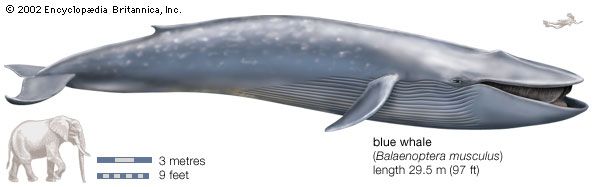
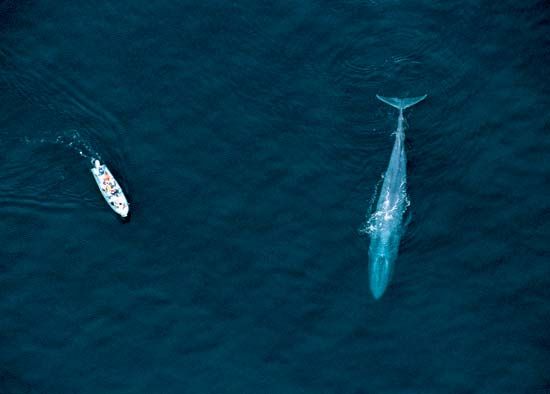
The blue whale (Balaenoptera musculus) is widely recognized as the largest animal to have ever lived on Earth. These marine giants can reach lengths exceeding 30 meters (98 feet) and weigh approximately 150 to 180 metric tons, with some reports suggesting weights up to 200 metric tons.10511
When comparing the blue whale to other massive creatures, the distinction often depends on whether one measures by length or mass:
- Compared to Land Animals: While modern land animals like the elephant are significantly smaller, some extinct sauropod dinosaurs, such as the titanosaur Patagotitan, were longer, with some estimates reaching 37 meters (121 feet). However, in terms of total mass, the blue whale remains heavier than these terrestrial giants, as the largest titanosaurs are estimated to have weighed between 60 and 100 metric tons.1213
- Compared to Other Marine Predators: The extinct megalodon was one of the largest marine carnivores in history, reaching lengths of at least 16 meters (50 feet). While impressive, it was significantly smaller and less massive than the blue whale.1415
How do blue whales regulate their body temperature in cold ocean waters?
Blue whales, like all cetaceans, maintain their body temperature in cold ocean waters through three primary evolutionary adaptations:
- Insulation: They possess a thick layer of blubber—a dense, fat-rich layer of the dermis that can reach up to 30 cm (12 inches) in thickness. Because fat and oil conduct heat poorly, this blanket acts as an effective thermal barrier covering the entire body.
- Reduced Surface Area: Blue whales have evolved to minimize external appendages that would otherwise facilitate significant heat loss, which also aids in efficient locomotion.
- Countercurrent Heat Exchange: This is the most critical mechanism for regulating internal temperature. Blood returning from the skin surface can be routed through different vessels depending on the whale’s needs. To conserve heat, oxygen-depleted venous blood returning to the heart is directed through vessels wrapped around arteries carrying warm blood to the periphery. This allows the venous blood to be warmed by the arterial blood before reaching the heart. Conversely, if the whale needs to shed excess heat, blood is routed through superficial veins to dissipate heat into the environment.16
Sources
- cetacean - Sound production and communication — Encyclopædia Britannica
- Why do whales sing? — Encyclopædia Britannica
- noise pollution - Effects on humans and wildlife — Encyclopædia Britannica
- whale vocalization — Encyclopædia Britannica
- blue whale — Encyclopædia Britannica
- whaling - Modern whaling — Encyclopædia Britannica
- whaling - Regulation — Encyclopædia Britannica
- cetacean - Abundance — Encyclopædia Britannica
- conservation - Whaling — Encyclopædia Britannica
- What is the largest animal on Earth? — Encyclopædia Britannica
- Titanosaurs: 8 of the World’s Biggest Dinosaurs — Encyclopædia Britannica
- mammal: Top Questions — Encyclopædia Britannica
- titanosaur: Top Questions — Encyclopædia Britannica
- megalodon - Predators and prey — Encyclopædia Britannica
- Tertiary Period - Large marine animals — Encyclopædia Britannica
- cetacean - Circulation and thermoregulation — Encyclopædia Britannica
- baleen whale — Encyclopædia Britannica
Published on · 4 min read