Borhyaenidae
Borhyaenidae is a family of extinct South American marsupial mammals that existed from the early Paleocene Epoch until the early Pliocene, spanning…
What is Borhyaenidae?
Borhyaenidae is a family of extinct South American marsupial mammals that existed from the early Paleocene Epoch until the early Pliocene, spanning approximately 63.5 to 5 million years ago.1
Named after the genus Borhyaena, the family exhibited a diverse range of forms. While some specimens, such as those found in 23-million-year-old Miocene rocks in Argentina, possessed large skulls and heavy crushing teeth similar to hyenas, others were wolflike or foxlike in appearance. Notably, the family included Thylacosmilus, a Pliocene-aged marsupial that served as a South American counterpart to the sabre-toothed tiger.1
What is convergent evolution and how does it relate to Borhyaenidae?
Convergent evolution, or convergence, is a phenomenon where unrelated species living in similar environments are shaped by natural selection to develop comparable morphological, physiological, or life history characteristics. Because these species face similar environmental pressures, they evolve to fill analogous ecological niches despite having different evolutionary origins.34
The Borhyaenidae family provides a classic example of this process. As extinct South American marsupial mammals, borhyaenids evolved to occupy roles that were filled by placental carnivores on other continents. Their diversity illustrates this convergence:1
- Hyena-like forms: Certain borhyaenids, such as the genus Borhyaena, developed large skulls and heavy crushing teeth, mirroring the adaptations of hyenas.1
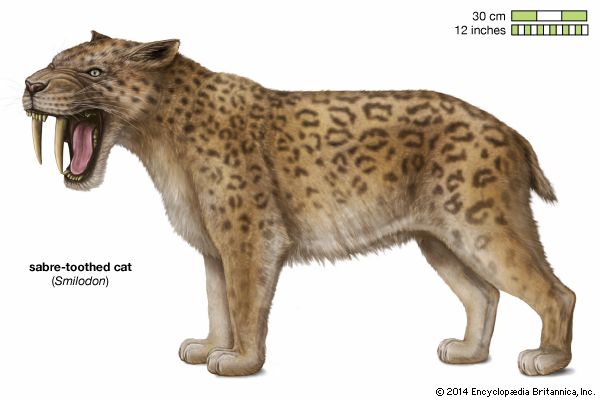
- Sabre-toothed forms: The Pliocene-aged Thylacosmilus evolved as a marsupial counterpart to the sabre-toothed tigertoothed tiger](https://www.britannica.com/animal/saber-toothed-cat).1
- Canid-like forms: Many other members of the family developed body plans similar to wolves or foxes.1
How did Thylacosmilus differ from the saber-toothed cats of North America?
While Thylacosmilus and North American sabre-toothed cats are striking examples of convergent evolution, they belong to fundamentally different biological groups. Thylacosmilus was a marsupial, whereas the sabre-toothed cats of North America were placental mammals.6
Despite this deep evolutionary divide, they shared remarkable physical similarities, such as long, powerful canine teeth used for stabbing prey. A key anatomical difference was the jaw structure: Thylacosmilus possessed a well-developed flange, or projecting edge, on the lower jaw that served as a sheath for its elongated upper canines. While both were apex predators, Thylacosmilus inhabited South America from the late Miocene to the late Pliocene Epoch, eventually going extinct following the formation of the land bridge between North and South America.6
What caused the extinction of the Borhyaenidae family?
The extinction of the Borhyaenidae family was primarily driven by the formation of the land bridge across the Isthmus of Panama approximately 3 million years ago. This geological event reconnected South America with North America, initiating a massive faunal exchange known as the Great American Biotic Interchange.17
Prior to this connection, South America had evolved in isolation, allowing its unique marsupial fauna to flourish with limited competition. Once the land bridge emerged, a large wave of highly adaptable placental mammals and carnivores migrated from the north into South America. These northern invaders proved more successful at competing for food and resources, which placed immense pressure on the endemic South American species. This intense competition from northern predators and herbivores is widely cited as a primary factor contributing to the extinction of several orders of South American land mammals, including the borhyaenids.71
Sources
- Borhyaenidae — Encyclopædia Britannica
- List of marsupials — Encyclopædia Britannica
- The rodent that acts like a hippo — Encyclopædia Britannica
- community ecology - Convergence — Encyclopædia Britannica
- Creodonta — Encyclopædia Britannica
- Thylacosmilus — Encyclopædia Britannica
- Tertiary Period - Mammalian migration between North and South America — Encyclopædia Britannica
- Pleistocene Epoch - Megafaunal extinctions — Encyclopædia Britannica
- plate tectonics - Evolution — Encyclopædia Britannica
Published on · 2 min read