Bothriolepis
Bothriolepis is a genus of extinct fish belonging to the order Antiarcha and the class Placodermi. These creatures lived during the Middle and Late Devonian…
What is Bothriolepis?
Bothriolepis is a genus of extinct fish belonging to the order Antiarcha and the class Placodermi. These creatures lived during the Middle and Late Devonian periods, approximately 387 million to 360 million years ago.1
Physically, Bothriolepis was characterized by heavy bony armor covering its head and thorax, while the posterior portion of its body lacked scales. Its eyes were positioned on top of the head shield, near the pineal eye. Additionally, the fish featured movable, serrated bony spines in the shoulder region.1
As a bottom-dweller, Bothriolepis inhabited streams and lakes. Given its small jaws and teeth, it was not a pursuit predator but likely fed on invertebrates found on the bottom of these water bodies. While some older classifications may refer to them as ostracoderms, they are formally recognized as placoderms.12
What are other examples of placoderms?
Placoderms were a diverse group of extinct, jawed fishes that dominated the Devonian Period. While Bothriolepis is a well-known example of the antiarchs—a group of bottom-dwelling placoderms—there were several other notable types:
- Arthrodires: This was a highly successful group characterized by a hinged joint between their head and trunk armor. They included both small species and massive predators.
- Dunkleosteus: Often cited as one of the most formidable predators of the Devonian seas, this genus of arthrodire could reach lengths of 10 meters (about 33 feet). It possessed heavy, sharp jaw plates capable of crushing hard-shelled prey or swallowing other fish whole.
- Dinichthys: Closely related to or synonymous with Dunkleosteus in many contexts, this large, armored predator is a classic example of the massive, specialized forms that evolved during the Late Devonian.
While some fossils like Palaeospondylus have historically been associated with the group, their classification remains uncertain and they are generally not considered true placoderms.
What defines the Devonian period?
The Devonian Period is a major interval of the Paleozoic Era that occurred between approximately 419.2 million and 358.9 million years ago, following the Silurian Period and preceding the Carboniferous Period.7
Often referred to as the “Age of Fishes,” the period is defined by the following key characteristics:
- Biological Innovation: The Devonian saw the first appearance of ammonites and forests. It is also marked by the earliest extensive evolutionary radiation of fish and the emergence of the first four-legged amphibians, signaling the colonization of land by vertebrates.897
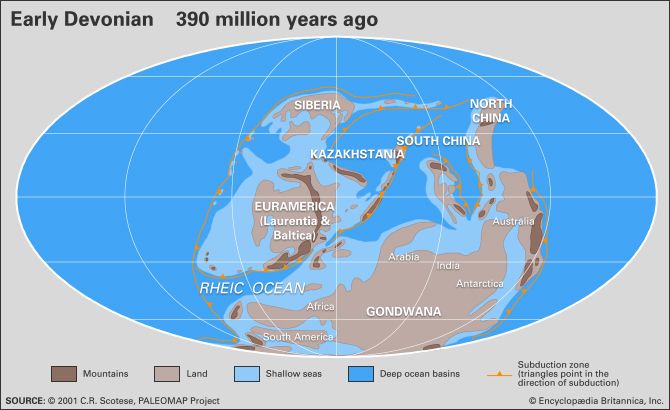
- Geologic Configuration: Early in the period, the paleocontinents of Laurentia and Baltica collided to form the supercontinent Laurussia (or Euramerica). Meanwhile, the southern continents were united as Gondwana.97
- Environmental Conditions: Oceans covered about 85 percent of the globe. The climate was generally warm and equitable, though the period experienced significant extinction events—such as the Kellwasser Event—often linked to oceanic anoxia, fluctuating sea levels, and environmental stress.8107
The period is named after Devon, England, where geologists first identified its distinct marine rock strata.7
How did bony armor help early fish survive?
Early fish, including agnathans and placoderms, utilized bony armor primarily as a defensive mechanism. This dermal armor, composed of skin bones, provided essential protection against predators, such as the clawed invertebrate eurypterids that inhabited the same waters.3115
Beyond defense, the development of this armor and the associated skeletal materials played a fundamental role in vertebrate evolution. In early environments, such as streams, the armor may have helped fish resist currents and navigate their surroundings. Furthermore, the evolution of bone—both external and internal—was critical for the development of homeostasis, allowing vertebrates to regulate the chemical composition of their internal fluids. This physiological independence from the external environment was a necessary precursor for the eventual emergence of terrestrial vertebrates. While the armor provided structural rigidity, it was the later adaptation of internal bone that offered significant mechanical advantages for life on land, away from the buoyancy of water.512
Sources
- Bothriolepis — Encyclopædia Britannica
- Bothriolepis — Merriam-Webster
- placoderm — Encyclopædia Britannica
- fish - Placodermi: plate-skin fishes — Encyclopædia Britannica
- Devonian Period - Vertebrates — Encyclopædia Britannica
- Carboniferous Period - Fishes — Encyclopædia Britannica
- A Journey Through Time Since the Precambrian - Devonian Period: 419.2 million to about 359 million years ago — Encyclopædia Britannica
- Devonian Period - Extinction events — Encyclopædia Britannica
- Devonian Period - Significant geologic events — Encyclopædia Britannica
- Devonian Period — Encyclopædia Britannica
- bone - Evolutionary origin and significance — Encyclopædia Britannica
- Devonian Period - Devonian life — Encyclopædia Britannica
- fish - Agnatha: early jawless fishes — Encyclopædia Britannica
Published on · 3 min read