Brontosaurus
The Brontosaurus has maintained a prominent place in popular culture throughout the 20th and 21st centuries, largely due to its iconic status as a…
How has Brontosaurus been depicted in popular culture, such as movies and books?
The Brontosaurus has maintained a prominent place in popular culture throughout the 20th and 21st centuries, largely due to its iconic status as a quintessential sauropod dinosaur.com/animal/sauropod) dinosaur. Despite a long period of taxonomic controversy where it was classified as Apatosaurus, the public continued to embrace the name “thunder lizard,” and its likeness was widely used in motion pictures, television, and advertising.12
Notable appearances and cultural impacts include:
- Corporate Branding: The Sinclair Oil Corporation adopted the Brontosaurus as its brand logo in 1930, establishing it as one of the most recognizable symbols in American business.1
- Film: The dinosaur was featured in Walt Disney’s classic film Fantasia (1940) and served as the inspiration for the lead character in the popular animated movie The Land Before Time (1988).1
- Museums: For decades, Brontosaurus reconstructions were staples in museums across North America and Europe, which helped cement its image in the public consciousness.1

What are the key physical characteristics of the Brontosaurus?
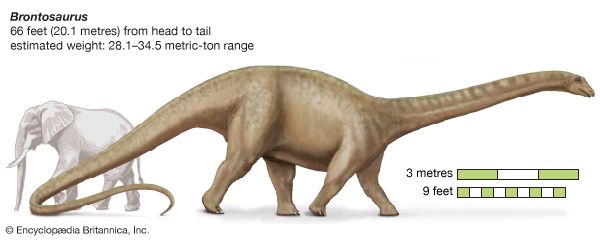
The Brontosaurus was a large, herbivorous sauropod dinosaur characterized by several distinct physical features that supported its terrestrial lifestyle.4
Key Physical Characteristics
- Body Structure: It was a quadrupedal animal, supported by four stout, pillarlike legs.4
- Neck and Tail: It possessed a long neck, which was balanced by a long, whiplike tail. The neck may have evolved to reach vegetation in marshes or high in trees.41
- Size: Early museum specimens measured approximately 20.3 meters (66.5 feet) in length, with estimated weights between 28.1 and 34.5 tonnes (31 and 38 tons). More recent studies estimate an average weight of 30.5 tonnes (33.6 tons).4
- Dietary Adaptations: As an herbivore, it consumed plant matter and ingested stones to assist in grinding and digesting food within its stomach.4
- Skull: While early, conjectural reconstructions incorrectly featured a skull similar to that of Camarasaurus, it is now known that Brontosaurus had a slender, elongated head more similar to that of the diplodocid group, featuring long, peglike teeth.41
How does Brontosaurus differ from other sauropod dinosaurs like Apatosaurus?
While Brontosaurus and Apatosaurus were historically consolidated into a single genus due to their anatomical similarities, they are now recognized as distinct genera following a comprehensive 2015 phylogenetic analysis of the family Diplodocidae.15
The primary differences between the two are based on morphological characteristics rather than habit, as both were terrestrial, quadrupedal herbivores with long necks and whiplike tails. Key distinctions include:15
- Size and Mass: Apatosaurus was generally larger and heavier than Brontosaurus. Estimates suggest Apatosaurus reached lengths of up to 27.4 meters (90 feet) and weighed approximately 41.3 tonnes (45.4 tons). In contrast, Brontosaurus was typically smaller, with an average weight estimated at 30.5 tonnes (33.6 tons).1
- Classification: The genus Brontosaurus was reinstated after researchers examined 477 physical features across 81 individual sauropod specimens, concluding that the morphological differences were sufficient to separate them into two distinct genera.15
- Taxonomic History: Apatosaurus was described in 1877, two years before Brontosaurus. For much of the 20th century, Brontosaurus was considered a synonym of Apatosaurus after paleontologist Elmer Riggs concluded in 1903 that the specimens represented the same type of animal.15
When and where did Brontosaurus live during the prehistoric era?
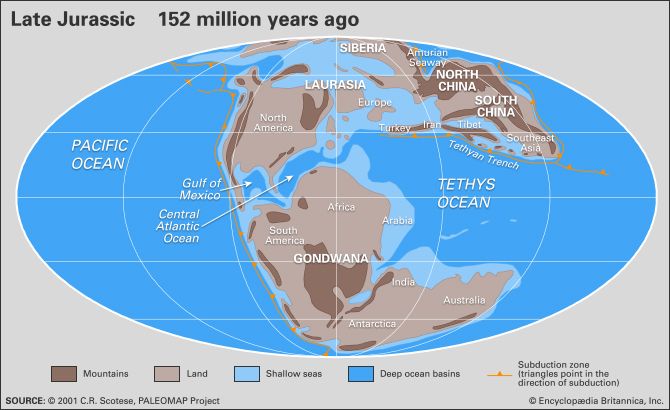
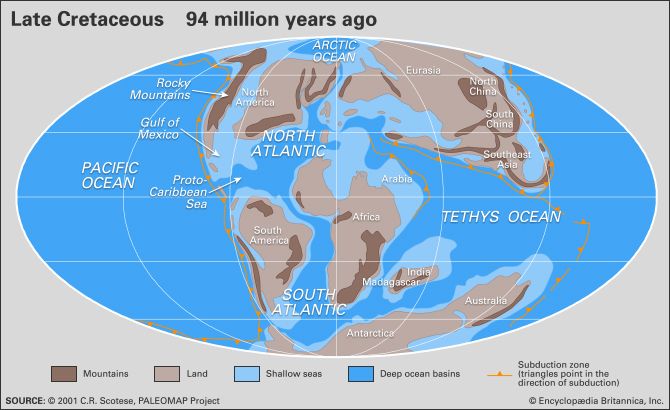
The Brontosaurus lived during the Late Jurassic and Early Cretaceous epochs, a timeframe spanning approximately 163.5 million to 100.5 million years ago.8
Regarding its geographic range, the first fossils of this genus were discovered in western [North America]. Specifically, the nearly complete skeleton described by Othniel Charles Marsh was excavated from rocks dating to the Jurassic Period at the Como Bluff Quarry 10 in Wyoming.8
Sources
- brontosaurus — Encyclopædia Britannica
- brontosaurus — Merriam-Webster
- Giganotosaurus — Encyclopædia Britannica
- brachiosaur — Encyclopædia Britannica
- Apatosaurus — Encyclopædia Britannica
- dinosaur - Sauropodomorpha — Encyclopædia Britannica
- Diplodocus — Encyclopædia Britannica
- Jurassic Period — Encyclopædia Britannica
- saurischian — Encyclopædia Britannica
Published on · 3 min read