Campagna Di Roma
The Campagna di Roma, also known as the Roman Campagna, is a lowland plain covering approximately 800 square miles (2,100 square km) surrounding the city of…
What is Campagna di Roma?
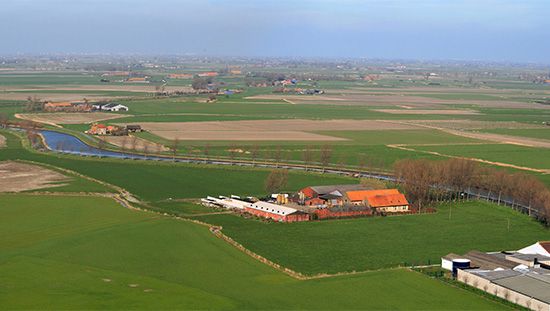
The Campagna di Roma, also known as the Roman Campagna, is a lowland plain covering approximately 800 square miles (2,100 square km) surrounding the city of Rome in the Lazio region of central Italy.12
Geographically, the area is bounded by the Tyrrhenian Sea to the southwest and various mountain ranges, including the Alban Hills, to the southeastAlban Hills](https://www.britannica.com/place/Alban-Hills), to the southeast. Historically, the Campagna was one of the last regions in central Italy to be settled in antiquity. During the Middle Ages, the district became largely abandoned to marshes and malaria.13
Significant land reclamation efforts in the late 19th and early 20th centuries transformed the region into productive agricultural land for cereals, livestock, and produce. However, in the late 20th century, the area’s character began to shift due to the abandonment of small farms and rapid, uncontrolled urban development.1
How did malaria affect the history of the Campagna?
Malaria played a significant role in shaping the history of the Campagna di Roma, particularly by influencing settlement patterns and land use. By the later classical period of the Roman Empire, the disease had become a serious health crisis in the region, with its prevalence closely linked to the Pontine Marshes.1
Ecological changes, including deforestation and intensified agricultural activity, created conditions that allowed new, more effective mosquito vectors from North Africa to establish themselves in the area. The Romans, observing the disease’s association with stagnant water, attributed it to “miasmas” or “bad air,” which is the origin of the term mal aria.1
During the Middle Ages, the persistent threat of malaria led to the widespread abandonment of the Campagna, leaving the district largely to marshes. It was not until major land reclamation projects were undertaken in the late 19th and early 20th centuries that the region was transformed back into productive agricultural land.41
What are the seven hills of Rome?
The Seven Hills of Rome are the historic group of hills upon which the ancient city of Rome was built. According to tradition, the original city of Romulus was established on the Palatine Hill.5
The seven hills are:
- Palatine Hill (Mons Palatinus)5
- Capitoline Hill (Mons Capitolinus)5
- Quirinal Hill (Mons Quirinalis)5
- Viminal Hill (Mons Viminalis)5
- Esquiline Hill (Mons Esquilinus)5
- Caelian Hill (Mons Caelius)5
- Aventine Hill (Mons Aventinus)5
These hills served as the foundational landscape for the city’s development, housing significant structures ranging from imperial palaces on the Palatine to religious and public sites across the other elevations.5678
How did land reclamation change the landscape of Italy?
Land reclamation has fundamentally reshaped the Italian landscape by transforming previously uninhabitable or unproductive areas into vital agricultural and economic zones. Historically, regions such as the Pontine Marshes were characterized by marshy, malarial terrain that remained largely undeveloped despite sporadic attempts at drainage by various emperors and popes over the centuries.9
A major transformation occurred in 1928 when the Fascist government launched an extensive project to drain these marshes, clear vegetation, and establish new towns, including Latina and Sabaudia. Following the damage sustained during World War II, these drainage works were repaired, successfully converting approximately 300 square miles into highly productive land for cereals, fruit, and livestock.9
Post-1945, land reform laws further altered the landscape by expropriating large, poorly cultivated estates to create smaller, peasant-owned farms. While this shift aimed to foster a settled society, it also led to increased mechanization and modernization, which replaced traditional labor roles and contributed to the growth of rural towns. These efforts, combined with regional development programs, transitioned many rural areas from stagnant wilderness into integrated parts of the national economy.109
Sources
- Campagna di Roma — Encyclopædia Britannica
- Rome - City site — Encyclopædia Britannica
- Campagna di Roma — Merriam-Webster
- malaria - Malaria through history — Encyclopædia Britannica
- Seven Hills of Rome — Encyclopædia Britannica
- Rome - The Palatine — Encyclopædia Britannica
- Rome - The Aventine — Encyclopædia Britannica
- Rome - The Caelian — Encyclopædia Britannica
- Drainage - Land reclamation — Encyclopædia Britannica
- Pontine Marshes — Encyclopædia Britannica
- Italy - Land reform — Encyclopædia Britannica
- Benito Mussolini - Dictatorship — Encyclopædia Britannica
- Italy - The republic of Salò (the Italian Social Republic) and the German occupation — Encyclopædia Britannica
- Origins of agriculture - Italy — Encyclopædia Britannica
- Italy - Lakes — Encyclopædia Britannica
Published on · 3 min read