How Does Carbon Dating Work?
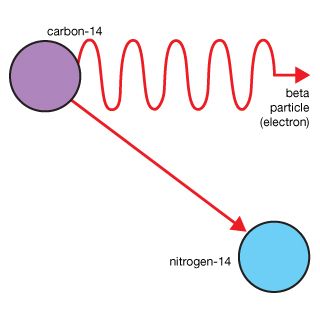
Carbon dating, or carbon-14 dating, is a method used to determine the age of organic remains by measuring the decay of the radioactive isotope carbon-14.
How does carbon dating work?
Carbon dating, or carbon-14 dating, is a method used to determine the age of organic remains by measuring the decay of the radioactive isotope carbon-14.12
How the Process Works
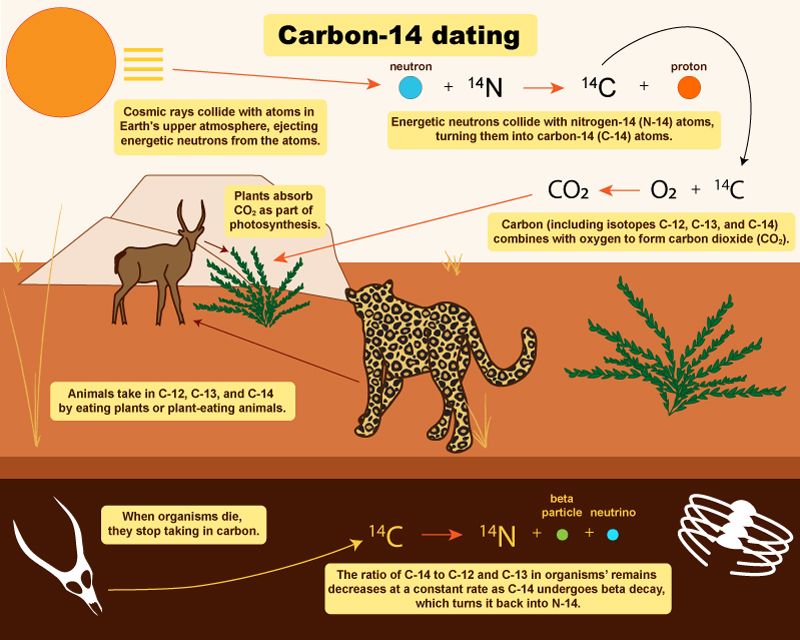
- Formation: Cosmic rays strike the upper atmosphere, creating neutrons that collide with nitrogen-14 atoms to produce carbon-14. This isotope then bonds with oxygen to form radioactive carbon dioxide.2
- Absorption: Through photosynthesis, plants absorb this carbon dioxide, which then enters the food chain as animals consume the plants.12
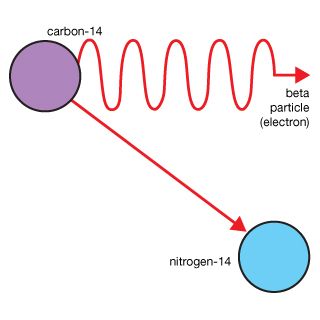
- Death and Decay: While an organism is alive, it maintains a stable ratio of carbon isotopes. Upon death, it stops taking in carbon. The carbon-14 begins to decay at a constant rate, with a half-life of 5,730 ± 40 years.12
- Measurement: Researchers use an accelerator mass spectrometer to measure the remaining carbon-14, allowing them to estimate the time elapsed since the organism died.23
Because atmospheric carbon levels have fluctuated over time, raw dates are often calibrated using dendrochronology to ensure accuracy.23
What is dendrochronology and how does it help calibrate carbon dating?
Dendrochronology, or tree-ring dating, is the scientific discipline of determining the age of past events by analyzing the annual growth rings of trees. Because many tree species produce one growth ring per year—with width influenced by local precipitation and temperature—researchers can create a chronological record by matching overlapping ring patterns from living trees, deadwood, and ancient timber.567
Calibrating Carbon Dating
While carbon-14 dating is a powerful tool, it assumes that atmospheric carbon-14 levels have remained constant over time. However, research has shown that these levels fluctuate due to variations in cosmic rays and other environmental factors.74
Dendrochronology helps correct these discrepancies by providing an independent, absolute timeline:64
- Calibration Curves: Scientists measure the carbon-14 content in tree rings of known calendar ages—such as those from the long-lived bristlecone pine—to create calibration curvescone pine](https://www.britannica.com/plant/bristlecone-pine)—to%E2%80%94to) create calibration curves.64
- Correction: By comparing the “radiocarbon age” of a sample against these curves, researchers can convert it into a more precise calendar date, accounting for historical fluctuations in atmospheric carbon.74
Why is carbon dating limited to organic materials that are less than 50,000 years old?
Carbon-14 dating is primarily limited to organic materials up to approximately 50,000 to 60,000 years old due to the nature of radioactive decay and the sensitivity of measurement techniques.41
Why the Limit Exists
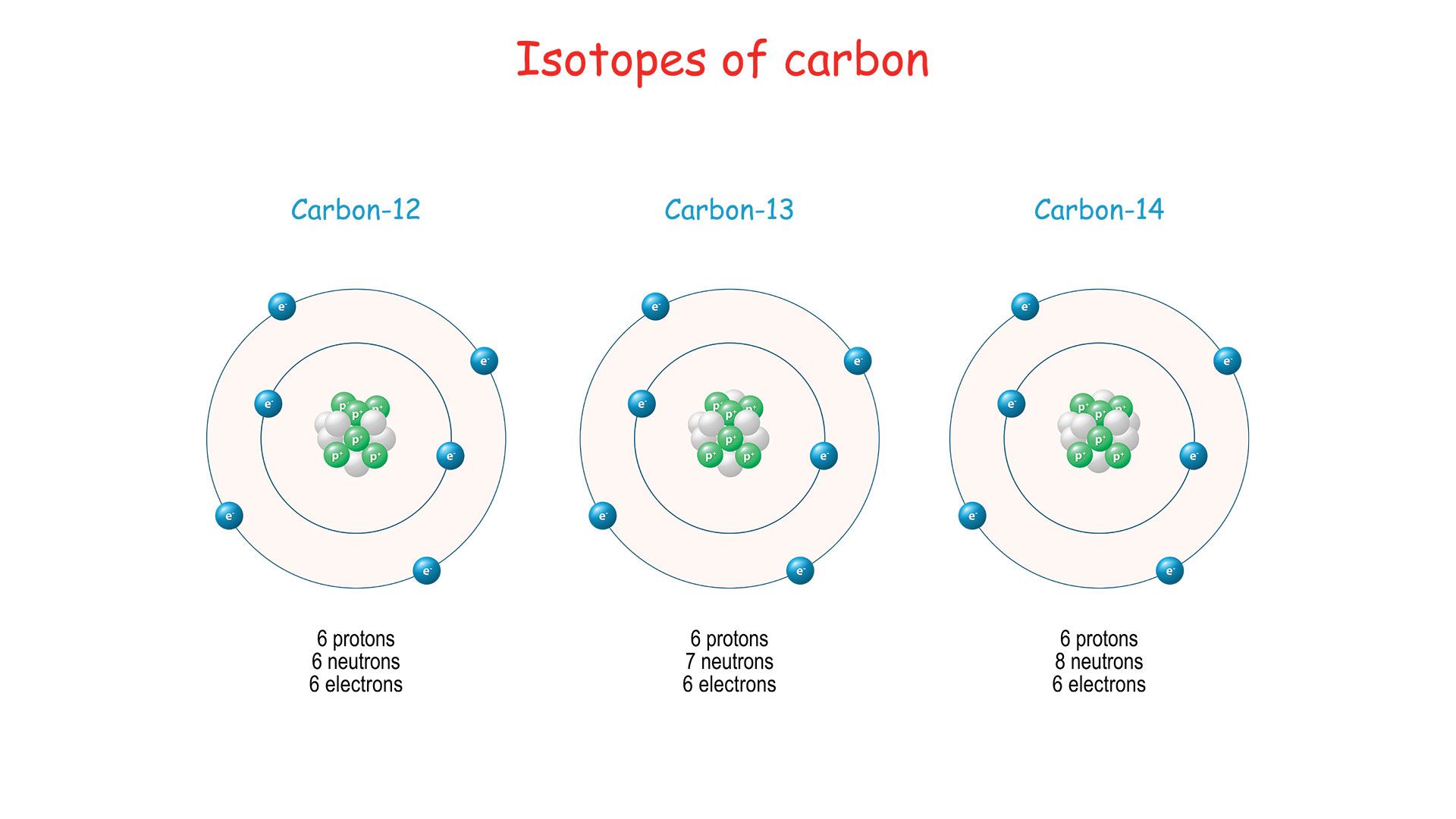
- Radioactive Decay: Carbon-14 has a half-life of 5,730 ± 40 years. This means that after every 5,730 years, the amount of carbon-14 in a sample is reduced by half. After about 50,000 to 60,000 years, the remaining amount of carbon-14 is so minuscule that it becomes nearly impossible to distinguish from background radiation or measurement noise.124
- Contamination: For samples older than 25,000 years, even a tiny amount of modern carbon contamination—such as from rootlets or environmental carbonates—can significantly skew the results. As the original carbon-14 signal fades, the impact of such contamination becomes disproportionately large, rendering the date unreliable.4
While accelerator mass spectrometry has improved sensitivity by allowing researchers to count individual carbon-14 atoms rather than waiting for them to decay, the physical depletion of the isotope remains an absolute barrier for dating much older materials.48
What are some other methods scientists use to date objects older than 50,000 years?
When dating objects older than 50,000 years, scientists rely on various radiometric dating methods that utilize isotopes with much longer half-lives than carbon-14. These techniques are essential for determining the age of rocks, minerals, and geological formations that span millions or even billions of years.1112
Key Radiometric Dating Methods
- Potassium-Argon Dating: This method measures the ratio of radioactive potassium-40 to its decay product, argon-40. Because potassium-40 has a half-life of approximately 1.25 billion years, it is highly effective for dating volcanic rocks and minerals ranging from 20,000 years to billions of years old.41112
- Uranium-Lead Dating: By analyzing the decay of uranium-238 and uranium-235 into stable lead isotopes, scientists can date igneous and metamorphic rocks. With half-lives in the hundreds of millions to billions of years, these “clocks” are fundamental for establishing the age of the Earth and ancient geological events.131112
- Samarium-Neodymium Dating: Utilizing the decay of samarium-147 to neodymium-143, this method is particularly useful for studying mafic igneous rocks and meteorites, as it is resistant to geological alteration.1112
Other Techniques
- Thermoluminescence: This method measures the light energy released from minerals when heated, which corresponds to the time elapsed since the material was last exposed to high-energy radiation or heat.14
- Cosmogenic Isotope Dating: Isotopes like beryllium-10 and aluminum-26 are produced by cosmic-ray bombardment and are used to date surface exposures, marine sediments, and glacial ice.912
Sources
- carbon-14 dating — Encyclopædia Britannica
- carbon-14 — Encyclopædia Britannica
- How does carbon dating work? — Encyclopædia Britannica
- dating - Carbon-14 dating and other cosmogenic methods — Encyclopædia Britannica
- dendrochronology — Encyclopædia Britannica
- geochronology - Tree-ring growth — Encyclopædia Britannica
- Holocene Epoch - Chronology and correlation — Encyclopædia Britannica
- Archaeology - Dating — Encyclopædia Britannica
- dating - Origin of radioactive elements used — Encyclopædia Britannica
- mass spectrometry - Development — Encyclopædia Britannica
- potassium-argon dating — Encyclopædia Britannica
- uranium-thorium-lead dating — Encyclopædia Britannica
- geology - Isotopic geochemistry — Encyclopædia Britannica
- thermoluminescence — Encyclopædia Britannica
Published on · 4 min read