Chinook Salmon
The chinook salmon (Oncorhynchus tshawytscha), also known as the king salmon or spring salmon, is a highly prized fish of the family Salmonidae native to the…
What is chinook salmon?
The chinook salmon (Oncorhynchus tshawytscha), also known as the king salmon or spring salmon, is a highly prized fish of the family Salmonidae native to the North Pacific Ocean.123
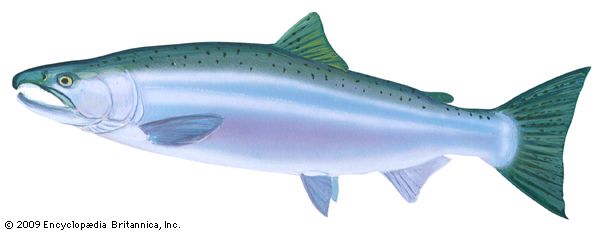
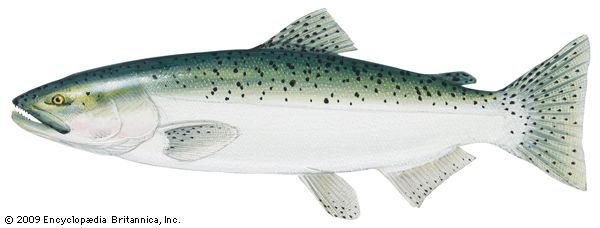
Physically, these salmon are typically bluish-green on their backs with silvery sides and round black spots; they are also distinguished by a dark mouth with black gums. While they average 13.5 to 18 kg (30 to 40 pounds), they can grow significantly larger, sometimes exceeding 54 kg (120 pounds).12
As a species of Pacific salmon, they spend most of their lives in the ocean before returning to freshwater streams to spawn. They are known for their impressive migrations, with some traveling as far as 3,200 km (2,000 miles) up the Yukon River. Young chinook typically remain in freshwater for one to three years before migrating to the sea. Beyond their native range, they have been successfully introduced to the Great Lakes, where they support a significant sport fishery.31
What is the life cycle of a salmon?
The life cycle of a salmon is a remarkable journey that typically begins and ends in freshwater, with a significant portion of adulthood spent in the open ocean.56
Freshwater Beginnings
Salmon are anadromous, meaning they are born in cold, clear freshwater streams or lakes. Females dig a pit in the gravel bed, where they deposit eggs to be fertilized by a male. These eggs incubate in the gravel, usually hatching in late winter. Upon hatching, the young fry rely on their attached yolk sac for nourishment before emerging to feed.746
Migration and Ocean Life
Depending on the species, young salmon may remain in freshwater for anywhere from a few weeks to several years before migrating downstream to the ocean. Once in the sea, they spend one or more years maturing, growing rapidly, and developing the silvery coloration characteristic of their adult phase.467
Spawning and Completion
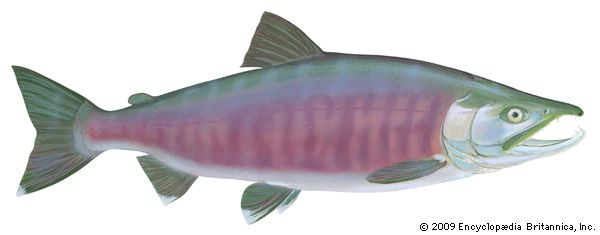
Driven by instinct and a keen sense of smell, adult salmon return to their natal streams to spawn. During this migration, they undergo physical changes, such as color shifts and the development of hooked jaws in males. While most Pacific salmon die shortly after spawning, some Atlantic salmon survive to return to the sea and may spawn multiple times.76
Why do salmon migrate upstream to spawn?
Salmon migrate upstream to spawn primarily to ensure the survival of their offspring in a specialized, stable environment. By returning to the cold, clear freshwater streams where they were hatched, salmon provide their eggs with a protected, oxygen-rich habitat that is often safer for developing embryos than the open ocean.569
This behavior is driven by a combination of instinct and biological programming. Over generations, salmon have adapted to the specific chemical signatures of their natal streams, which they identify through a highly developed sense of olfaction (smell) and, in some species, by sensing Earth’s magnetic field.5410
The journey is a massive reproductive investment. As anadromous fish, they rely on energy reserves stored as oils during their time in the ocean to fuel their arduous upstream travel, during which they stop eating entirely. For many Pacific salmon, this is a terminal effort; they are biologically programmed to expend all their energy to reach the spawning grounds, ensuring their genes are passed on before they die. This “ultimate sacrifice” is nature’s way of prioritizing the next generation’s success.764
What are the differences between various species of Pacific salmon?
There are six recognized species of Pacific salmon within the genus Oncorhynchus, each with distinct characteristics, ranges, and life history traits.4
Species Overview
- Chinook salmon (O. tshawytscha): Also known as king or spring salmon, these are the largest species, averaging about 23 pounds (10 kg), though some reach 50–80 pounds. They range from the Yukon River to California.4
- Sockeye salmon (O. nerka): Known as red salmon, they weigh 4–7 pounds (2–3 kg). They are notable for their ability to use Earth’s magnetic field to navigate back to their home streams.4
- Coho salmon (O. kisutch): Also called silver salmon, they weigh 7–10 pounds (3–4.5 kg) and range from the Bering Sea to the Salinas River in California.4
- Chum salmon (O. keta): Often called dog salmon, they average 10–12 pounds (4.5–5.5 kg) and have a wide range from the Arctic to the Rogue River.4
- Pink salmon (O. gorbuscha): The smallest species, weighing 3–6 pounds (1.3–2.7 kg). They are unique for their rapid migration to the sea shortly after hatching.49
- Cherry salmon (O. masu): This species is primarily found off the coast of Japan.4
Key Differences in Life History
While all Pacific salmon are anadromous, their time spent in freshwater varies significantly. For example, young pink salmon descend to the ocean almost immediately, while coho salmon remain in streams for a full year, and sockeye salmon may dwell in lakes for up to five years before migrating. Additionally, while most Pacific salmon die after spawning, the species exhibit varying levels of physical transformation during the breeding season, with males typically developing hooked jaws.47
Sources
- chinook salmon — Encyclopædia Britannica
- Chinook salmon — Merriam-Webster
- king salmon — Merriam-Webster
- salmon — Encyclopædia Britannica
- 14 Questions About Aquatic Animals Answered - Is it true that a salmon will always return to its birthplace? — Encyclopædia Britannica
- Migration - Anadromous fish — Encyclopædia Britannica
- protacanthopterygian - Life cycle and reproduction — Encyclopædia Britannica
- fish - Reproduction — Encyclopædia Britannica
- Why do salmon die after spawning? — Encyclopædia Britannica
- Chemoreception - Homing — Encyclopædia Britannica
Published on · 4 min read