Cimarron River
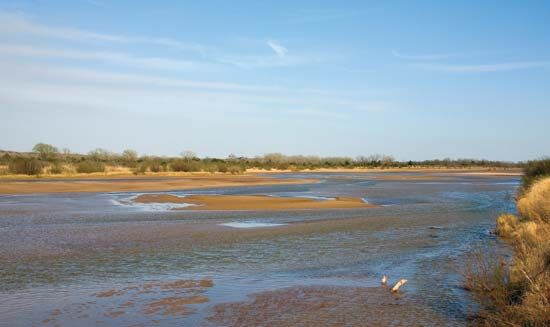
The Cimarron River is a 698-mile-long waterway in the United States that originates in northeastern New Mexico near the Capulin Volcano National Monument. It…
What is Cimarron River?
The Cimarron River is a 698-mile-long waterway in the United States that originates in northeastern New Mexico near the Capulin Volcano National Monument. It flows eastward through the Oklahoma Panhandle, clips the corners of Colorado and Kansas, and eventually joins the Arkansas River near Tulsa, Oklahoma.1
While the riverbed is often dry in its upper reaches, it becomes a permanent stream after reentering Oklahoma south of Coldwater, Kansas. Its name is likely derived from the Spanish word cimarrón, meaning “wild”. Historically, the river was significant for the Santa Fe Trail, which followed its valley for 100 miles, with travelers referring to the Oklahoma Panhandle section as the “Cimarron Cutoff”. Although the river is unnavigable, it passes near several communities, including Guthrie and Cushing.1
What was the significance of the Santa Fe Trail?
The Santa Fe Trail served as a vital commercial artery between Independence, Missouri, and Santa Fe, New Mexico, from 1821 to 1880. Established by trader William Becknell, the route facilitated the exchange of manufactured goods from the United States for silver and furs from the Southwest.23
The trail’s significance included:
- Economic Integration: It opened trade channels that helped integrate the remote New Mexico frontier into the broader American economy.34
- Geopolitical Impact: The volume of trade and the growing American presence along the route were contributing factors to the U.S. seizure of New Mexico during the Mexican-American War2.
- Infrastructure Development: The trail evolved to include stagecoach mail service by 1849, though its utility eventually declined with the arrival of the railroad in 1880.2
Travelers often faced significant risks, including frequent conflicts with Native Americans between 1864 and 1869, which necessitated the use of defensive wagon formations.2
How do rivers like the Cimarron change between wet and dry seasons?
Rivers like the Cimarron River often exhibit dramatic fluctuations in flow based on seasonal precipitation and temperature patterns. In its upper reaches, the Cimarron’s riverbed is typically dry, with water flow occurring primarily during spring and early summer or following occasional floods.1
These variations are driven by several environmental factors:
- Precipitation and Runoff: In many midlatitude climates, soil moisture depletion during the spring and early summer—caused by rising temperatures and plant growth—can lead to a deficit that reduces runoff and streamflow.5
- Seasonal Regimes: In the American Southwest, rivers often experience their highest water levels during winter, while flow dwindles significantly during the summer months.6
- Infiltration and Storage: The balance between precipitation and soil infiltration determines when surface flow becomes erosive. Groundwater tables also play a critical role; they can absorb water during high-stage periods and release it during low-stage periods, helping to dampen or regulate flow variations.5
- Vegetation: The presence of vegetation influences the rate of evapotranspiration, which can further impact the amount of water available to sustain a river channel.5
What are the major tributaries of the Arkansas River?
The Arkansas River receives its primary tributaries within the state of Oklahoma. These major waterways include:
- Salt Fork
- Cimarron River
- Verdigris River
- Grand River
- Canadian River
Additionally, the Purgatoire River flows into the Arkansas River in Colorado, just above the John Martin Reservoir near Las Animas.7
Sources
- Cimarron River — Encyclopædia Britannica
- Santa Fe Trail — Encyclopædia Britannica
- William Becknell — Encyclopædia Britannica
- New Mexico - Spanish and Mexican rule — Encyclopædia Britannica
- river - Determining factors — Encyclopædia Britannica
- North America - Rivers — Encyclopædia Britannica
- Arkansas River — Encyclopædia Britannica
Published on · 2 min read