Coal Ball
A coal ball is a lump of petrified plant matter, typically spheroid in shape, found within coal seams dating back to the Upper Carboniferous Period…
What is coal ball?
A coal ball is a lump of petrified plant matter, typically spheroid in shape, found within coal seams dating back to the Upper Carboniferous Period (approximately 325 to 280 million years ago).1
These nodules are primarily composed of mineral salts, such as calcite or silica, mixed with carbonaceous material. They formed when small pockets of plant debris in ancient swamps were infiltrated by mineral-rich water, causing them to petrify instead of transforming into coal.21
Coal balls are highly significant to paleontologists because they preserve delicate, microscopic plant remains, serving as vital sources of fossil information about the forests that existed before the Coal Age. They have been discovered in various regions, including the central United States, England, Belgium, Ukraine, and Spain, with sizes ranging from a few grams to several hundred kilograms.21
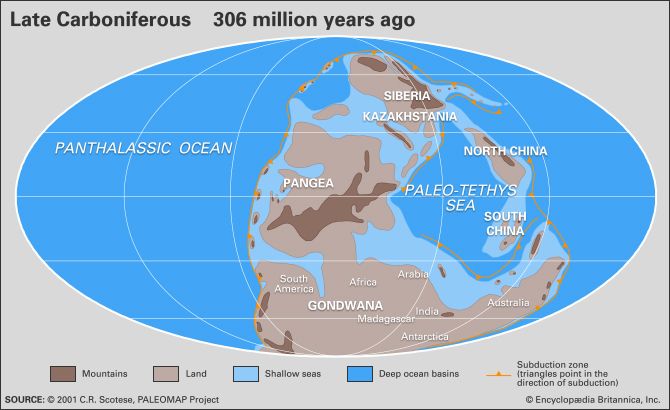
What was the climate like during the Carboniferous Period?
During the Carboniferous Period, the climate was heavily influenced by the latitudinal position of various landmasses, resulting in distinct regional conditions.3
- Equatorial Regions: These areas were characterized by tropical conditions, which supported the development of extensive coal swamps. Fossil plants found in these equatorial settings typically lack seasonal growth rings, suggesting a consistent, year-round climate.3
- Mid-latitudes: These regions were generally dry.3
- High Latitudes: The Northern Hemisphere’s high latitudes were cooler and moist. In contrast, the bulk of the supercontinent Gondwana was situated below 30° South latitude, experiencing cold conditions that allowed for the formation of continental glaciers.3
As the period progressed into the Pennsylvanian subperiod, paleogeography continued to dictate climate patterns. Increased mountain building created rain-shadow effects that inhibited coal deposition in some areas, while expanding glaciation in Gondwana reached into lower latitudes. By the later part of the Carboniferous, global temperatures cooled to levels similar to those of the present day.34
How do scientists extract fossils from coal balls?
The provided search results do not contain information regarding the specific techniques or methods used by scientists to extract or study fossils from within coal balls. While the articles confirm that coal balls are significant sources of fossil information, they do not detail the laboratory processes involved in their analysis.7
What are the main differences between coal and petrified wood?
Coal and petrified wood are both derived from ancient organic matter, but they differ significantly in their formation, composition, and utility as energy sources.
Formation and Composition
- Coal: This is a fossil fuel formed through the process of coalification. Over millions of years, plant material accumulates in oxygen-poor environments to form peat, which is then buried and subjected to increasing temperature and pressure. This process concentrates carbon, making coal a combustible energy source.891011
- Petrified Wood: This is a fossil created when plant tissues are infiltrated and replaced by minerals, such as silica or calcite. Unlike coal, which retains its organic, carbon-rich nature, petrified wood is converted into a stony, inorganic substance.1210
Key Differences
Feature
Coal
Petrified Wood
Primary Process
Geochemical coalification
Mineralization/Petrifaction
Composition
Organic, carbon-rich
macerals
Inorganic minerals (e.g., quartz)
Energy Utility
High (combustible fuel)
None (non-combustible)
Preservation
Often obscures original structure
Often preserves internal cell structure
While both can originate from similar ancient plant life, petrified wood represents a process where organic tissues are replaced by minerals, whereas coal represents the preservation and transformation of organic matter into a fuel source.102
Sources
- coal ball — Merriam-Webster
- coal ball — Encyclopædia Britannica
- Carboniferous Period - Paleoclimate — Encyclopædia Britannica
- Cambrian Period — Encyclopædia Britannica
- Carboniferous Period - Distinctive features — Encyclopædia Britannica
- A Journey Through Time Since the Precambrian - Carboniferous Period: 358.9 million to about 298.9 million years ago — Encyclopædia Britannica
- coal - Plant matter — Encyclopædia Britannica
- coal - Coalification — Encyclopædia Britannica
- petrified wood — Encyclopædia Britannica
- Do Fossil Fuels Really Come from Fossils? — Encyclopædia Britannica
- coal utilization - Coal type — Encyclopædia Britannica
- coal - Peat — Encyclopædia Britannica
Published on · 3 min read