Cordillera Blanca
The Cordillera Blanca is a prominent, snowcapped mountain range located in the eastern section of the Cordillera Occidental of the Andes in west-central…
What is Cordillera Blanca?
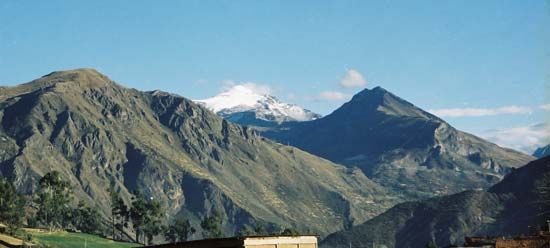
The Cordillera Blanca is a prominent, snowcapped mountain range located in the eastern section of the Cordillera Occidental of the Andes in west-central Peru. Stretching approximately 110 miles (180 km) from southeast to northwest, the range is separated from the Cordillera Negra to the west by the Santa River and the Callejón de Huaylas.1
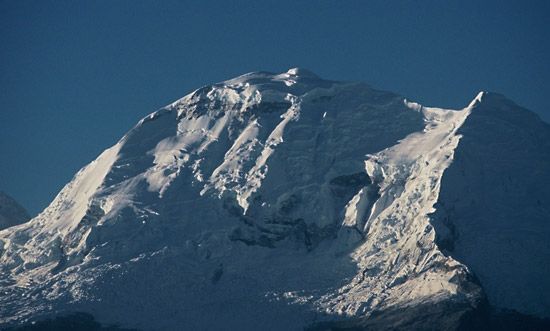
The range is home to Mount Huascarán, which, at 22,205 feet (6,768 meters), is the highest peak in Peru. While the region is a popular destination for mountaineers and tourists, it has also been the site of significant natural disasters, including devastating avalanches and landslides triggered by seismic activity.2
What is the difference between the Cordillera Blanca and the Cordillera Negra?
The Cordillera Blanca and the Cordillera Negra are two distinct mountain ranges in west-central Peru that run parallel to each other, separated by the Santa River and the Callejón de Huaylas (also known as the upper Santa River Valley).134
The primary differences between the two ranges include:
- Glaciation and Appearance: The Cordillera Blanca is characterized by its permanently snowcapped peaks, which give the range its name, meaning “white.” In contrast, the Cordillera Negra is significantly lower in elevation and lacks permanent snow cover, leading to its name, which means “black.”34
- Elevation: The Cordillera Blanca contains some of the highest peaks in the Andes, including Mount Huascarán, which reaches 22,205 feet (6,768 meters). The Cordillera Negra is much lower, rising to a maximum elevation of approximately 14,764 feet (4,430 meters).143
- Geography: Both ranges extend for about 110 miles (180 km) and eventually join together at approximately 9° S latitude.134
How do glaciers in the Andes affect the local environment?
Glaciers in the Andes and other mountainous regions serve as critical natural reservoirs, significantly influencing the local environment through their hydrologic and erosional processes.
Hydrologic Regulation
Glaciers act as complex reservoirs that store precipitation in solid form and release it as meltwater, often with a seasonal delay. This process provides a “buffering effect” against climatic variability; for instance, during dry years, increased melting of older ice helps maintain streamflow, while heavy snowpacks in wet years reduce melt rates by increasing surface reflectivity, or albedo7. This regulation is vital for stabilizing water supplies, which are essential for hydroelectric power generation and agricultural irrigation in downstream communities.56
Landscape and Sedimentation
Glaciers are powerful agents of erosion, producing large quantities of sediment, including fine-grained rock flour. This sediment is transported into streams and lakes, often giving them a distinct green color. The continuous movement of this debris and the daily fluctuations in discharge lead to constant readjustments of stream channels.6
Furthermore, glaciers are highly sensitive to changes in temperature and precipitation, making them key indicators of local climatic shifts.7
What are the primary causes of landslides in high mountain regions?
Landslides occur when the gravitational and other shear stresses acting upon a slope exceed the shear strength of the materials forming that slope. In high mountain regions, this instability is driven by several key processes:910
- Increased Shear Stress: Stresses can be amplified by the oversteepening of a slope’s base—often through natural erosion—or by loading the slope with excess weight, such as the accumulation of debris or a rise in the groundwater table.9
- Weakened Shear Strength: The internal resistance of slope materials can be compromised by water saturation, which reduces interparticle friction in sandy materials and dissolves cements or hydrates minerals in clay.9
- Triggering Events: Short-term, high-intensity events are frequent catalysts in mountainous terrain. Earthquakes and torrential rainstorms can trigger massive movements, including rapid rock or debris avalanches, which are particularly dangerous due to their high velocity.910
Sources
- Cordillera Blanca — Encyclopædia Britannica
- Mount Huascarán — Encyclopædia Britannica
- Cordillera Negra — Encyclopædia Britannica
- Andes Mountains - Physiography of the Central Andes — Encyclopædia Britannica
- glacier - Distribution of glaciers — Encyclopædia Britannica
- Chile - Drainage — Encyclopædia Britannica
- glacier - Glacier hydrology — Encyclopædia Britannica
- glacier - Glaciers and climate — Encyclopædia Britannica
- landslide — Encyclopædia Britannica
- landslide: Top Questions — Encyclopædia Britannica
Published on · 3 min read