Corpus Christi Bay
The Port of Corpus Christi is central to the economic significance of Corpus Christi Bay, serving as a vital deepwater harbor that facilitates major…
What role does the Port of Corpus Christi play in the bay’s economic importance?
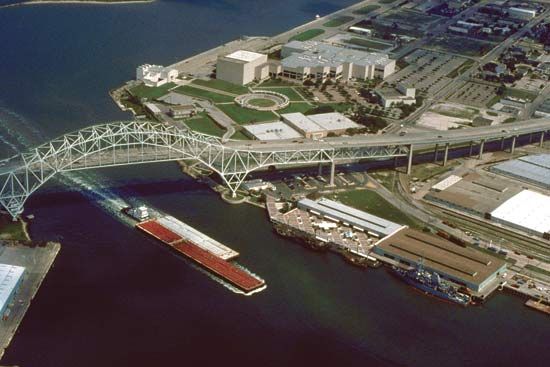
The Port of Corpus Christi is central to the economic significance of Corpus Christi Bay, serving as a vital deepwater harbor that facilitates major industrial activity. Established in 1926, the port functions as a critical hub on the Gulf Intracoastal Waterway, enabling the efficient transport of diverse bulk cargoes, including petroleum, chemicals, grain, cotton, ores, and various raw materials.12
Beyond its role in shipping, the bay’s resources directly support the region’s industrial base; for example, the bay provides oyster shells utilized in local chemical plants. The synergy between the port’s logistics and the surrounding industries—such as petrochemicals, aluminum, and agriculture—forms the primary economic foundation for the city of Corpus Christi. Furthermore, the bay’s sheltered waters contribute to the local economy through tourism and recreation, including sport fishing and boating, which complement the industrial utility of the harbor.21
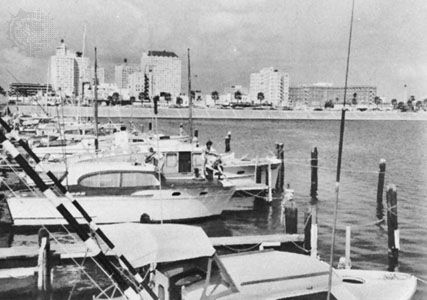
Where is Corpus Christi Bay located and what are its main geographical features?
Corpus Christi Bay is an inlet of the Gulf of Mexico located in southern Texas. It serves as a deepwater harbor for the city of Corpus Christi.2
The bay features the following geographical characteristics:
- Dimensions: It measures approximately 25 miles (40 km) in length and ranges from 3 to 10 miles (5 to 16 km) in width.2
- Shelter: The bay is protected from the Gulf of Mexico on its eastern side by Mustang Island.2
- Connectivity: It is linked to Aransas Bay to the north and Laguna Madre to the south via the Gulf Intracoastal Waterway. Access to the open gulf is provided through Aransas Pass, located north of Mustang Island.2
- Extensions: A western extension of the bay, known as Nueces Bay, serves as the mouth of the Nueces River.23
How does the Nueces River influence Corpus Christi Bay?
The Nueces River influences Corpus Christi Bay primarily by flowing into its western extension, known as Nueces Bay. This connection establishes the river as a significant geographical feature at the mouth of which the city of Corpus Christi is situated.21
How did Corpus Christi Bay get its name and what is its historical significance?
Corpus Christi Bay is believed to have been named by the Spanish explorer Alonso Álvarez de Pineda, who is thought to have entered the inlet on the feast day of Corpus Christi in 1519 and claimed the region for Spain.2
The bay holds significant historical importance as a focal point for regional development and conflict:
- Early Inhabitants: The area was originally home to Karankawa and other Native American peoples.1
- Military History: The bay served as a setting for operations during the Mexican-American War and was the site of blockade skirmishes during the American Civil War.1
- Economic Development: Following the establishment of a trading post in 1839, the bay became the namesake for the city of Corpus Christi. The development of a deepwater port in 1926 and the subsequent exploitation of oil and gas resources transformed the region into a major industrial and shipping hub.21
Sources
- Corpus Christi — Encyclopædia Britannica
- Corpus Christi Bay — Encyclopædia Britannica
- Gulf Coast — Encyclopædia Britannica
- Gulf of Mexico / Gulf of America - Climate — Encyclopædia Britannica
- Corpus Christi — Merriam-Webster
Published on · 2 min read