Coryphodon
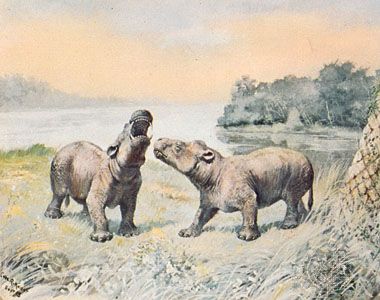
Coryphodon is a genus of extinct, primitive hoofed mammals that lived during the Late Paleocene and Early Eocene epochs, approximately 63.5 to 52 million…
What is Coryphodon?
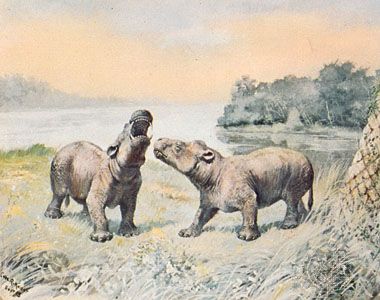
Coryphodon is a genus of extinct, primitive hoofed mammals that lived during the Late Paleocene and Early Eocene epochs, approximately 63.5 to 52 million years ago. These animals were members of the Pantodonta order, a group of archaic ungulates found across North America, Europe, and eastern Asia.12
Physically, Coryphodon was a robust creature, comparable in size to a modern tapir, with a heavy skeleton and strongly constructed limbs designed to support its significant bulk. It possessed broad, five-toed feet and a flat, wide skull featuring large upper canines. With a full set of 44 teeth, it maintained a primitive mammalian dental structure. Because it was not a swift runner, researchers believe it was a browser that fed similarly to modern tapirs.1
What are pantodonts and how are they classified?
Pantodonts are members of the order Pantodonta, a group of extinct, primitive ungulate mammals. These animals were widely distributed across North America, Europe, and Asia, existing from the Paleocene through the Oligocene epochs.41
Classification and Characteristics
Pantodonts are classified as archaic ungulates. While the fossil record of mammals is generally robust, the classification of many extinct groups relies heavily on dental characteristics, as teeth are the most common and durable remains found in the fossil record.35
Key features of the group include:
- Robust Build: Many pantodonts, such as the well-known genus Coryphodon, were heavily built animals with strongly constructed limbs designed to support significant body mass.3
- Primitive Traits: They often exhibited primitive mammalian characteristics, such as a full set of 44 teeth.3
- Physical Adaptations: They typically possessed broad, five-toed feet and lacked horns or other cranial protuberances, though some featured bony attachments for powerful neck muscles.3
Because they were not specialized for high-speed running, researchers generally categorize them as browsers that occupied ecological niches similar to those of modern tapirs.3
How did the environment change from the Paleocene to the Eocene?
The transition from the Paleocene Epoch to the Eocene Epoch was marked by significant climatic and biological shifts, most notably the Paleocene-Eocene Thermal Maximum (PETM).
Climatic Changes
The Paleocene was characterized by a general warming trend with seasonal wet and dry cycles. This transitioned into the PETM, a rapid interval of extreme global warming approximately 56 million years ago, where temperatures rose by more than 5 °C (9 °F) within a few thousand years. Following the PETM, temperatures briefly declined before rising again during the Eocene Optimum. Throughout the Eocene, the world remained generally warm and humid, with widespread temperate and subtropical forests and limited grasslands.10111213
Biological Impacts
The environmental instability of this transition triggered widespread extinctions in both marine and terrestrial ecosystems extinctions in both marine and terrestrial ecosystems. Biologically, the period saw a major faunal turnover:1012
- Replacement of Archaic Groups: Many Paleocene mammals, such as multituberculates and condylarths, were replaced by modern groups.1410
- Rise of Modern Mammals: The early Eocene marked the appearance of perissodactyls (odd-toed ungulates) and artiodactyls (even-toed ungulates), as well as the first cetaceans, sirenians, and bats.1413
What are some other examples of primitive hoofed mammals?
Beyond the pantodonts, the fossil record contains several other groups of primitive or archaic hoofed mammals that flourished during the Paleogene period:
- Condylarthra: An informal group of extinct ungulates that were most diverse during the Paleocene. They are considered ancestral to more advanced hoofed mammals, including perissodactyls and potentially cetaceans. A well-known example is Phenacodus, which reached the size of a modern tapir.
- Dinocerata: A small order of primitive ungulates that lived during the Paleocene and Eocene. These animals are notable for their unique cranial features, such as the bony protuberances found in genera like Uintatherium.
- Notoungulata: A diverse group of hoofed mammals that evolved largely in isolation in South America from the late Paleocene to the early Pleistocene. They exhibited remarkable convergent evolution, with some forms resembling rodents or rabbits, while others, such as the massive Toxodon, occupied niches similar to large modern ungulates.
- Palaeodonta: A primitive infraorder of early artiodactyls (even-toed ungulates) that existed from the Eocene to the lower Miocene. These were generally small-brained, primitive forms that represent early branches of the artiodactyl lineage.
Sources
- Coryphodon — Encyclopædia Britannica
- coryphodon — Merriam-Webster
- Pantodonta — Merriam-Webster
- pantodont — Merriam-Webster
- primate - Pleistocene — Encyclopædia Britannica
- primate - Paleocene — Encyclopædia Britannica
- entelodont — Encyclopædia Britannica
- mammal - Classification — Encyclopædia Britannica
- tetraodontiform - Critical appraisal — Encyclopædia Britannica
- Paleocene-Eocene Thermal Maximum — Encyclopædia Britannica
- Climate change - Cenozoic climates — Encyclopædia Britannica
- Tertiary Period - The rise of mammals — Encyclopædia Britannica
- Eocene Epoch — Encyclopædia Britannica
- Paleocene Epoch — Encyclopædia Britannica
- Condylarthra — Encyclopædia Britannica
- hoof — Encyclopædia Britannica
- artiodactyl - Annotated classification — Encyclopædia Britannica
- Dinocerata — Merriam-Webster
- Notoungulata — Encyclopædia Britannica
- Moropus — Encyclopædia Britannica
Published on · 3 min read