Coucal
The provided information does not specify the conservation status of coucals, nor does it detail specific conservation efforts for these birds.
Are coucals considered threatened or endangered, and what conservation efforts exist?
The provided information does not specify the conservation status of coucals, nor does it detail specific conservation efforts for these birds.
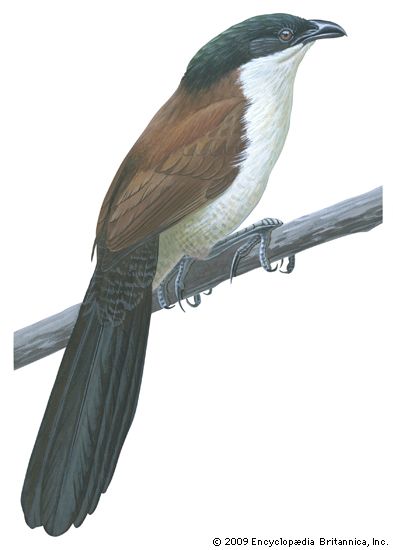
Coucals are a genus of about 27 species of medium to large birds found across Africa, Madagascar, southern Asia, Australia, and the Solomon Islands. While they are known for their distinct physical characteristics—such as stout, down-curved bills and long, graduated tails—the current data does not indicate whether any of these species are considered threatened or endangered.1
How do coucals reproduce and care for their young?
Unlike many other members of the cuckoo family, which are known for being brood parasites that lay their eggs in the nests of other species, coucals are nonparasitic birds that build their own nests and rear their own young.23
Coucals typically form stable pair bonds and defend territories where they conduct their breeding activities. They are unique among cuckoos for constructing sizable, domed nests made of grass and twigs, which are positioned on the ground or in low vegetation and feature a side entrance. A typical clutch consists of three to five eggs.24
While specific details regarding the division of labor between the sexes for coucals are not explicitly detailed in the provided text, general avian behavior suggests that in most species that form pairs, both individuals participate in incubation and feeding the young, though the female often carries a greater share of the responsibility.5
How do coucals differ from other members of the cuckoo family?
Coucals (Centropus) differ from many other members of the cuckoo family in several key behavioral and physical ways:
- Nonparasitic Breeding: Unlike the approximately 50 species of cuckoos that practice brood parasitism—laying eggs in the nests of other birds—coucals are nonparasitic. They build their own nests and rear their own young.28
- Unique Nest Construction: While other nonparasitic cuckoos typically build loose platforms of twigs in low vegetation, coucals are unusual for constructing sizable, domed nests made of grass and twigs. These nests are placed on or near the ground and feature a side entrance.2
- Seasonal Coloration: The black coucal (C. toulou) is notable for being the only cuckoo species known to undergo a seasonal change in plumage coloration.9
- Lifestyle and Habitat: Coucals are largely terrestrial, compact birds found in Africa, Asia, and Australasia. While many cuckoos are arboreal and solitary, coucals are known to be weak fliers that feed primarily on large insects, though they are also capable of running down small rodents and reptiles.1109
Are there any unique behaviors or adaptations that coucals have developed?
Coucals, which belong to the genus Centropus within the cuckoo family, exhibit several distinct behaviors and adaptations that set them apart from their relatives:
- Nonparasitic Breeding: Unlike many cuckoos that practice brood parasitism, coucals are independent breeders. They form stable pair bonds, defend their own territories, and raise their own young.12
- Unique Nest Architecture: While other nonparasitic cuckoos typically construct loose, flimsy platforms of twigs, coucals are unusual for building large, domed nests made of grass and twigs. These structures are placed on or near the ground and feature a specialized side entrance.12
- Seasonal Coloration: The black coucal (C. toulou) is notable for being the only cuckoo species that undergoes a seasonal change in plumage, shifting from an all-black appearance to a streaked, nonbreeding plumage.1
- Terrestrial Lifestyle: Coucals are primarily terrestrial birds. Although they are weak fliers, they are adept at running on the ground to hunt for large insects, small rodents, and reptiles.1
Sources
- Coucal — Encyclopædia Britannica
- Cuculiform - Nonparasitic cuckoos — Encyclopædia Britannica
- Passeriform - Territoriality and courtship — Encyclopædia Britannica
- Reproductive behaviour - Birds — Encyclopædia Britannica
- How long do chicken eggs take to hatch? — Encyclopædia Britannica
- Animal social behavior - Social interactions involving the costs and benefits of parental care — Encyclopædia Britannica
- Bird - Nesting — Encyclopædia Britannica
- Cuckoo — Encyclopædia Britannica
- Cuculiform - Brood parasitism — Encyclopædia Britannica
- Cuculiform - General features — Encyclopædia Britannica
- Cuculiform - Distribution — Encyclopædia Britannica
- Cuculiform - Vocalizations — Encyclopædia Britannica
Published on · 3 min read