Coua
A Coua is any of approximately 10 species of terrestrial birds belonging to the genus Coua within the cuckoo family (Cuculidae). These birds are endemic to…
What is Coua?
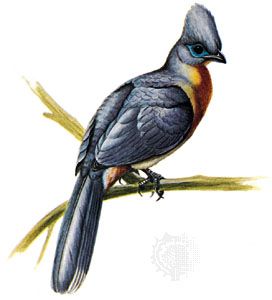
A Coua is any of approximately 10 species of terrestrial birds belonging to the genus Coua within the cuckoo family (Cuculidae). These birds are endemic to Madagascar.1
Physically, couas are characterized by their long tails and weak flight capabilities, typically measuring between 45 and 60 cm (18 to 24 inches) in length. They generally exhibit soft, muted colorations, often appearing in shades of blue or gray. While they primarily feed on insects, they are distinct from many other cuckoos in that they also consume fruit. As members of the order Cuculiformes, they share a lineage with other groups such as roadrunners, coucals, and anis.12
What makes Madagascar’s wildlife so unique?
Madagascar’s wildlife is remarkably unique due to the island’s long-standing geographic isolation, which has allowed its flora and fauna to evolve into distinct forms that differ significantly from those found on the nearby African mainland.34
Unique Fauna
The island is famous for its high level of endemism, meaning many species are found nowhere else on Earth. Notable examples include:
- Lemurs: Approximately 40 species of these primitive primates are indigenous to the island.5
- Tenrecs: These unique, hedgehog-like insectivores have evolved into diverse forms within the region.35
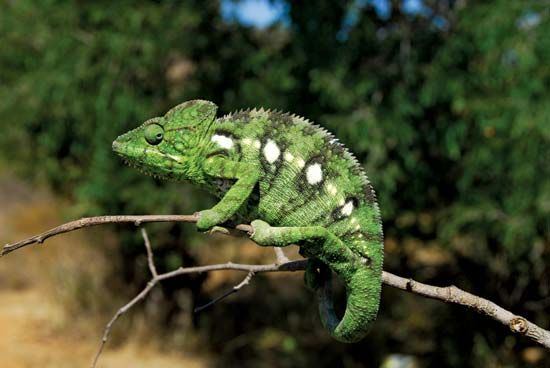
- Reptiles and Fish: Madagascar is home to a wide variety of chameleons and the coelacanth, a rare “living fossil” found in its offshore waters.56
- Absence of Mainland Species: Unlike the African continent, Madagascar lacks familiar animals such as monkeys, elephants, big cats, and rhinoceroses.3
Distinctive Flora
The island’s vegetation is equally anomalous. In the eastern regions, more than three-fourths of the thousands of plant species are endemic. The landscape ranges from rainforests featuring dwarf palms and unique bamboos to arid southern thickets populated by giant cacti, dwarf baobab trees, and various xerophytes (drought-resistant plants).75
How do brood parasites raise their young?
Brood parasitism is a reproductive strategy in which a bird lays its eggs in the nest of another species, leaving the host to provide all parental care for the developing young. This behavior is notably practiced by approximately 50 species of cuckoos, as well as other birds.910
Strategies for Success
To ensure their offspring survive, brood parasites have evolved several specialized behaviors:
- Egg Mimicry: Many parasites lay eggs that closely resemble those of their host in color and pattern. This mimicry reduces the likelihood that the host will reject the foreign egg, as hosts often abandon nests or eject objects they perceive as threats.1011
- Host Selection: Female parasites often specialize in a specific host species, a practice linked to the evolution of distinct “gentes” (clans) that target particular birds.10
- Nest-Mate Eviction: In many parasitic species, the newly hatched chick possesses a strong instinct to remove competition. It will heave the host’s eggs or other nestlings over the rim of the nest, ensuring it receives the full attention and food supply from the foster parents.10
- Strategic Timing: Parasites often monitor host nests during construction and lay their eggs after the host has begun its clutch but before incubation starts.10
What are some other birds in the cuckoo family?
The family Cuculidae is diverse, encompassing approximately 140 species across 35 genera. While the term “cuckoo” often refers to the arboreal members of the subfamilies Cuculinae and Phaenicophaeinae, the family includes several other distinct groups.1415
Some notable members of the cuckoo family include:
- Roadrunners: Terrestrial birds of the genus Geococcyx found in the deserts of Mexico and the southwestern United States, known for their preference for running over flying.1617
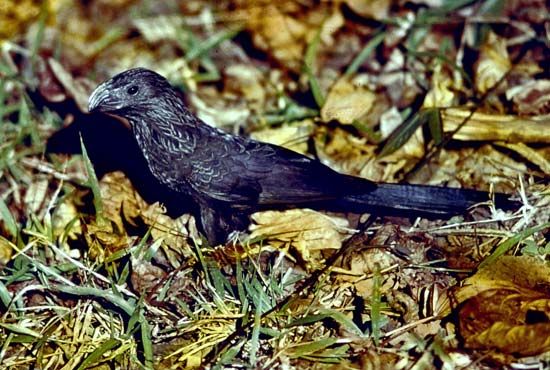
- Anis: Glossy black, big-billed birds of the genus Crotophaga that are unique for their communal nesting habits, where multiple females share a single nest.1819
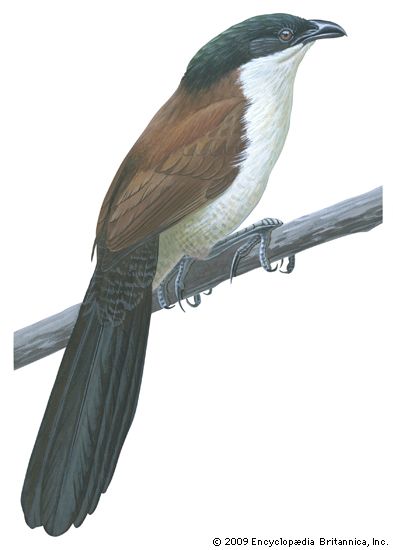
- Coucals: Largely terrestrial birds of the genus Centropus found in Africa, Asia, and Australasia.1817
- Couas: A group of cuckoos found in Madagascar.1514
- Guiras: A distinct species within the family.1514
- Malkohas: A group of non-parasitic cuckoos.14
These birds vary significantly in behavior and habitat, ranging from the solitary, parasitic “typical” cuckoos to the communal, ground-foraging anis.181519
Sources
- Coua — Encyclopædia Britannica
- Cuculiform — Encyclopædia Britannica
- biogeographic region - Madagascan region — Encyclopædia Britannica
- Africa - Madagascar — Encyclopædia Britannica
- Madagascar - Plant and animal life — Encyclopædia Britannica
- Madagascar — Encyclopædia Britannica
- Madagascar - Madagascar from 1500 to c. 1650 — Encyclopædia Britannica
- Comoros - Plant and animal life — Encyclopædia Britannica
- brood parasitism — Merriam-Webster
- Cuculiform - Brood parasitism — Encyclopædia Britannica
- mimicry - Cuckoos — Encyclopædia Britannica
- kleptoparasitism: Top Questions — Encyclopædia Britannica
- Animal reproductive system - Provisions for the developing embryo — Encyclopædia Britannica
- Cuculiform - Distribution — Encyclopædia Britannica
- Cuckoo — Encyclopædia Britannica
- Roadrunner — Encyclopædia Britannica
- Cuculiform - Classification — Encyclopædia Britannica
- Cuculiform - General features — Encyclopædia Britannica
- Ani — Encyclopædia Britannica
Published on · 3 min read