Cuba
Since the 1959 revolution, Cuba has evolved into a unitary socialist republic governed by a totalitarian system that exerts significant control over most…
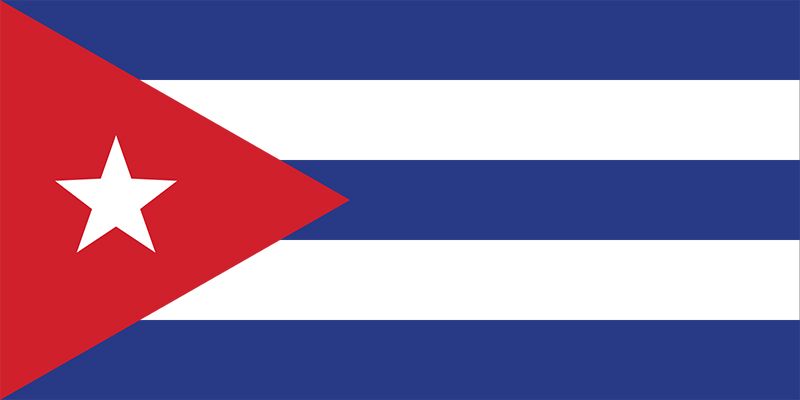
How has Cuba’s political system evolved since the revolution, and what is it like today?
Since the 1959 revolution, Cuba has evolved into a unitary socialist republic governed by a totalitarian system that exerts significant control over most aspects of life. Following the revolution, the government consolidated power by dissolving existing political parties and merging revolutionary organizations into the Communist Party of Cuba (PCC), which was established as the sole legal political entity.123
The political structure is defined by the 1976 constitution, which has undergone several revisions, most notably in 2019. Legislative authority rests with the National Assembly of People’s Power, which appoints the Council of State and the president. While the system allows for direct elections of assembly members and includes competition for local offices, the PCC remains the “organized vanguard of the nation,” heavily influencing all levels of government.143
Leadership transitioned from Fidel Castro to his brother Raúl Castro in 2008, and subsequently to Miguel Díaz-Canel in 2018. Díaz-Canel, the first leader since the revolution not named Castro, represents a generational shift, though he continues to uphold the party’s socialist framework.15
How did Cuba gain independence, and what was its relationship with Spain?
Cuba’s path to independence was marked by a long, strained relationship with Spain, characterized by corrupt and inflexible colonial administration. Tensions escalated due to economic grievances, including high taxes and trade restrictions, leading to the Ten Years’ War (1868–1878). Although the Pact of Zanjón ended the conflict, Spain failed to implement promised reforms, fueling further unrest and the eventual outbreak of a new war in 1895 led by José Martí and Máximo Gómez.8
The conflict intensified as Spanish forces employed brutal “reconcentration” tactics against civilians. Following the sinking of the USS Maine, the United States intervened, leading to the Spanish-American War. The war concluded with the Treaty of Paris in 1898, in which Spain relinquished all claims to Cuba, effectively ending centuries of Spanish colonial rule.89
How does Cuba’s healthcare system work, and why is it often praised internationally?
Cuba’s healthcare system is a state-operated model managed by the Ministry of Public Health, providing services free of charge or at a nominal cost to the entire population. Since the 1960s, the government has significantly expanded the availability of hospital beds and physicians, leading to a notable decline in infant and overall mortality rates.10
The system is highly centralized, with administration largely based in Havana. Citizens are assigned to specific hospitals and clinics for their medical needs. Internationally, the system has garnered attention for its high standards and specialized medical treatments, particularly in the areas of heart disease and ophthalmology, which began attracting global interest during the 1980s. Beyond clinical care, the state also oversees social security programs, including pensions for the elderly and disabled, and manages institutions such as nursing homes and day-care centers to support the labor force.1110
How has tourism developed in Cuba, and what impact has it had on the country?
Tourism in Cuba underwent significant expansion during the 1990s as the government sought to modernize the economy following the collapse of the Soviet Union, which had previously subsidized the nation’s finances. To attract foreign investment, the state partnered with international investors—notably from Spain and Canada—to construct new hotels and resorts.121314
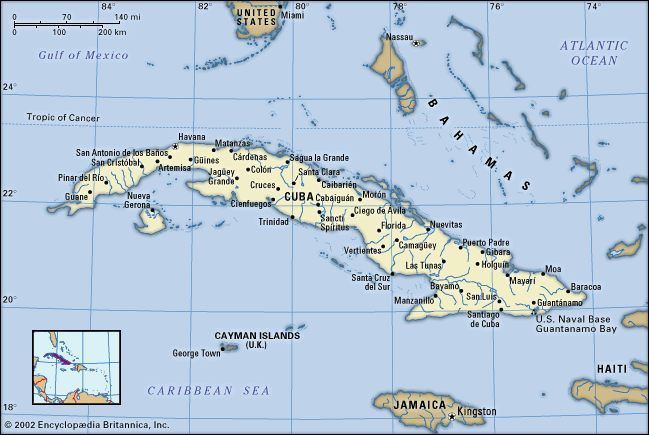
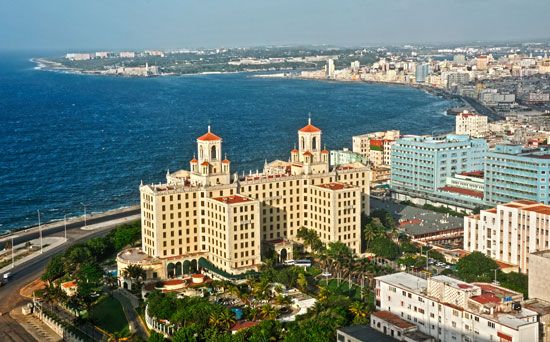
Visitors are primarily drawn to Cuba’s natural landscapes, including white sand beaches, coral reefs, and forested highlands, as well as historic sites in cities like Havana, Santiago de Cuba, and Trinidad, many of which are designated UNESCO World Heritage sites.14
The impact of this development has been complex. While tourism has become a vital economic pillar, it has also fostered socioeconomic inequality. Tourist-oriented areas often feature amenities unavailable to the general public, leading to concerns about a “tourism apartheid.” Furthermore, the industry has been linked to an increase in social issues such as drug trafficking and prostitution. Additionally, the influx of foreign currency has created a divide between those with access to hard currency—often workers in the service and tourist sectors—and those who rely solely on state-controlled wages.1415
Sources
- Cuba - Constitutional framework — Encyclopædia Britannica
- Communist Party of Cuba — Encyclopædia Britannica
- Cuba - Revolution — Encyclopædia Britannica
- Raúl Castro - Economic and political reform — Encyclopædia Britannica
- Cuba - Local government — Encyclopædia Britannica
- Miguel Díaz-Canel — Encyclopædia Britannica
- Cuba - Political process — Encyclopædia Britannica
- Cuba - Filibustering and the struggle for independence — Encyclopædia Britannica
- Treaty of Paris — Encyclopædia Britannica
- Cuba - Health and welfare — Encyclopædia Britannica
- Havana - Health — Encyclopædia Britannica
- Cuba - Services — Encyclopædia Britannica
- Cuba - Economy — Encyclopædia Britannica
- Cuba - Daily life and social customs — Encyclopædia Britannica
- Cuba - Transportation and telecommunications — Encyclopædia Britannica
- Havana - The city under Castro — Encyclopædia Britannica
Published on · 3 min read