Cuckoo Bee
A cuckoo bee is not a specific taxonomic group but rather a behavioral descriptor for more than 3,000 species of solitary bees that engage in brood…
What is cuckoo bee?
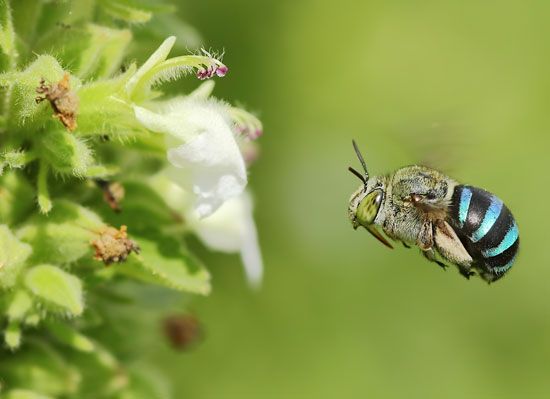
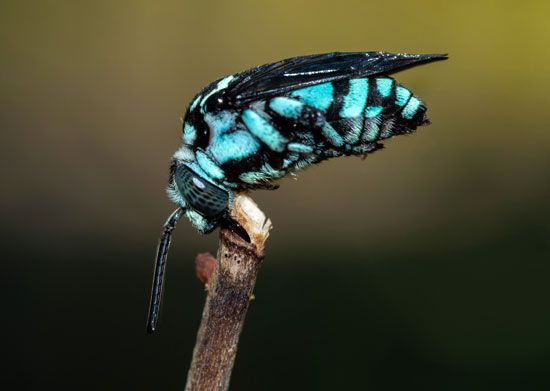
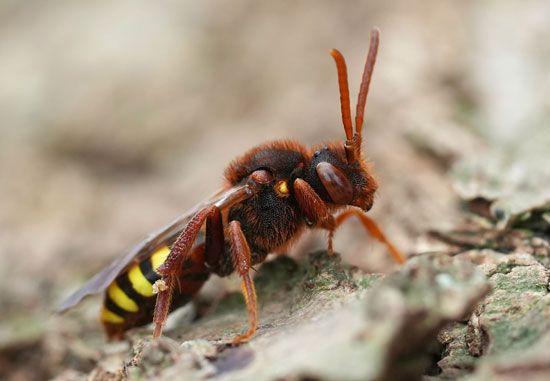
A cuckoo bee is not a specific taxonomic group but rather a behavioral descriptor for more than 3,000 species of solitary bees that engage in brood parasitism, a form of kleptoparasitism.1
These bees are found on every continent except Antarctica and are named for their similarity to cuckoo birds, which also lay their eggs in the nests of other species. A female cuckoo bee infiltrates the nest of a host bee and deposits an egg in a cell provisioned with food. The cuckoo bee larva may then destroy the host’s egg or larva, or starve it by consuming the food supply.1
Because they do not collect pollen for their offspring, cuckoo bees lack the pollen-carrying structures, or corbiculae, found on other bees. They are diverse in appearance, often appearing thicker, more compact, or hairless, and some species have evolved to mimic the appearance of their hosts or wasps.1
What is the difference between solitary bees and social bees?
The primary distinction between solitary and social bees lies in their social structure, nesting habits, and methods of provisioning their young.
Solitary Bees
Most bee species are solitary, meaning they do not live in colonies and lack a caste system (such as queens or workers).56
- Nesting: Each female constructs and provisions her own individual nest, typically by digging burrows in the ground or nesting in wood, pithy twigs, or canes.75
- Provisioning: Solitary bees provide all the food (pollen and nectar) a larva requires to complete its development before the cell is sealed.5
- Lifespan: Adults are generally short-lived, often in flight for only a few weeks of the year, while spending the remainder of their life cycle in their cells as eggs, larvae, or pupae.75
Social Bees
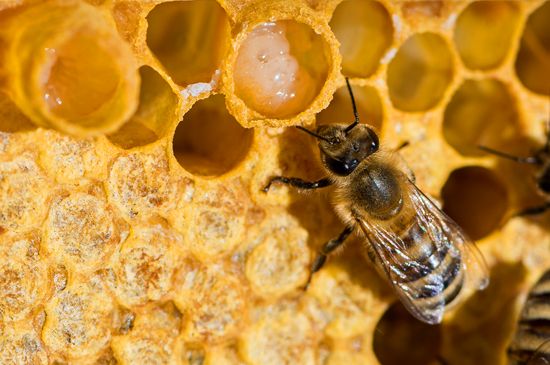
Social bees, such as honeybees, bumblebees, and stingless bees, live in colonies dependent on a queen.8
- Caste System: These colonies feature specialized castes, including a queen responsible for reproduction and workers that maintain the hive.8
- Provisioning: Unlike solitary bees, social bees feed their young progressively throughout their development.5
How do host bees defend their nests against parasites?
Host bees employ several strategies to defend their nests against parasites like cuckoo bees, primarily relying on chemical cues and physical barriers.
- Chemical Recognition: Social bees, such as honeybees, utilize a highly developed sense of smell to protect their colonies. Guards stationed at the hive entrance inspect every bee attempting to enter; because each colony possesses a unique odor, guards can identify and exclude intruders that do not belong to the group.3
- Nest Sealing and Maintenance: Many solitary bees construct individual cells, which they provision with food and then seal shut after laying an egg. This physical barrier helps protect the developing larva from external threats. Similarly, some bees use propolis, a resinous material collected from trees, to seal cracks in the hive or cover foreign objects that they are unable to remove from the nest.69
- Communal Defense: In some primitive social species, such as certain Halictinae, females may cooperate to build and defend their nests together, providing a collective defense that solitary individuals lack.10
What are some other examples of animals that practice brood parasitism?
Brood parasitism is a reproductive strategy in which an animal lays its eggs in the nest of another species, relying on the host to provide all parental care for the offspring. While this behavior is most famously associated with cuckoos, several other bird groups also practice it cuckoos, several other bird groups also practice it.12413
Examples of birds that practice brood parasitism include:
- Cowbirds: All species of cowbirds are obligate brood parasites, meaning they do not build their own nests and rely entirely on other species to raise their young.414
- Whydahs: These birds, belonging to the family Estrildidae, also exhibit brood parasitic behavior, depositing their eggs in the nests of other, usually smaller, bird species.14
In these relationships, the parasite often evolves adaptations such as egg mimicry—where the parasite’s eggs resemble those of the host—to increase the likelihood that the host will accept and incubate the foreign egg.1315
Sources
- cuckoo bee: Top Questions — Encyclopædia Britannica
- cuckoo bee — Merriam-Webster
- cuckoo bee — Encyclopædia Britannica
- parasitism — Encyclopædia Britannica
- How long do queen bees live? — Encyclopædia Britannica
- Hymenoptera - Solitary forms — Encyclopædia Britannica
- bee — Encyclopædia Britannica
- bee: Top Questions — Encyclopædia Britannica
- Hymenoptera - Social forms — Encyclopædia Britannica
- Hymenoptera - Chemical — Encyclopædia Britannica
- western honeybee - Colony and life cycle — Encyclopædia Britannica
- brood parasitism — Merriam-Webster
- Cuculiform - Brood parasitism — Encyclopædia Britannica
- Passeriform - Territoriality and courtship — Encyclopædia Britannica
- coevolutionary alternation — Encyclopædia Britannica
Published on · 3 min read