Cynodont
Cynodonts were a group of mammal-like reptiles belonging to the order Therapsida. They existed from the Late Permian Period to the Early Cretaceous Epoch…
What was the time period when cynodonts lived, and how long did they exist?
Cynodonts were a group of mammal-like reptiles belonging to the order Therapsida. They existed from the Late Permian Period to the Early Cretaceous Epoch, spanning approximately 159 million years (from 259.5 million to 100.5 million years ago).1
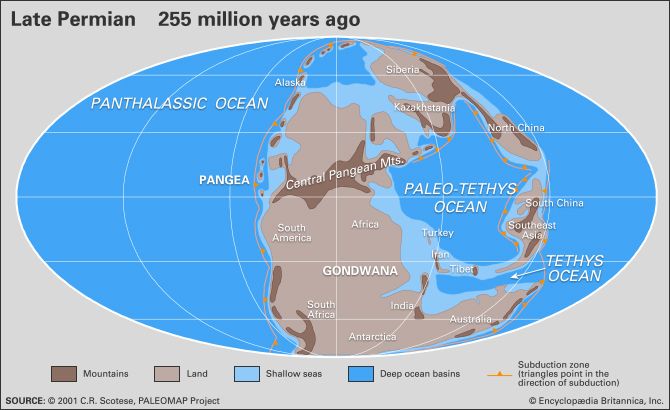
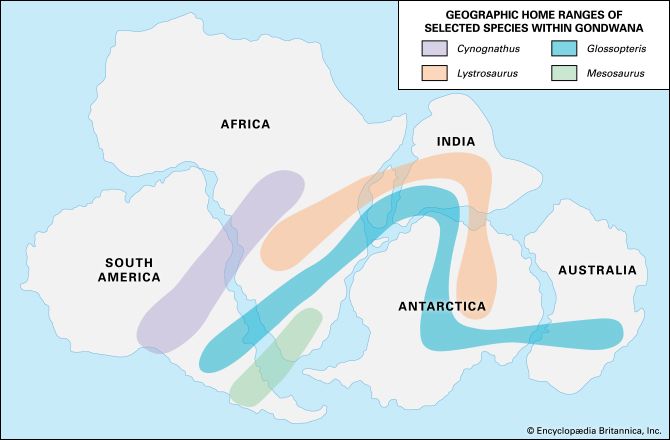
The earliest known cynodont, Charassognathus gracilis, dates back to the Wuchiapingian Age of the Permian (259.5 million to 254.1 million years ago). Throughout their existence, these animals became widespread across the globe, with fossil evidence found on every continent. While they maintained a largely reptilian skeleton, they developed several mammalian characteristics, such as a secondary palate and specialized teeth, which allowed for more efficient chewing and digestion. The group eventually declined, with the last known members—the family Tritylodontidae—going extinct approximately 125 million years ago.1
How did cynodonts’ limb structure and posture compare to modern mammals?
While many aspects of the cynodont skull and physiology anticipated those of modern mammals, their skeletal structure remained largely reptilian for much of their history. In most cynodonts, the limbs were positioned on the sides of the body rather than underneath it, resulting in a sprawling posture and gait.1
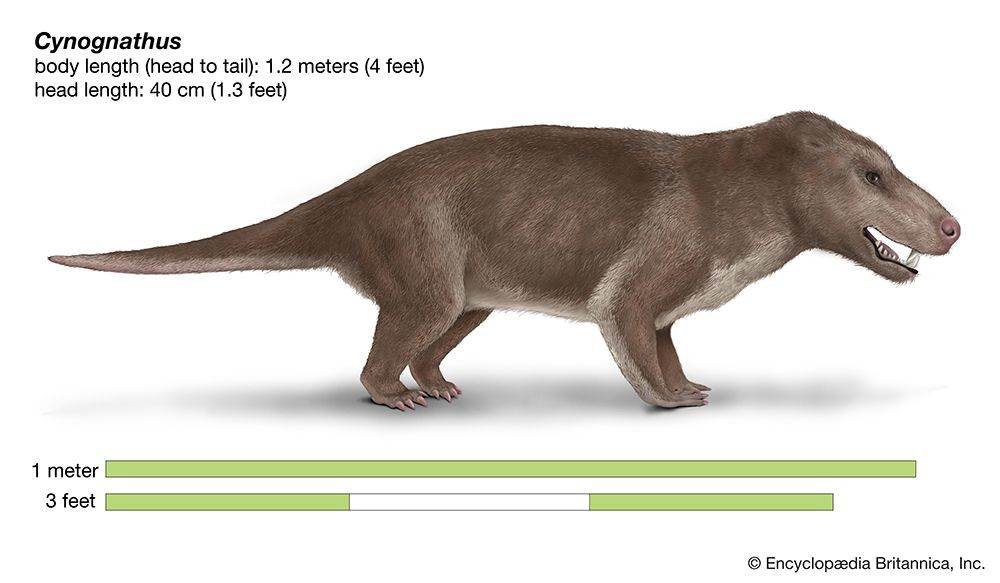
However, there was significant variation within the group. Some advanced forms, such as the predatory genus Cynognathus, exhibited a more derived skeletal structure. In Cynognathus, the limbs were tucked well under and close to the body, a configuration that provided the potential for rapid and efficient locomotion similar to that seen in modern mammals. This transition in limb posture represents a key evolutionary shift, as the movement of limbs from a lateral position to a position beneath the body allowed for more effective weight-bearing and energy-efficient movement.2
How are cynodonts related to modern mammals?
Cynodonts are the direct evolutionary ancestors of modern mammals, with fossil evidence indicating that mammals emerged from cynodont stock during the early Jurassic Period.1
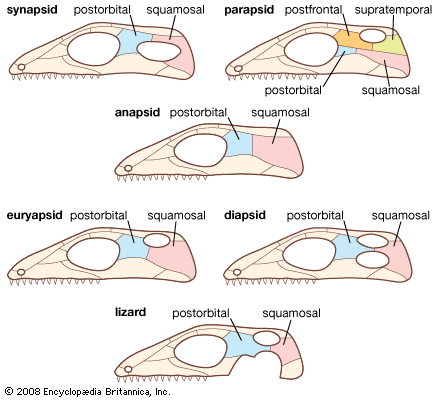
The relationship is defined by several key anatomical transitions found in the cynodont skull that prefigured mammalian biology:
- Secondary Palate: This feature allowed cynodonts to chew food while breathing, a critical adaptation that facilitated faster digestion and suggests a higher metabolic rate similar to that of mammals.1
- Dentition and Jaw: They possessed differentiated teeth and specialized jaw structures designed for chewing, moving away from the reptilian habit of swallowing food whole.1
- Braincase: While their brains remained small, the structure of the braincase began to resemble that of mammals, signaling the evolutionary trend toward brain enlargement in their descendants.1
While their skeletons remained largely reptilian with a sprawling gait, the family Tritylodontidae represents the closest extinct relatives to mammals, bridging the gap before their extinction in the Cretaceous Period their extinction in the Cretaceous Period.1
What evidence do we have about cynodont behavior and lifestyle based on fossil records?
Fossil records provide significant insights into the biology and lifestyle of cynodonts, though direct evidence of their behavior remains limited, as the fossil record is generally uninformative regarding complex social or reproductive habits.12
Based on anatomical evidence, we can infer several aspects of their lifestyle:
- Diet and Metabolism: The presence of a secondary palate allowed cynodonts to chew food while breathing, a trait that facilitated faster digestion. This, combined with specialized teeth and jaw structures, suggests they likely maintained a higher metabolic rate and had larger food requirements than most reptiles.1
- Predatory Behavior: Genera such as Cynognathus were active predators. Their dentition, which included nipping incisors, strong canines, and cheek teeth for slicing food, indicates a specialized carnivorous diet.3
- Locomotion: While many cynodonts had a sprawling gait, advanced forms like Cynognathus possessed limbs tucked under the body, enabling more rapid and efficient movement similar to modern mammals and efficient movement similar to modern mammals.13
Sources
- cynodont — Encyclopædia Britannica
- Cynognathus — Encyclopædia Britannica
- Animal behaviour - Evolutionary history of behaviour — Encyclopædia Britannica
Published on · 3 min read