D’Entrecasteaux Channel
The D’Entrecasteaux Channel is an inlet of the Tasman Sea located in Tasmania, Australia. Extending approximately 35 miles (55 km) to the northeast, the…
What is D’Entrecasteaux Channel?
The D’Entrecasteaux Channel is an inlet of the Tasman Sea located in Tasmania, Australia. Extending approximately 35 miles (55 km) to the northeast, the channel separates the southeast coast of mainland Tasmania from Bruny Island before merging with the River Derwent estuary.12
Known locally as “The Channel,” it serves as the southern maritime approach to Hobart. The waterway was first sighted by the Dutch navigator Abel Tasman in 1642. It was later surveyed in 1792 by the French admiral Bruni d’Entrecasteaux, who determined that the passage was a channel rather than a bay. The western shoreline of the channel is characterized by significant indentations, including the Huon River estuary and Port Esperance.12
Who was the explorer Bruni d’Entrecasteaux?
Bruni d’Entrecasteaux (1737–1793) was a French admiral and navigator best known for his maritime explorations in the Pacific region. In 1792, he conducted a significant survey of the D’Entrecasteaux Channel in Tasmania, Australia, during which he successfully determined that the waterway was a channel rather than a bay, as had been previously suggested following its initial sighting by Abel Tasman in 1642.3
His work contributed to the broader era of French Pacific exploration, which also included notable expeditions by figures such as Jean-François de Galaup, comte de La Pérouse, who sought to expand upon the geographical discoveries made by James Cook in the late 18th century.1
What makes Bruny Island a unique destination?
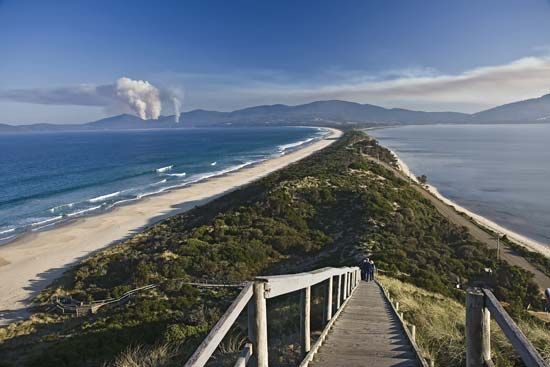
Bruny Island is a unique destination defined by its distinct geography and rich maritime history. Located off the southeastern coast of Tasmania, the 35-mile-long island is composed of two sections—north and south—connected by a narrow isthmus. Its landscape is characterized by rugged coastlines, deep bays such as Adventure and Cloudy bays, and mountainous terrain in the south, including Mt. Bruny, which rises to 1,659 feet (506 meters).2
The island’s history is deeply tied to early exploration; it was first sighted by Abel Tasman in 1642 and later named by the French explorer Bruni d’Entrecasteaux, who surveyed its waters in 1792. Once a base for whaling, the island has transitioned into a popular holiday destination. Visitors typically access the island via a ferry from Kettering, traveling from nearby Hobart to explore its wooded interior and scenic coastal settlements.2
How did whaling impact the history of Tasmania?
Whaling played a pivotal role in the early economic development of Tasmania during the 19th century. By the mid-1800s, the industry had become a cornerstone of the colonial economy, significantly influencing the growth of infrastructure and commerce.56
Key impacts of the whaling industry included:
- Port Development: Hobart emerged as a major international port for whaling ships, thanks to its superb deepwater harbor, which was unhampered by tidal changes.576
- Economic Growth: Local exploitation of whale and seal fisheries encouraged the expansion of essential support services, most notably shipbuilding and various maritime trades.56
- Labor Utilization: The industry relied on the labor of the era, including convicts, to assist in the operations of the fisheries and the construction of public works and buildings that supported the growing port city.56
While this period was marked by economic prosperity, it is essential to acknowledge that this development occurred alongside the displacement and suffering of the Tasmanian Aboriginal people, who bore the profound human cost of colonial expansion.56
Sources
- D’Entrecasteaux Channel — Encyclopædia Britannica
- Bruny Island — Encyclopædia Britannica
- Jean-François de Galaup, comte de La Pérouse — Encyclopædia Britannica
- Tasmania — Encyclopædia Britannica
- Tasmania - Agriculture, forestry, and fishing — Encyclopædia Britannica
- Colonization of Australia - Tasmania — Encyclopædia Britannica
- Hobart — Encyclopædia Britannica
- Tasmania - Prehistory and European exploration — Encyclopædia Britannica
Published on · 2 min read