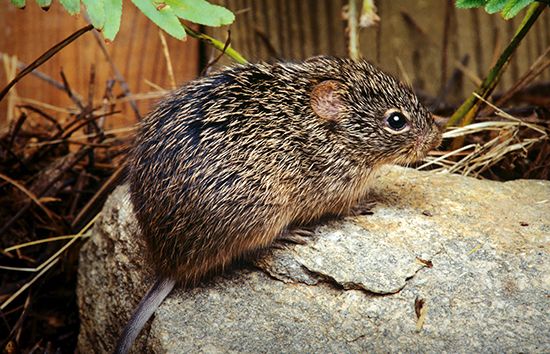
Desman
Desmans are not a separate group from moles; rather, they are classified as a subfamily (Desmaninae) within the family Talpidae, which comprises all "true"…
How are desmans related to other mammals like moles and shrews?
Desmans are not a separate group from moles; rather, they are classified as a subfamily (Desmaninae) within the family Talpidae, which comprises all “true” moles. While typical moles are highly specialized for burrowing, desmans have evolved to be amphibious, spending much of their time foraging underwater.12
Regarding their relationship to other mammals, desmans and moles belong to a larger, informal group of mammals historically referred to as insectivores. Within this group, the closest living relatives of moles (including desmans) are shrews (family Soricidae)2.
Taxonomically, these animals were once grouped under the order Insectivora, though that classification is now considered obsolete. Modern mammalogists often place them within the grandorder Lipotyphla, though the exact evolutionary relationships between these various insect-eating mammals remain a subject of ongoing study and debate among specialists.3
How are desmans adapted for their semi-aquatic lifestyle?
Desmans have evolved several specialized physical adaptations that allow them to thrive in semi-aquatic environments, transitioning from the burrowing lifestyle typical of other moles to foraging underwater.1
Physical Adaptations for Swimming
- Limbs and Feet: Their forefeet are partially webbed and fringed with stiff hairs, while their hind feet are fully webbed to the tips of the digits and also fringed with hair, providing powerful propulsion.1
- Tail: The Russian desman possesses a horizontally flattened tail that aids in swimming, while the Pyrenean desman features a cylindrical tail that is flat near the tip and fringed with stiff hairs.1
- Fur: Both species are covered in long, dense, and water-repellent fur that protects them in cold aquatic habitats.1
Sensory and Protective Features
- Snout: They utilize a flexible, proboscis-like snout that is flat and grooved with a lobed tip, allowing them to probe the bottom of water bodies for prey.1
- Underwater Protection: To survive while submerged, they have tiny eyes and no external ears; their nostrils and ear holes are capable of closing tightly underwater.1
What is a desman and where are they primarily found?
A desman is an amphibious mammal belonging to the subfamily Desmaninae within the family Talpidae, which also includes true moles. There are two extant species: the Russian desman (Desmana moschata) and the Pyrenean desman (Galemys pyrenaicus).1
These animals are primarily found in Eurasia:
- Russian Desman: This species is indigenous to southwestern Russia, Ukraine, and Kazakhstan, specifically within the basins of the Don, Volga, and Ural rivers. It has also been introduced into the catchments of the Ob and Dnieper rivers.1
- Pyrenean Desman: This species inhabits the Pyrenees Mountains and the northern mountain ranges of the Iberian Peninsula, preferring cold, clear, and swift-moving streams at high elevations.1
Both species are nocturnal and rely on specialized physical traits, such as webbed feet and a flexible, proboscis-like snout, to forage for prey underwater.1
What unique physical features do desmans have that help them survive in their habitat?
Desmans possess several specialized physical features that enable their semi-aquatic lifestyle, allowing them to forage underwater rather than burrowing through soil like other moles.1
Sensory and Protective Adaptations
- Snout: They feature a flexible, proboscis-like snout that is flat and grooved with a lobed tip, which they use to probe the bottom of water bodies for prey.1
- Sensory Organs: To navigate underwater, they have tiny eyes and no external ears; their nostrils and ear holes are designed to close tightly when submerged.1
- Fur: They are covered in long, soft, and dense fur that is water-repellent, providing essential protection in their aquatic habitats.1
Locomotion and Morphology
- Feet: Their forefeet are partially webbed and fringed with stiff hairs, while their hind feet are webbed to the tips of the digits and also fringed with hair to aid in swimming.1
- Tail: The Russian desman has a horizontally flattened tail, while the Pyrenean desman has a cylindrical tail that is flat near the tip and fringed with stiff hairs.1
- Scent Glands: Both species possess scent glands at the base of the tail that exude a strong, musky odor.1
Sources
- desman — Encyclopædia Britannica
- mole — Encyclopædia Britannica
- insectivore — Encyclopædia Britannica
- desman — Merriam-Webster
Published on · 3 min read