Platystrophia
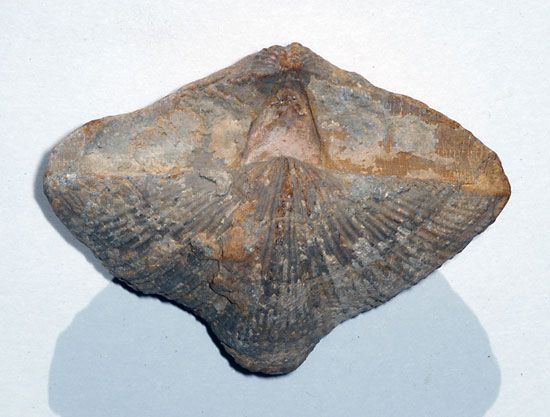
Platystrophia is a genus of extinct brachiopods, commonly known as lamp shells, that lived between approximately 472 million and 423 million years ago…
What is Platystrophia?
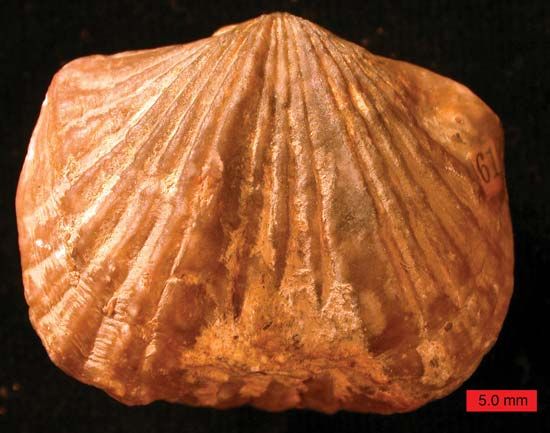
Platystrophia is a genus of extinct brachiopods, commonly known as lamp shells, that lived between approximately 472 million and 423 million years ago, spanning the Middle Ordovician to the middle of the Silurian period.1
These organisms are characterized by shells with a convex profile on each valve and a wide hinge line. Their surfaces are distinguished by prominent angular ridges separated by linear depressions. Because they are common in Late Ordovician strata, Platystrophia serves as a valuable tool for stratigraphic correlation, helping geologists date and link rock layers across different locations.1
It is important to note that Platystrophia is a brachiopod and is distinct from flatworms (platyhelminths), which are a separate group of unsegmented, acoelomate animals.12
What are brachiopods and how do they differ from mollusks?
Brachiopods, commonly known as lamp shells, are sedentary marine invertebrates belonging to the phylum Brachiopoda. While they superficially resemble mollusks—specifically bivalves—they are not related.345
Key Differences
The primary distinctions between brachiopods and mollusks (such as bivalves) lie in their body symmetry and internal anatomy:
- Symmetry: Brachiopod shells consist of two valves that are unequal in size but bilaterally symmetrical; the left and right sides of an individual valve are mirror images. In contrast, bivalve mollusks typically have two valves that are mirror images of each other (left and right valves), while the individual valves themselves are often asymmetrical.346
- Anatomy: Brachiopods possess a specialized feeding organ called a lophophore, which is absent in mollusks. Additionally, their circulatory systems differ; brachiopods have an open circulatory system with a small contractile heart.475
- Orientation: In brachiopods, the two valves cover the dorsal (top) and ventral (bottom) sides of the animal. In bivalve mollusks, the valves cover the left and right sides.346
How do fossils help scientists determine the age of rock layers?
Fossils help scientists determine the relative age of rock layers primarily through the law of faunal succession. This principle observes that different groups of fossilized plants and animals appear in the rock record in a predictable, orderly sequence over time. Because specific organisms lived during distinct intervals of geologic time, their presence in a rock layer acts as a chronological marker.910
To correlate and date these layers, geologists often use index fossils. An ideal index fossil is:
- Distinctive: Easily recognizable to prevent misidentification.1011
- Abundant: Found in sufficient numbers to be discovered easily.1011
- Widespread: Distributed across large geographic areas.1011
- Short-lived: Existed for a brief period of geologic time, allowing for precise dating.1011
By identifying these fossils within sedimentary strata, scientists can perform biostratigraphy to link separated rock outcrops and establish their relative ages. While fossils provide the relative order of events, they are often calibrated using absolute dating techniques, such as measuring radioactive isotopes, to confirm the precise age of the deposits.111213
What other types of marine life existed during the Ordovician period?
The Ordovician Period (485.4 million to 443.4 million years ago) was marked by the “Ordovician radiation,” a period of intense diversification that saw the evolution of nearly every modern marine invertebrate phylum.1415
Marine ecosystems were dominated by a wide variety of invertebrates, including:
- Brachiopods and Bryozoans: Brachiopods (lamp shells) and bryozoans (moss animals) were dominant components of many assemblages.1416
- Mollusks: This group was highly diverse, featuring gastropods, bivalves, cephalopods, monoplacophorans, chitons, scaphopods, and rostroconchs.16
- Echinoderms: Reaching a peak diversity of 20 classes, common forms included crinoids, cystoids, asteroids (starfishes), edrioasteroids, and homalozoans.16
- Arthropods: While trilobites remained common, they were joined by ostracods, barnacles, phyllocarid shrimp, aglaspids, and eurypterids (sea scorpions).16
- Other Invertebrates: The period saw the rise of corals—specifically tabulate and rugosa (horn) corals—as well as sponges, graptolites, and conodonts.1716
Additionally, the Ordovician marked the rise of early fish. These organisms exploited new habitats, such as reefs and crinoid gardens, and developed complex ecological tiers that extended above the seafloor.141518
Sources
- Platystrophia — Encyclopædia Britannica
- flatworm - Distinguishing taxonomic features — Encyclopædia Britannica
- lamp shells — Encyclopædia Britannica
- Brachiopoda — Merriam-Webster
- lamp shells - Annotated classification — Encyclopædia Britannica
- lamp shells - Form and function — Encyclopædia Britannica
- Circulatory system - Brachiopoda — Encyclopædia Britannica
- bivalve - Internal features — Encyclopædia Britannica
- index fossil — Encyclopædia Britannica
- dating - Principles and techniques — Encyclopædia Britannica
- law of faunal succession — Encyclopædia Britannica
- dating - Distinctions between relative-age and absolute-age measurements — Encyclopædia Britannica
- biostratigraphy — Merriam-Webster
- A Journey Through Time Since the Precambrian - Ordovician Period: 485.4 million to 443.4 million years ago — Encyclopædia Britannica
- Ordovician Period - Diversification of life — Encyclopædia Britannica
- Ordovician radiation — Encyclopædia Britannica
- Ordovician Period - Invertebrates — Encyclopædia Britannica
- Ordovician Period - Exploitation of habitats — Encyclopædia Britannica
Published on · 3 min read