Eastern Diamondback Rattlesnake
The eastern diamondback rattlesnake (Crotalus adamanteus) is a large, venomous pit viper native to the coastal plains of the southeastern United States…
What is an eastern diamondback rattlesnake?
The eastern diamondback rattlesnake (Crotalus adamanteus) is a large, venomous pit viper native to the coastal plains of the southeastern United States, ranging from North Carolina to the Florida Keys and west to the Mississippi River. It holds the distinction of being the largest species of rattlesnake.1
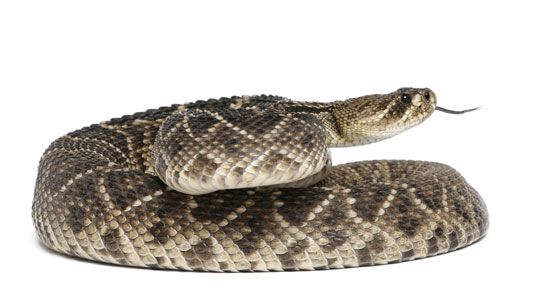
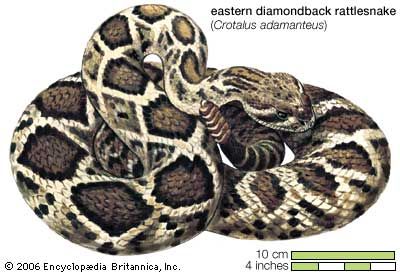
Physically, the snake is characterized by a stout body, a triangular head, and a pattern of large, white-edged diamonds in shades of gray, olive, or brown. It utilizes heat-sensing pits on its snout to detect infrared radiation from prey, such as rabbits and squirrels.1
While the eastern diamondback is not naturally aggressive and typically attempts to retreat when encountered, it is considered highly dangerous if provoked. Its bite delivers a potent hemotoxic venom that causes significant tissue damage. Although the species is a vital part of its ecosystem, human safety remains a priority; antivenin is effective if administered promptly.1
Where does the eastern diamondback rattlesnake live?
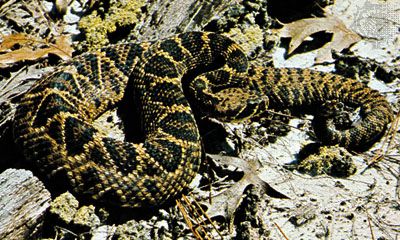
The eastern diamondback rattlesnake (Crotalus adamanteus) is found in the coastal plains of the southeastern United States. Its range extends from North Carolina in the north, southward through the Florida Keys, and westward as far as the Mississippi River.1
Within these regions, the snake is most active during the morning and evening hours. During the heat of the day, it typically seeks shelter in underground burrows, beneath rocks, or at the base of trees.1
What does the eastern diamondback rattlesnake look like?
The eastern diamondback rattlesnake (Crotalus adamanteus) is a large, stout-bodied pit viper with a distinctively triangular head and a narrow neck. Its appearance is defined by several key features:
- Pattern and Coloration: The body is covered in rough scales patterned with large, white-edged diamonds. Its base coloration typically ranges in shades of gray, olive, or brown.1
- Head Features: The snake has small eyes with vertical pupils. Overhanging scales above the eyes give the face a scowling appearance, and there are two light-colored diagonal stripes on each side of the head.1
- Tail and Rattle: It has a short tail ringed with black bands, ending in a rattle composed of horny, loosely connected hollow segments.1
- Size: While some individuals can grow to more than 2.4 meters (8 feet) in length, most are significantly smaller due to environmental pressures.1
- Juveniles: Newborns are patterned exactly like adults but are predominantly a pale gray-green. They are born with a single “button” on the tail rather than a full rattle.1
How does the eastern diamondback rattlesnake hunt its prey?
The eastern diamondback rattlesnake (Crotalus adamanteus) is an ambush predator that primarily hunts small mammals, such as rabbits and squirrels. Its hunting strategy relies on a combination of scent detection and specialized sensory organs:1
- Scent Tracking: The snake locates the scent trails of its prey. It uses its tongue to collect odor molecules from the environment, which are then transferred to the vomeronasal organ (or Jacobson’s organ) in the roof of its mouth to identify and track the prey.156
- Ambush Tactics: Once a scent trail is found, the snake lies coiled in wait until the prey passes by.1
- Heat Sensing: To supplement its vision, the snake utilizes a pair of pit organs—small depressions located on each side of its snout. These organs detect infrared radiation, allowing the snake to “see” the heat emitted by warm-blooded prey, which is particularly effective for striking accurately in low-light conditions.17
- The Strike: When the prey is within range, the snake strikes—reaching up to two-thirds of its body length—and injects a potent hemotoxic venom through its hollow fangs. After the strike, the snake typically waits for the venom to take effect before following the scent trail to locate and consume its meal.1
Sources
- eastern diamondback rattlesnake — Encyclopædia Britannica
- western diamondback rattlesnake — Encyclopædia Britannica
- Mexican west coast rattlesnake — Encyclopædia Britannica
- rattlesnake — Encyclopædia Britannica
- Thermoreception - Reptiles and amphibians — Encyclopædia Britannica
- bushmaster — Encyclopædia Britannica
- Chemoreception - Terrestrial vertebrates — Encyclopædia Britannica
- Jacobson’s organ — Encyclopædia Britannica
Published on · 3 min read