Bushmaster
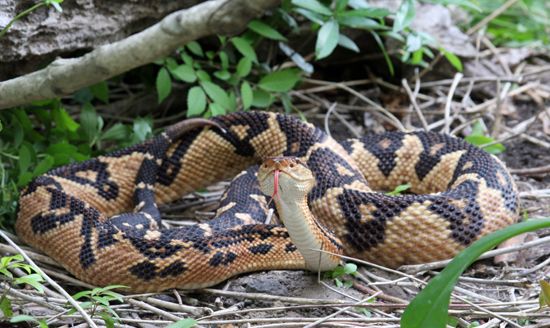
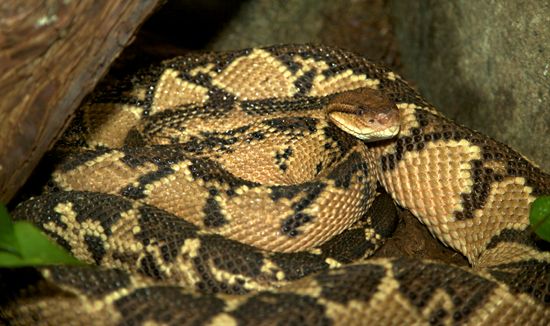
The bushmaster (Lachesis) is the longest venomous snake in the New World, capable of reaching lengths of up to 3 meters (10 feet). While it is seldom…
How venomous is the bushmaster snake, and what makes its venom unique?
The bushmaster (Lachesis) is the longest venomous snake in the New World, capable of reaching lengths of up to 3 meters (10 feet). While it is seldom encountered due to its elusive nature, the bushmaster is considered dangerous, possessing a potentially lethal venom.12
As a member of the pit viper subfamily (Crotalinae), the bushmaster utilizes specialized infrared pits located between its eyes and nostrils to detect the heat signatures of its prey. While the provided information confirms the lethality of its bite, it does not detail specific biochemical properties that make its venom unique compared to other vipers. Unlike most other pit vipers in the Americas, which are live-bearers, the bushmaster is unique for being the only member of its group to lay eggs.12
How do bushmasters compare in size to other venomous snakes?
While the bushmaster (Lachesis) is the longest venomous snake in the New World, reaching lengths of up to 3 meters (10 feet), it is not the longest venomous snake globally.14
That distinction belongs to the king cobra, which typically measures between 3.6 and 4.5 meters (12–15 feet) and has been recorded at lengths exceeding 5.5 meters (18 feet).2
To provide further context on how the bushmaster compares to other vipers and snakes:
- Within the Viper Family: The bushmaster is among the largest members of the family Viperidae, which ranges in size from the Namaqua dwarf viper—measuring less than 25 cm (10 inches)—to the bushmaster at over 3 meters.4
- Compared to Non-Venomous Giants: While the bushmaster is impressive for a venomous species, it is significantly smaller than the world’s largest non-venomous snakes, such as the reticulated python and the green anaconda, which can reach lengths of 7 to 8 meters (23–26 feet) or more.2
What are the different species of bushmaster snakes, and how do they differ?
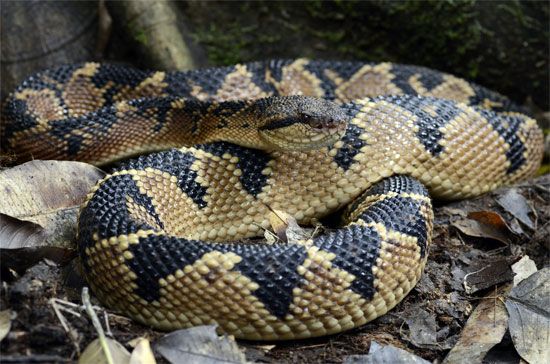
There are three recognized species within the genus Lachesis, commonly known as the bushmaster:
- Lachesis muta: Often referred to as the South American bushmaster, this is the most widely distributed species, found throughout the Amazon River basin.
- Lachesis stenophrys: Known as the Central American bushmaster, this species is found in regions extending north toward Costa Rica.
- Lachesis melanocephala: The black-headed bushmaster, which is distinct in its regional classification.
While these species share the genus’s defining characteristics—such as their status as the longest venomous snakes in the New World, their reddish-brown to pinkish-gray coloration, and their unique behavior of laying eggs—they are primarily differentiated by their specific geographic ranges across Central and South America. All three species are pit vipers that utilize infrared pits to ambush small rodents on the forest floor.1
Are there any cultural or mythological references to bushmasters in the regions where they are found?
Sorry, the Britannica knowledge base does not contain this information.
Sources
- bushmaster — Encyclopædia Britannica
- viper — Encyclopædia Britannica
- bushmaster — Merriam-Webster
- What is the largest snake in the world? — Encyclopædia Britannica
- pit vipers — Merriam-Webster
Published on · 2 min read