Brazil Current
The Brazil Current is a warm, southward-flowing branch of the Atlantic South Equatorial Current located in the South Atlantic Ocean. It serves as a weak…
What is Brazil Current?
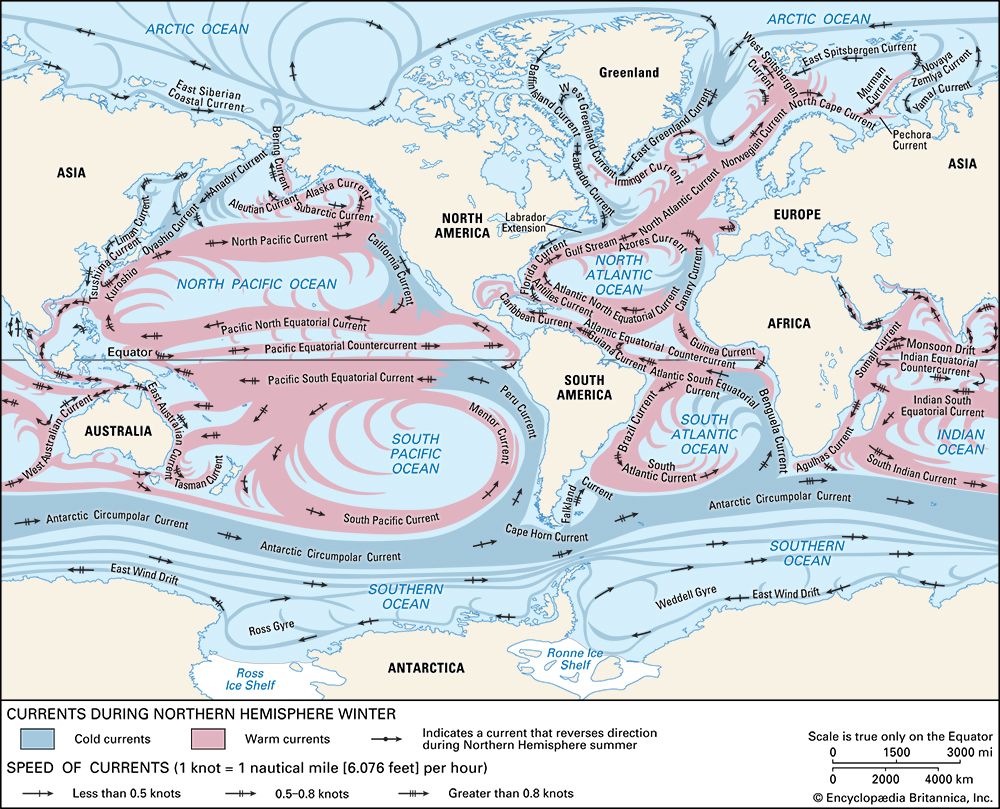
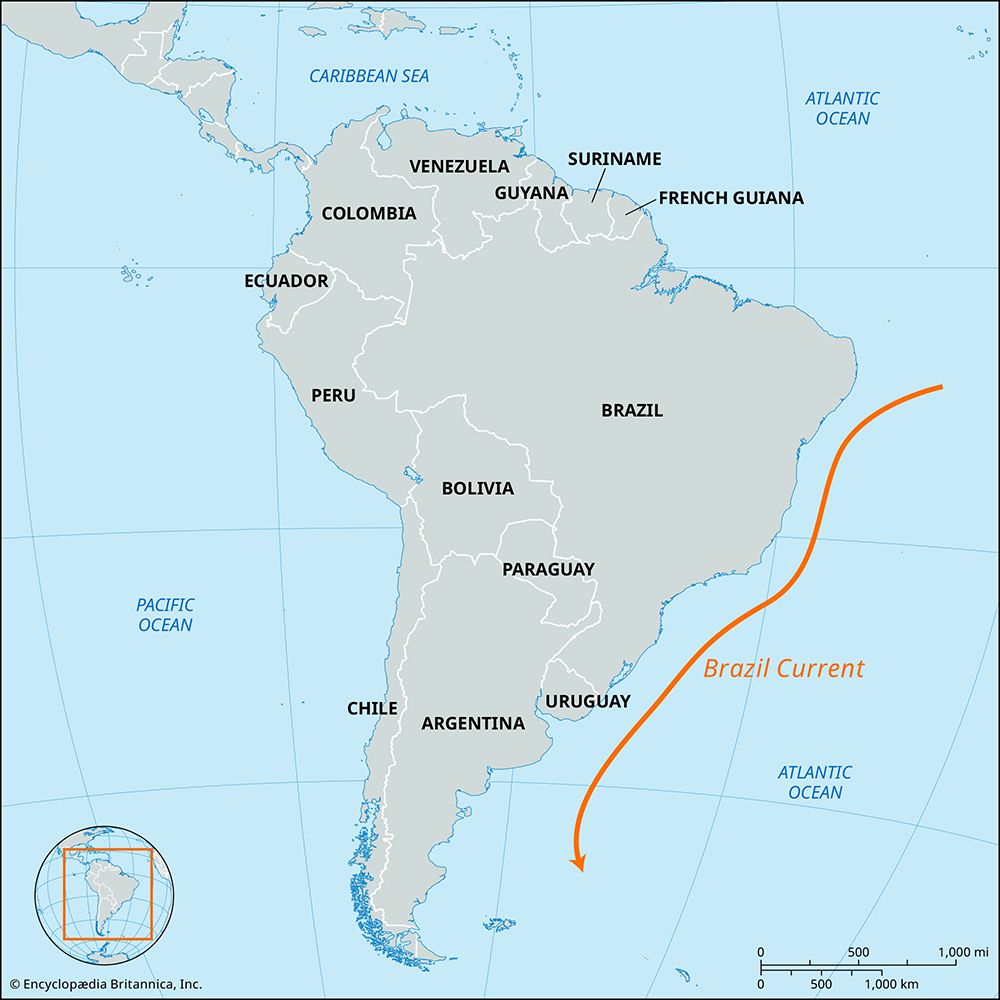
The Brazil Current is a warm, southward-flowing branch of the Atlantic South Equatorial Current located in the South Atlantic Ocean. It serves as a weak counterpart to the Gulf Stream and flows along the eastern coast of South America, stretching from Cape St. Roque, Brazil, to approximately 30°–40° S latitude.12
At this southern limit, the northward-flowing Falkland Current deflects the Brazil Current to the east, where it becomes the South Atlantic Current it becomes the South Atlantic Current.13
Key characteristics of the current include:
- Temperature: Warm, ranging from 66 to 81 °F (19 to 27 °C).1
- Salinity: High, averaging 35 to 37 parts per thousand.1
- Dimensions: It is relatively shallow and weak, with a depth of 330–660 feet (100–200 meters) and a surface speed of one to two knots.1
How does the Brazil Current compare to the Gulf Stream?
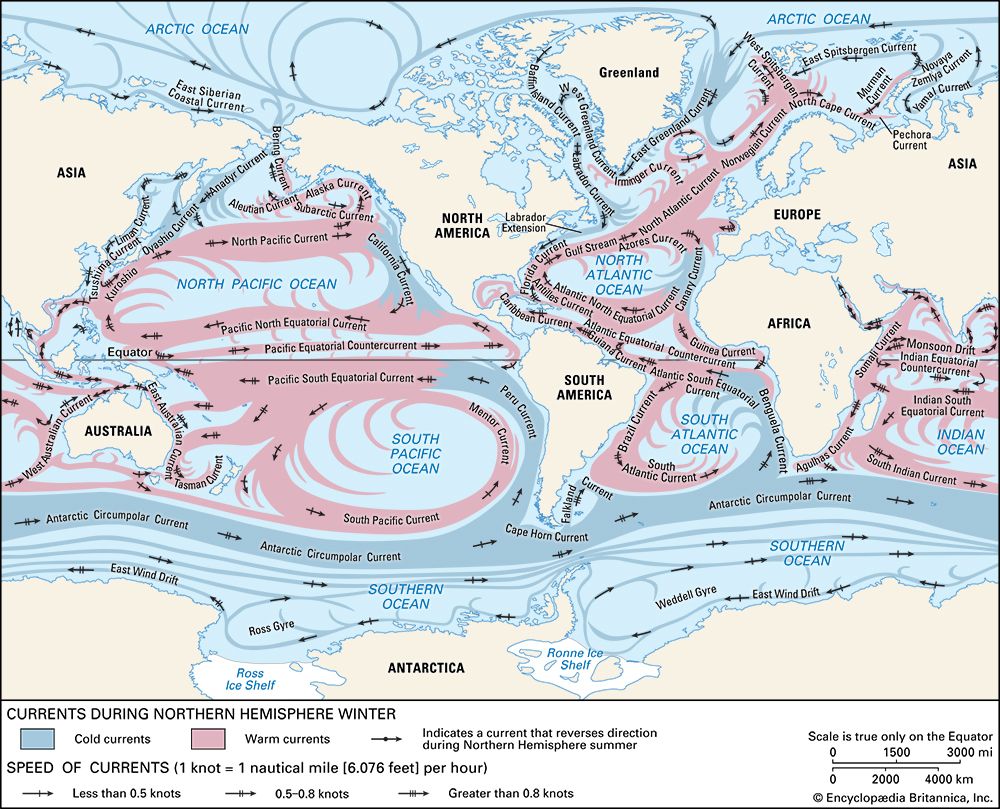
Both the Brazil Current and the Gulf Stream are western boundary currents within their respective subtropical gyres, yet they differ significantly in scale and intensity.
The Gulf Stream is the strongest of the western boundary currents. It is a powerful, jetlike flow that transports approximately 30 million cubic meters of water per second through the Straits of Florida, increasing to roughly 80 million cubic meters per second past Cape Hatteras. It is characterized by complex dynamics, including the formation of significant warm and cold eddies and distinct meanders after separating from the continental margin.41
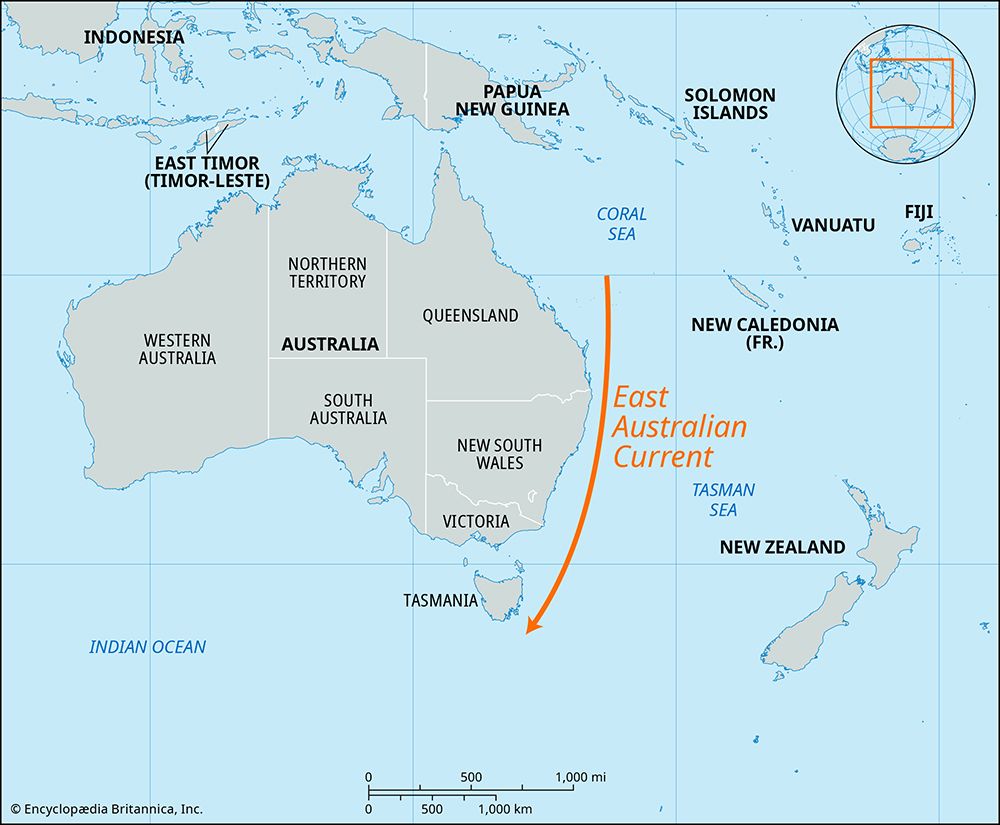
In contrast, the Brazil Current is relatively weak and shallow. It carries a volume of approximately 10 million cubic meters per second—a fraction of the Gulf Stream’s transport. While the Gulf Stream is a major driver of heat transport in the North Atlantic, the Brazil Current is considered one of the weaker western boundary currents, similar in that regard to the East Australian Current.451
What is the role of trade winds in driving ocean currents?
Trade winds are a primary driver of global ocean circulation, exerting stress on the sea surface that sets water in motion. This wind-driven circulation is fundamental to the formation of large-scale ocean currents and gyres.536
Mechanisms of Wind-Driven Circulation
- Surface Stress and Ekman Transport: Wind blowing across the ocean surface creates stress proportional to the square of the wind speed. Due to the Coriolis force, this movement results in Ekman transport, where the average water movement in the upper layer occurs at a 90-degree angle to the wind direction.53
- Equatorial Currents: Trade winds are the primary force behind equatorial currents. For example, the Northeast and Southeast trade winds push surface waters westward, creating the North and South equatorial current systems.7
- Convergence and Upwelling: Variations in wind patterns create zones of convergence and divergence. Convergence leads to downwelling, while divergence draws deeper, nutrient-rich water to the surface in a process known as upwelling.53
- Gyre Formation: The Sverdrup transport theory explains how these wind-induced movements form massive subtropical gyres that circulate water across entire ocean basins.53
How do ocean currents influence global climate patterns?
Ocean currents are vital components of the Earth’s climate system, acting as a global conveyor that redistributes heat, moisture, and energy across the planet.11128
Heat Redistribution
The most significant climatic role of ocean currents is the transport of heat from the tropics toward the poles. Warm currents, such as the Gulf Stream, carry thermal energy into higher latitudes, where it is released into the atmosphere. This process significantly moderates the climate of regions like northwestern Europe, keeping them warmer than their latitude would otherwise suggest. Conversely, cold currents, such as the Peru Current, transport cooler water toward the equator, influencing regional temperatures and atmospheric stability.1112813
Atmospheric Interaction
Ocean currents influence the atmosphere through several key mechanisms:
- Moisture Supply: Warm surface waters evaporate, supplying moisture to the atmosphere. When this vapor condenses into clouds, it releases latent heat, further contributing to the global heat budget.8
- Jet Stream Guidance: Strong thermal gradients at the boundaries of warm and cold currents influence the positioning and strength of the jet stream, which in turn steers weather systems across hemispheres.8
- Upwelling and Aridity: Cold water upwelling stabilizes the lower atmosphere, reducing convection and precipitation, which contributes to the arid conditions found along certain subtropical western coasts.13
Climatic Anomalies
Interactions between the ocean and atmosphere can trigger major climatic events. For instance, El Niño occurs when weakened trade winds allow warmer water to shift eastward in the Pacific, fundamentally altering global precipitation and temperature patterns. Additionally, the thermohaline circulation moves vast volumes of water globally, and scientists monitor its potential weakening due to freshwater influx as a factor in future climate stability.13812
Sources
- Brazil Current — Encyclopædia Britannica
- Atlantic Ocean - The South Atlantic — Encyclopædia Britannica
- Equatorial current — Encyclopædia Britannica
- subtropical gyre — Encyclopædia Britannica
- ocean current - The subtropical gyres — Encyclopædia Britannica
- ocean current - Wind-driven circulation — Encyclopædia Britannica
- Climate - The ocean surface and climate anomalies — Encyclopædia Britannica
- Atmosphere - Effect of oceans on air movement — Encyclopædia Britannica
- ocean current - Ekman layer — Encyclopædia Britannica
- Ekman layer — Encyclopædia Britannica
- How Do Ocean Currents Affect the Biosphere? — Encyclopædia Britannica
- thermohaline circulation — Encyclopædia Britannica
- Climate - Circulation, currents, and ocean-atmosphere interaction — Encyclopædia Britannica
Published on · 4 min read