Estuarine Crocodile
The estuarine crocodile (Crocodylus porosus), also widely known as the saltwater crocodile, is the largest and heaviest living reptile in the world.
What is estuarine crocodile?
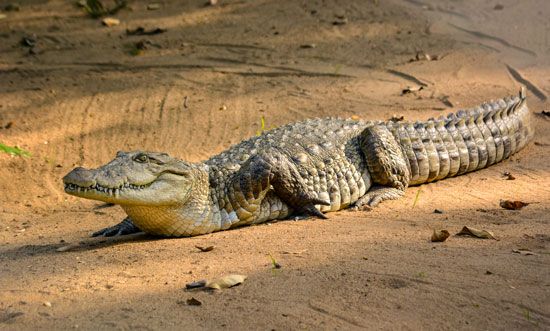
The estuarine crocodile (Crocodylus porosus), also widely known as the saltwater crocodile, is the largest and heaviest living reptile in the world1.1
These apex predators can grow up to 7 meters (about 23 feet) in length and weigh as much as 1,200 kg (nearly 2,650 pounds). Despite their name, they are not restricted to saltwater; they inhabit brackish waters, wetlands, and freshwater streams across a vast range spanning from India and Southeast Asia to Australia’s northern coast.23
Known for their aggressive nature, estuarine crocodiles are opportunistic, nocturnal hunters that consume a wide variety of prey, including fish, crustaceans, and large mammals like water buffalo. They are also known to attack humans and livestock, which often leads to conflict in areas where their habitat overlaps with human populations. Currently, the International Union for Conservation of Nature (IUCN) lists the species as being of least concern due to its stable population.23
How do estuarine crocodiles differ from alligators?
Estuarine crocodiles and alligators are distinct crocodilians that can be distinguished by several physical and behavioral characteristics:
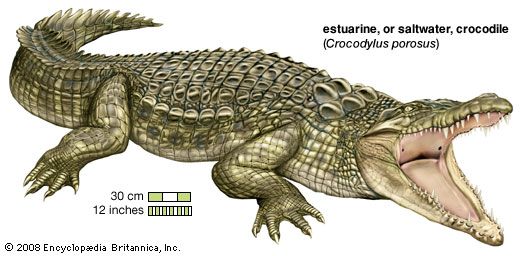
- Snout Shape: The most recognizable difference is the snout. Estuarine crocodiles have a narrow, V-shaped snout, whereas alligators possess a broad, U-shaped snout.67
- Teeth: When an alligator’s mouth is closed, its lower teeth are typically hidden from view because they fit into sockets in the upper jaw. In contrast, an estuarine crocodile’s teeth are visible along the jawline, with the large fourth tooth on the lower jaw appearing outside the upper snout when the mouth is shut.671
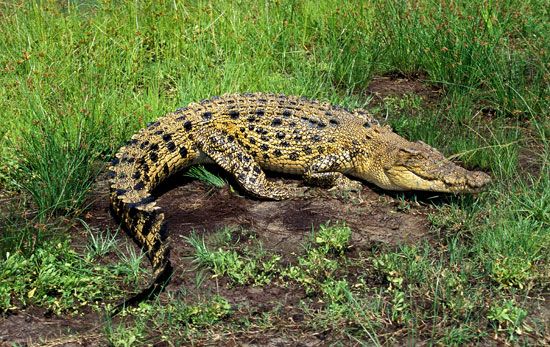
- Coloration: Alligators generally appear gray or black, while crocodiles tend to be olive or tan.6
- Habitat: Estuarine crocodiles are adapted to saltwater and brackish environments, often swimming far out to sea, whereas alligators primarily prefer freshwater habitats like rivers, lakes, and swamps.68
- Behavior: Estuarine crocodiles are typically more aggressive than alligators.6
What adaptations allow crocodiles to live in saltwater?
Crocodiles that inhabit marine environments, such as the estuarine crocodile and the American crocodile, have evolved specific physiological mechanisms to manage the challenges of living in saltwater.10
The primary adaptation allowing these reptiles to thrive in saline environments is the presence of specialized glands located in the tongue. These glands function as an osmoregulatory mechanism, enabling the crocodile to actively excrete excess salt from its body. This process is essential because, in a salty environment, organisms face a constant influx of ions and a potential loss of water through their permeable surfaces. By actively transporting and expelling these salts, the crocodile maintains an internal balance between water and dissolved materials, regardless of the salinity of the surrounding water.101112
While these specialized glands are critical for saltwater tolerance, crocodiles also possess other adaptations for an amphibious lifestyle, such as the ability to close their nostrils and ears with membranous flaps when submerged.5
How do mother crocodiles protect their young?
Mother crocodiles provide extensive parental care, which is considered among the most intricate examples of such behavior in reptiles. Their protective efforts occur in several stages:
- Nest Protection: After laying her eggs in a mound of soil and vegetation or a hole in the ground, the female remains nearby to guard the nest against predators throughout the incubation period, which lasts from 55 to 100 days.1314
- Assisting Hatching: When the young are ready to emerge, they begin to emit chirping or squeaking sounds. This signals the mother to uncover the nest. She may assist the hatchlings by carefully opening the eggs with her tongue.1314
- Transport and Defense: The mother often carries her hatchlings to the water in her mouth. Once in the water, she remains close to her offspring, providing protection from predators for several weeks to months.1314
- Continued Presence: As the young grow, they gradually disperse, though they may stay near the nest site for over a year.13
While the female is the primary caregiver, in some captive settings, males have also been observed assisting in the hatching process and providing care for the young.13
Sources
- estuarine crocodile — Encyclopædia Britannica
- estuarine crocodile — Merriam-Webster
- 7 Crocodilian Species That Are Dangerous to Humans — Encyclopædia Britannica
- freshwater crocodile — Encyclopædia Britannica
- crocodile - Ecology — Encyclopædia Britannica
- What’s the Difference Between Alligators and Crocodiles? — Encyclopædia Britannica
- alligator — Encyclopædia Britannica
- crocodile - Behavior — Encyclopædia Britannica
- 7 Questions About Lizards, Snakes, and Other Reptiles Answered — Encyclopædia Britannica
- crocodile - Form and function — Encyclopædia Britannica
- Biosphere - Salinity — Encyclopædia Britannica
- Osmoregulation — Encyclopædia Britannica
- crocodile - Reproduction — Encyclopædia Britannica
- reptile - Embryonic development and parental care — Encyclopædia Britannica
- Animal social behavior - Social interactions involving the costs and benefits of parental care — Encyclopædia Britannica
Published on · 4 min read