Fitzroy River
There are two distinct rivers in Australia named the Fitzroy River:
What is Fitzroy River?
There are two distinct rivers in Australia named the Fitzroy River:
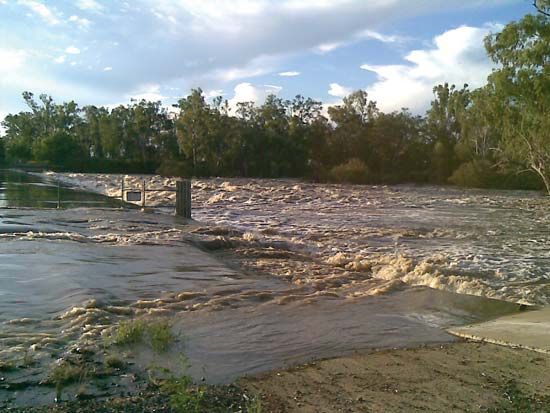
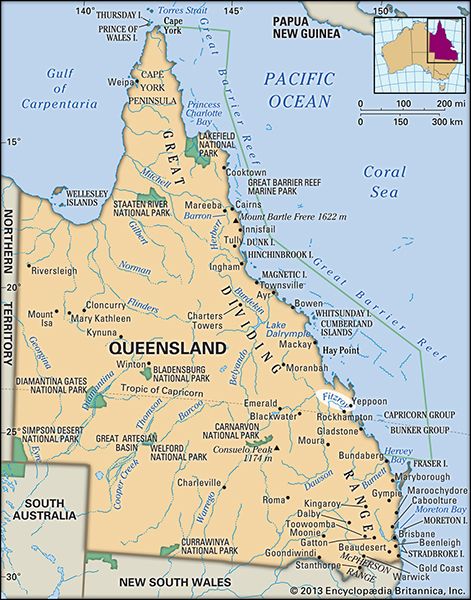
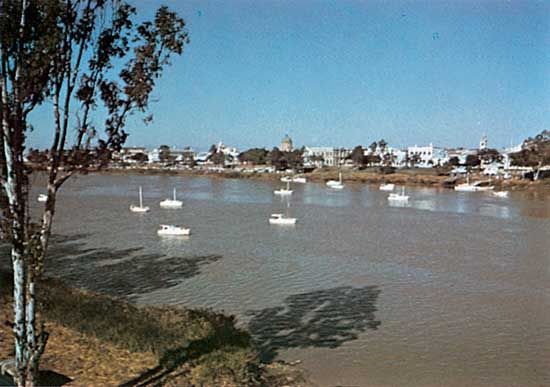
- Queensland: This river in eastern Queensland is formed by the confluence of the Dawson and Mackenzie rivers. It flows 300 miles (480 km) to enter Keppel Bay in the Pacific Ocean. It is navigable up to Rockhampton and is named after Sir Charles FitzRoy.1
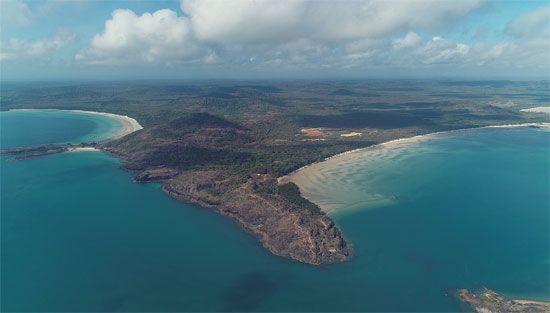
- Western Australia: This river rises in the Durack Range and flows 325 miles (525 km) through the Kimberley region to empty into the Indian Ocean at King Sound. It is known for the Geikie Gorge and was named in honor of Capt. Robert Fitzroy.2
Both rivers support agricultural activities, including rice farming on their respective floodplains.12
What is the Great Dividing Range?
The Great Dividing Range is the primary watershed of eastern Australia. It consists of a complex series of plateaus and low mountain ranges that parallel the coasts of Queensland, New South Wales, and Victoria for approximately 2,300 miles (3,700 km).34
Extending from the Cape York Peninsula in the north to the Grampians in the south, the range also continues into Tasmania across the Bass Strait. While generally modest in elevation, it reaches its highest point at Mount Kosciuszko (7,310 feet [2,228 meters]) within the Australian Alps.34
The range serves as a critical hydrological divide, feeding major rivers like the Darling and Murray. Historically, the mountains acted as a barrier to European migration until they were successfully traversed in 1813 by Gregory Blaxland, W.C. Wentworth, and William Lawson. Today, the region is vital for agriculture, mining, and tourism.4
How do rivers like the Fitzroy support agriculture in Australia?
Rivers like the Fitzroy River support agriculture in Australia primarily by providing water for irrigation and creating fertile environments along their floodplains. In the case of the Fitzroy, experimental pasturing and rice farming are practiced along its lower reaches. To manage these water resources, infrastructure such as dams—like the one at Camballin—is used to control water for irrigation purposes.16
More broadly, Australian rivers are essential to the country’s agricultural productivity, particularly in the Murray-Darling Basin. This system supports the nation’s largest area of irrigated crops and pastures, including cattle, sheep, grains, fruit, and wine production. Irrigation is facilitated by extensive networks of dams and weirs that capture water from rivers, which is especially critical given Australia’s status as the driest inhabited continent. However, these practices require careful management, as overwatering and poor drainage can lead to soil salinization and other environmental challenges.278
What kind of wildlife lives in the Kimberley region?
The Kimberley region, located in the northwestern corner of Western Australia, is characterized by unique terrestrial and marine ecosystems that support a diverse range of wildlife.
Flora
The landscape is sparsely wooded, dominated by eucalypts and the distinctive, moisture-storing boab tree. Spinifex grass is also ubiquitous throughout the region, which is typical for areas north of the Tropic of Capricorn.9
Fauna and Conservation
The region is home to a wide variety of native species, though specific wildlife populations are often discussed in the context of the broader state of Western Australia. The state hosts approximately 150 species of mammals—including kangaroos, wallabies, bandicoots, and various bats—as well as hundreds of species of birds and reptiles. Coastal and inland waters in the region support marine and freshwater turtles, while coastal areas may host dugongs and dolphins.9
Because the Kimberley contains such unique ecosystems, it has been the focus of extensive conservation efforts. The Western Australian government’s Kimberley Science and Conservation Strategy supports scientific research and the creation of new parks, which are often jointly managed by Aboriginal groups. These initiatives employ land management practices such as controlled burning and the control of feral animals and weeds to protect the region’s biodiversity.10
Sources
- Fitzroy River — Encyclopædia Britannica
- Fitzroy River — Encyclopædia Britannica
- Exploring 7 of Earth’s Great Mountain Ranges - Great Dividing Range — Encyclopædia Britannica
- Great Dividing Range — Merriam-Webster
- Great Dividing Range — Encyclopædia Britannica
- Murray River — Encyclopædia Britannica
- New South Wales - Drainage — Encyclopædia Britannica
- Australia - Agriculture, forestry, and fishing — Encyclopædia Britannica
- Western Australia - Plant and animal life — Encyclopædia Britannica
- Australia - Conservation — Encyclopædia Britannica
- Kimberley — Encyclopædia Britannica
Published on · 3 min read