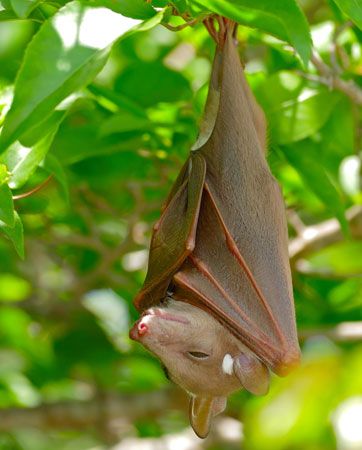
Flying Fox
Flying foxes (genus Pteropus) are distinct from most other bat species in several key biological and behavioral ways:
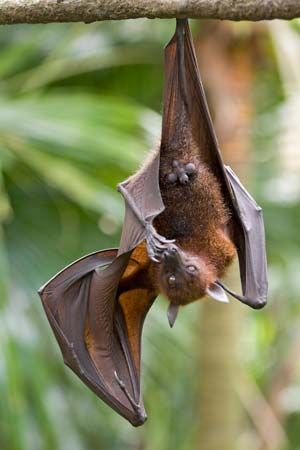
What are the main differences between flying foxes and other bat species?
Flying foxes (genus Pteropus) are distinct from most other bat species in several key biological and behavioral ways:
- Navigation: Unlike most bats, which rely on echolocation to navigate, flying foxes primarily use their sense of sight.1
- Vision: They possess eyes equipped with both rods and cones, granting them colour vision, whereas many other bats are adapted for low-light navigation without color perception.1
- Size: Flying foxes are the largest bats, with some species reaching a wingspan of 1.5 metres (5 feet). In contrast, other bats vary significantly in size, ranging from the tiny hog-nosed bat to various insectivorous and carnivorous species.12
- Diet: They are specialized Old World fruit bats that feed on fruit and nectar. While other bat groups have diversified into insectivorous, carnivorous, and even blood-lapping diets, flying foxes have largely maintained their frugivorous habits.13
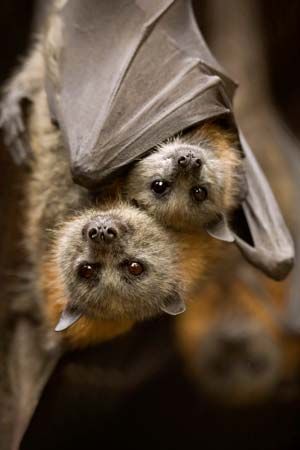
How have flying foxes adapted to their nocturnal lifestyle?
Flying foxes have evolved specialized physiological and behavioral traits to thrive in their nocturnal environment. Unlike most other bats that rely on echolocation for navigation, flying foxes primarily utilize their highly developed sense of sight.14
Their eyes are uniquely adapted for low-light conditions, containing both rods for shape and pattern recognition and cones that provide colour vision. Research indicates that these bats are capable of making visual discriminations at light levels even lower than those perceivable by humans, which is particularly advantageous when flying beneath or within the dense jungle canopy.14
Beyond sensory adaptations, the nocturnal habit itself offers significant survival benefits. By foraging at night, flying foxes avoid visual predators, intense solar radiation, and high ambient temperatures that could lead to excessive water loss through their large, thin wing membranes. They also use their sense of smell to locate food sources, such as fruit and flowers, which often bloom or ripen in ways that attract nocturnal visitors.546
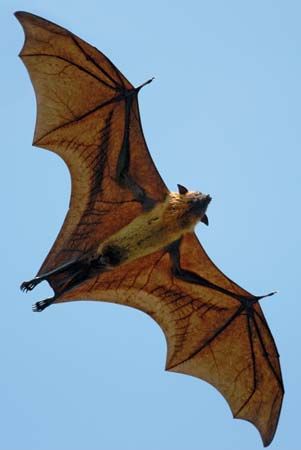
How large can flying foxes grow, and what is their typical wingspan?
Flying foxes (genus Pteropus) are recognized as the largest of all bat species. In terms of physical dimensions, these bats can attain a wingspan of approximately 1.5 metres (5 feet).172
Regarding their body size, they typically reach a head and body length of about 40 cm (16 inches). In terms of mass, these animals weigh approximately 1 kg (2.2 pounds). While they are the largest bats, they are distinct from the extinct pterosaurs—often informally called pterodactyls—which were flying reptiles that could reach much larger wingspans, sometimes exceeding 7 to 11 metres.128
What is a flying fox and why is it classified as a mammal?
A flying fox (genus Pteropus) is a type of Old World fruit bat belonging to the family Pteropodidae. These animals are the largest of all bat species, with some reaching a wingspan of 1.5 metres (5 feet). Unlike many other bats that use echolocation to navigate, flying foxes primarily rely on their keen sense of sight, possessing eyes equipped with both rods and cones for colour vision.19
Flying foxes are classified as mammals because they share the defining characteristics of the class Mammalia. Specifically:210
- Nourishment: Like all mammals, they nourish their young with milk produced by mammary glands.2
- Viviparity: They are viviparous, meaning they bear live young rather than laying eggs.2
- Physical Traits: They possess hair and exhibit the unique skeletal structure characteristic of mammals, such as a lower jaw hinged directly to the skull.2
Despite their foxlike muzzles, they are not related to rodents; they belong to the order Chiroptera.11
Sources
- flying fox — Encyclopædia Britannica
- bat - General features — Encyclopædia Britannica
- mammal - Food habits — Encyclopædia Britannica
- bat - Activity patterns — Encyclopædia Britannica
- bat - Senses — Encyclopædia Britannica
- bat - Food habits — Encyclopædia Britannica
- Old World fruit bat — Encyclopædia Britannica
- pterodactyl — Encyclopædia Britannica
- mammal — Encyclopædia Britannica
- Are Bats Rodents? — Encyclopædia Britannica
- bat - Anatomical specializations — Encyclopædia Britannica
Published on · 3 min read