Flying Gurnard
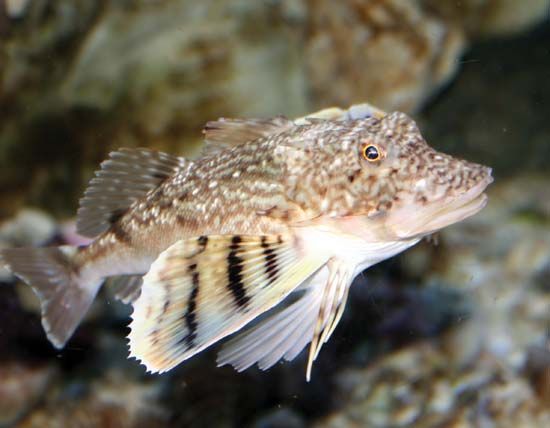
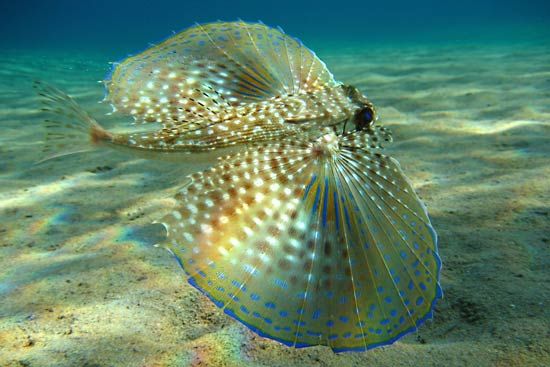
The flying gurnard (family Dactylopteridae) is a marine fish characterized by its large, winglike pectoral fins and bony head plates. These fish reach a…
How large do flying gurnards typically grow, and what is their lifespan?
The flying gurnard (family Dactylopteridae) is a marine fish characterized by its large, winglike pectoral fins and bony head plates. These fish reach a maximum length of approximately 50 cm (20 inches).1
Regarding your question about their lifespan, the provided information does not contain data on the typical life expectancy of flying gurnards.
In which oceanic regions can flying gurnards be found?
Flying gurnards are primarily found in warm and tropical seas across the globe.1
Specific distribution details include:
- Atlantic Ocean: Species such as Dactylopterus volitans inhabit these waters.1
- Mediterranean Sea: This region is also home to the Dactylopterus volitans species.1
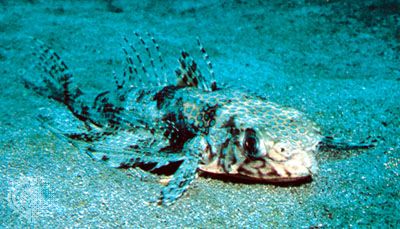
These fish are bottom-dwelling creatures that utilize their large, winglike pectoral fins to glide above the water for short distances.12
Are there any conservation concerns or interesting facts about flying gurnards?
Regarding your query, the provided search results do not contain information concerning the conservation status of flying gurnards.
However, these fish possess several fascinating characteristics:
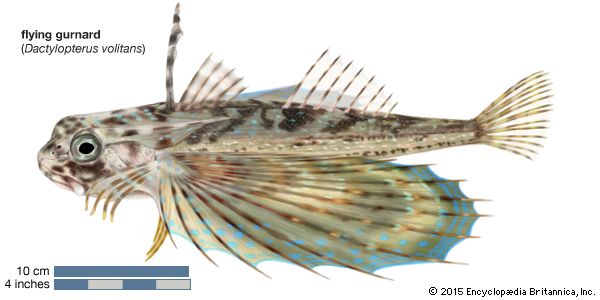
- Unique Anatomy: They are covered in protective bony plates on their heads and feature a distinct dorsal fin ray located on the nape of the neck, separate from the rest of the fin.1
- Winglike Fins: Their pectoral fins are divided into two parts: a shorter forward section and a large, colorful posterior section that resembles wings.1
- Vibrant Appearance: Species such as Dactylopterus volitans are known for their striking coloration, with fins that are often brightly spotted with blue.1
- Gliding Ability: While they are primarily bottom-dwelling fish, they are capable of using their expansive fins to glide above the water for short distances.12
How do flying gurnards communicate or attract mates?
The provided search results do not contain specific information regarding how flying gurnards communicate or attract mates.
However, it is known that flying gurnards (family Dactylopteridae) possess a sonic mechanism and sound-production capacity similar to that of sea robins (family Triglidae). Sea robins are well-documented sound-producing fishes that utilize a large swim bladder vibrated by specialized lateral muscles to create barks, growls, and clucks. While these sounds are often associated with the sonic capabilities of the group, the specific role these sounds play in the courtship or mating behavior of flying gurnards is not detailed in the available data.3
Sources
- flying gurnard — Encyclopædia Britannica
- flying gurnard — Merriam-Webster
- Animal social behavior - Social interactions involving sex — Encyclopædia Britannica
- Gruiform - Courtship — Encyclopædia Britannica
- scorpaeniform - Sound production — Encyclopædia Britannica
Published on · 2 min read