How Big Are Anglerfish Compared to Humans?
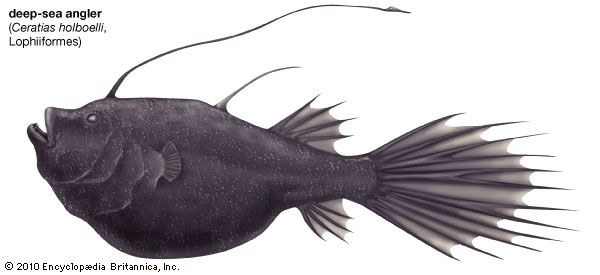
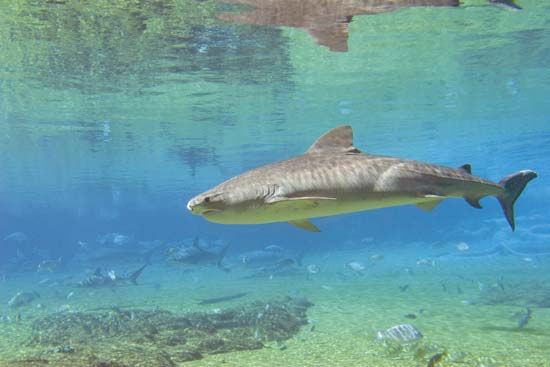
Most anglerfish are significantly smaller than humans, typically measuring about 30 centimeters (1 foot) in length.
How big are anglerfish compared to humans?
Most anglerfish are significantly smaller than humans, typically measuring about 30 centimeters (1 foot) in length.1
However, size varies greatly across the order Lophiiformes:
- European monkfish: This species can reach up to 2 meters (6.6 feet) in length, which is longer than the average human height of approximately 1.7 meters (5.5 feet).1
- Deep-sea anglerfish: These fish can grow up to 1.2 meters (4 feet) in length, though most are much smaller.12
A notable biological characteristic of these fish is sexual dimorphism, where females are significantly larger than males. In certain deep-sea families, the tiny males attach to the female as permanent parasites, eventually fusing their circulatory systems to hers for nourishment.12
How does the anglerfish’s bioluminescent lure work?
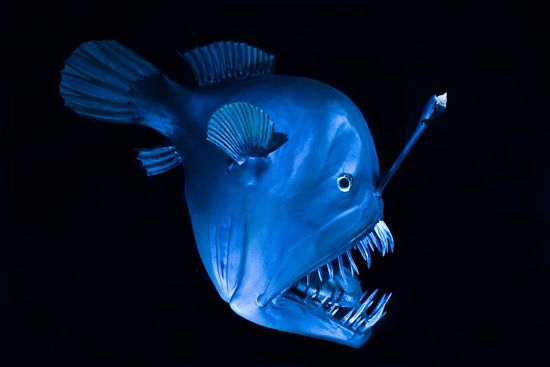
The anglerfish utilizes a specialized adaptation to hunt in the darkness of the deep sea. The first spine of its dorsal fin is modified into an elongated rod that extends forward over the fish’s mouth, tipped with a fleshy, luminous organ known as a “bait” or lure.34
This bioluminescence is generally produced through the oxidation of a molecule called luciferin, a reaction catalyzed by the enzyme luciferase. In some cases, this light is generated by the fish itself, while in others, it is produced by symbiotic bioluminescent bacteria housed within the lure.2
When other deep-sea organisms are drawn to this glowing “lantern” in search of food, they venture close enough to the anglerfish to be engulfed by its large, waiting jaws. This method of predation is highly effective in the lightless depths, where the lure acts as a deceptive beacon for unsuspecting prey.324
Why do male anglerfish become parasites on females?
In three families of deep-sea anglerfish, males exhibit a unique reproductive strategy where they live as permanent parasites on the female. This behavior is an extreme adaptation to the challenges of finding a mate in the vast, sparsely populated environment of the deep sea.25
The process begins when a small, free-swimming male encounters a much larger female. He attaches himself to her body by biting into her skin. Over time, the tissues of the two fish fuse together, and their circulatory systems become connected. Once this union is complete, the male becomes entirely dependent on the female for nourishment, effectively serving as a permanent appendage.215
This biological arrangement ensures that the female has a constant supply of sperm available for spawning, which is highly advantageous in an environment where individuals rarely encounter one another.21
What other creatures live in the deep sea?
The deep sea is a specialized environment characterized by extreme pressure, cold, and darkness, necessitating unique evolutionary adaptations among its inhabitants. Life in these depths is broadly categorized into mid-water (pelagic) and bottom-living (benthic) organisms.67
Mid-water (Pelagic) Inhabitants
Mid-water species often possess large mouths, enlarged eyes, and bioluminescent organs used to attract prey or mates. Notable groups include:6
- Deep-sea anglerfishes: Known for their modified dorsal fin spines used as lures.68
- Viperfishes: Predators equipped with numerous fanglike teeth.6
- Bristlemouths: Among the most abundant fishes globally.6
- General fauna: The bathypelagic zone also hosts a variety of eels, mollusks, and other marine forms.9
Bottom-living (Benthic) Inhabitants
Benthic organisms typically have smaller eyes and mouths and often lack bioluminescence. These include:6
- Grenadiers, batfishes, and cusk eels: Common bottom-dwellers.68
- Invertebrates: Ciliates, crabs, and clams have been recovered from extreme depths.10
Hydrothermal Vent Communities
Exotic ecosystems exist around deep-sea vents, where life is independent of sunlight. These communities rely on chemosynthesis performed by sulfur-fixing bacteria rather than photosynthesis.1110
Sources
- How big are anglerfish compared to humans? — Encyclopædia Britannica
- anglerfish — Encyclopædia Britannica
- Bioluminescence - The role of bioluminescence in behavior — Encyclopædia Britannica
- Everything’s Illuminated: 6 Bioluminescent Organisms — Encyclopædia Britannica
- paracanthopterygian - Life cycle and reproduction — Encyclopædia Britannica
- deep-sea fish — Encyclopædia Britannica
- deep-sea vent — Encyclopædia Britannica
- Marine ecosystem - Geography, oceanography, and topography — Encyclopædia Britannica
- bathypelagic zone — Encyclopædia Britannica
- life - Temperature and desiccation — Encyclopædia Britannica
- paracanthopterygian - Ecology and behavior — Encyclopædia Britannica
- Biosphere - Hydrostatic pressure — Encyclopædia Britannica
Published on · 3 min read