Gammarid
Gammarids are members of the family Gammaridae, which is the largest family within the crustacean order Amphipoda. These organisms are defined by several key…
What are the key characteristics that define gammarid crustaceans?
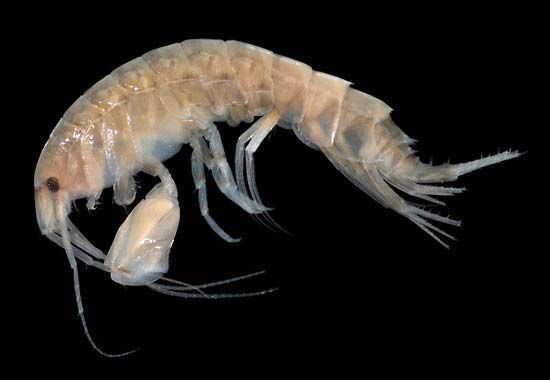
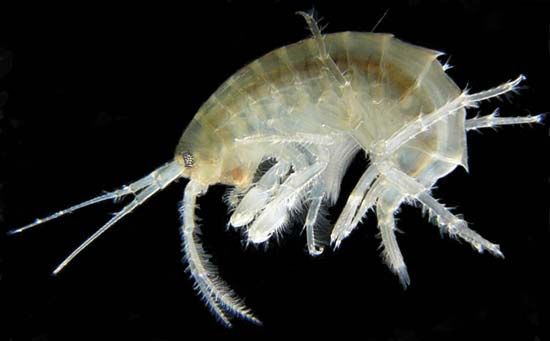
Gammarids are members of the family Gammaridae, which is the largest family within the crustacean order Amphipoda. These organisms are defined by several key physical and behavioral characteristics:1
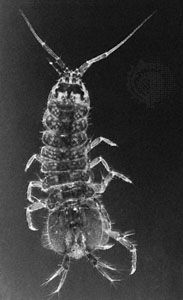
- Body Structure: They possess the classic amphipod shape, characterized by a body that is flattened from side to side. They typically range in size from 5 to 30 mm (0.2 to 1.2 inches).1
- Appendages: They have seven pairs of thoracic walking legs, with the first two pairs frequently being enlarged. Additionally, they feature six pairs of abdominal limbs; the front three pairs are adapted for swimming, while the back three are used for gliding across solid surfaces.1
- Habitat and Diet: While primarily found in freshwater, they also exist in marine environments. They are often abundant among aquatic plants and exhibit diverse feeding habits, including consuming fragmented organic matter, acting as herbivores, carnivores, deposit feeders, or even external parasites.12
- Reproduction: Eggs and developing young are carried in a ventral brood pouch.1
How do gammarids fit into the larger classification of crustaceans?
Gammarids are classified within the subphylum Crustacea, a diverse group of arthropods that includes familiar animals like crabs, lobsters, and shrimp. Within this subphylum, gammarids belong to the class Malacostraca, which is the largest class of crustaceans.1
Specifically, gammarids are members of the order Amphipoda. The family Gammaridae is the largest of the approximately 80 families that constitute this order. As malacostracans, gammarids share advanced evolutionary characteristics with other members of the class, such as limbs modified as maxillipeds and a body plan that includes a head, thorax, and abdomen.45
Today, amphipods, along with isopods and decapods, make up 90 percent of all living malacostracans, highlighting the significant role these groups play within the broader crustacean classification.5
How do gammarids differ from other types of amphipods?
While gammarids are the largest family within the order Amphipoda, they share the fundamental body plan of the order, such as being laterally compressed and possessing sessile eyes. However, they differ from other amphipods in several key ways:16
- Habitat Preference: While amphipods as a whole inhabit diverse environments ranging from deep-sea trenches to terrestrial sand beaches, gammarids occur primarily in freshwater habitats.16
- Feeding Ecology: Many amphipods have specialized lifestyles, such as wood-boring (family Cheluridae) or living as sedentary parasites on cnidarians and sponges. In contrast, gammarids are typically scavengers and herbivores that often burrow into soft mud or reside among aquatic vegetation.6
- Locomotion: While most amphipods are active swimmers, gammarids utilize a specific combination of abdominal limbs: the front three pairs are adapted for swimming, while the back three are specialized for gliding across solid surfaces.1
- Diversity: The family Gammaridae represents a massive portion of the order, with about 5,000 of the approximately 6,000 described amphipod species belonging to this group.16
How are gammarids used in scientific research or environmental monitoring?
Gammarids are frequently utilized in scientific research and environmental monitoring due to their role as key indicators of aquatic ecosystem health. Because they are often locally abundant and feed on fragmented organic matter, they serve as essential links in the food web, processing nutrients and supporting higher trophic levels.1
In environmental monitoring, researchers use gammarids to assess water quality. Their sensitivity to pollutants and changes in water chemistry makes them effective bioindicators; their presence or absence can signal shifts in the health of freshwater habitats. Furthermore, their diverse feeding habits—ranging from herbivory and scavenging to deposit feeding—allow scientists to study the accumulation of contaminants within aquatic food chains.1
Sources
- gammarid — Encyclopædia Britannica
- gammarid — Merriam-Webster
- Gammaridae — Merriam-Webster
- List of crustaceans — Encyclopædia Britannica
- malacostracan - Evolution and paleontology — Encyclopædia Britannica
- amphipod — Encyclopædia Britannica
Published on · 3 min read