Isopod
In isopods, the respiratory function is primarily handled by the abdominal appendages, known as pleopods. These structures are adapted for gas exchange by…
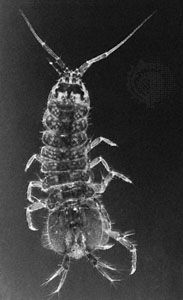
How do isopods breathe, and how does this differ between aquatic and terrestrial species?
In isopods, the respiratory function is primarily handled by the abdominal appendages, known as pleopods. These structures are adapted for gas exchange by becoming thin and flattened, allowing oxygen to pass into the body.12
The method of respiration varies based on the environment:
- Aquatic Species: These isopods rely on their flattened abdominal appendages to extract dissolved oxygen directly from the water. Like other aquatic arthropods, they utilize these gill-like structures for respiration.13
- Terrestrial Species: To survive on land, many terrestrial isopods—such as sow bugs and pill bugs—have evolved additional adaptations. In addition to their abdominal appendages, they possess trachea-like infoldings located in some of the exopodites (the outer branches of the appendages). These structures allow for more efficient gas exchange in an aerial environment, helping the animals manage the challenges of breathing outside of water.1
What is the evolutionary history of isopods, and how long have they existed on Earth?
Isopods are members of the order Isopoda, a diverse group of crustaceans that evolved within the broader malacostracan lineage. Their evolutionary history is closely tied to the development of other malacostracans, which have a fossil record extending back to the early Paleozoic Era (approximately 488 million to 472 million years ago).
During the late Paleozoic (the Carboniferous and Permian periods, roughly 359 million to 251 million years ago), malacostracans underwent rapid evolution, coinciding with the proliferation of coastal vascular plants. It was during this time that the order Isopoda emerged as a distinct group of bottom-dwelling organisms in brackish to fresh lagoons and estuaries. As they evolved, isopods reduced or lost their carapace and thoracic respiratory chambers, shifting their respiration and swimming propulsion to the abdomen.
By the Mesozoic Era (251 million to 65.5 million years ago), isopods had diversified into their 10 existing suborders. During this period, they successfully penetrated continental fresh waters and began occupying moist terrestrial environments as land became forested with angiosperms. Today, isopods, along with decapods and amphipods, constitute 90 percent of all living malacostracans.
What are the defining characteristics of isopods within the crustacean group?
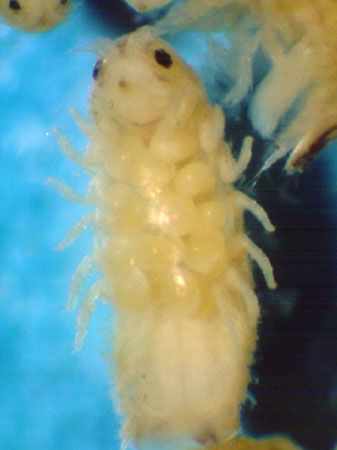
Isopods are a diverse order of crustaceans within the class Malacostraca, found in marine, freshwater, and terrestrial environments. Their defining characteristics include:8
- Body Structure: They typically possess an elongated, somewhat flattened, and arched body. The body is divided into a thorax consisting of seven segments and an abdomen with six segments.8
- Armor: The back is covered by a series of wide, armor-like plates.8
- Limbs: While they usually have six pairs of limbs, the number can vary, ranging from as few as two to as many as eight.8
- Reproduction: Like most crustaceans, isopods are dioecious and possess paired gonads. A key reproductive feature in females is the presence of a ventral brood chamber, known as a marsupium, which is formed by a series of plates called oostegites located in the thoracic region.14
- Diversity: The order includes approximately 10,000 species, ranging from small forms like the pill bug and sow bug to larger marine species such as Bathynomus giganteus. While most are free-living, some marine species are parasitic.8
How are isopods classified, and what are some common examples of isopod species?
Isopods are classified within the class Malacostraca, specifically under the superorder Peracarida and the order Isopoda. This order is highly diverse, containing approximately 10,000 species organized into 10 suborders and 100 families.8
Classification and Characteristics
Isopods are distinguished by their flattened or cylindrical bodies, sessile (fixed) eyes, and the absence of a carapace. They possess seven pairs of uniramous thoracic legs and broad pleopods that often function as gills. Unlike many other crustaceans, they lack a respiratory chamber.8
Common Examples
Isopods occupy a wide range of environments, from the deep sea to terrestrial habitats. Some common examples include:1613
- Pill bugs: Often found in leaf litter, these are well-known terrestrial isopods.16
- Sow bugs: Similar to pill bugs, these are also common in damp, terrestrial environments.16
- Gribbles: Small marine isopods known for boring into wooden structures.16
- Wood lice: Members of the suborder Oniscoidea, these are the most terrestrial of all crustaceans, though most still require damp conditions to survive.1317
- Bathynomus giganteus: A notable deep-sea marine species that can grow up to 35 cm (14 inches) in length.16
Sources
- Respiratory system - Trachea — Encyclopædia Britannica
- arthropod - Respiratory system — Encyclopædia Britannica
- heteropteran - Respiratory system — Encyclopædia Britannica
- Respiratory system - Gills of invertebrates — Encyclopædia Britannica
- crustacean - The respiratory system — Encyclopædia Britannica
- pseudotrachea — Merriam-Webster
- pleopod — Merriam-Webster
- isopod — Encyclopædia Britannica
- malacostracan - Evolution and paleontology — Encyclopædia Britannica
- insect - Origin of insects — Encyclopædia Britannica
- geology - Invertebrate paleontology — Encyclopædia Britannica
- branchiopod - Evolution and paleontology — Encyclopædia Britannica
- crustacean - Distribution and abundance — Encyclopædia Britannica
- List of crustaceans — Encyclopædia Britannica
- Animal reproductive system - Arthropods — Encyclopædia Britannica
- malacostracan - Annotated classification — Encyclopædia Britannica
- branchiopod - Critical appraisal — Encyclopædia Britannica
- Oniscoidea — Merriam-Webster
Published on · 3 min read