Wildcat
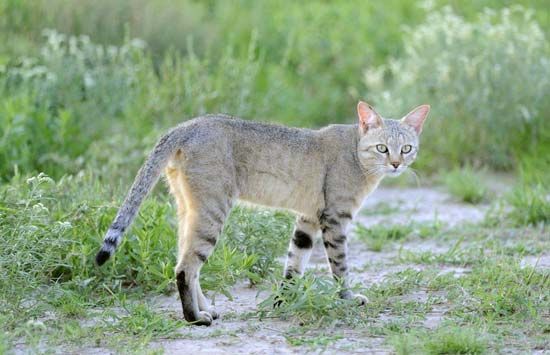
The domestic cat is closely linked to the African wildcat (Felis silvestris lybica), which is considered its primary ancestor. Unlike dogs, which have…
How have wildcats contributed to the evolution of domestic cats?
The domestic cat is closely linked to the African wildcat (Felis silvestris lybica), which is considered its primary ancestor. Unlike dogs, which have undergone significant physical and temperamental changes through domestication, domestic cats remain genetically and physically nearly identical to their wildcat counterparts.12
This close relationship is evidenced by several factors:
- Genetic Similarity: Domestic cats and wildcats are so genetically similar that they readily interbreed. This interbreeding is so frequent in some regions that it threatens the existence of the wildcat as a pure species.12
- Physical Traits: All domestic cats retain the genetic blueprint for tabby coat patterns, which are characteristic of their wildcat ancestors.3
- Behavioral Independence: Because they have not undergone the same degree of “infantilization” as dogs, cats have retained their independent nature and predatory instincts. This allows them to thrive in the wild, which is why experts often do not classify the cat as a fully domesticated animal.1
What is the taxonomic classification of the wildcat (Felis silvestris)?
The wildcat (Felis silvestris) is classified within the cat family, known scientifically as Felidae. Within this family, it belongs to the subfamily Felinae, which encompasses small to medium-sized cats.24
The taxonomic hierarchy for the wildcat is as follows:
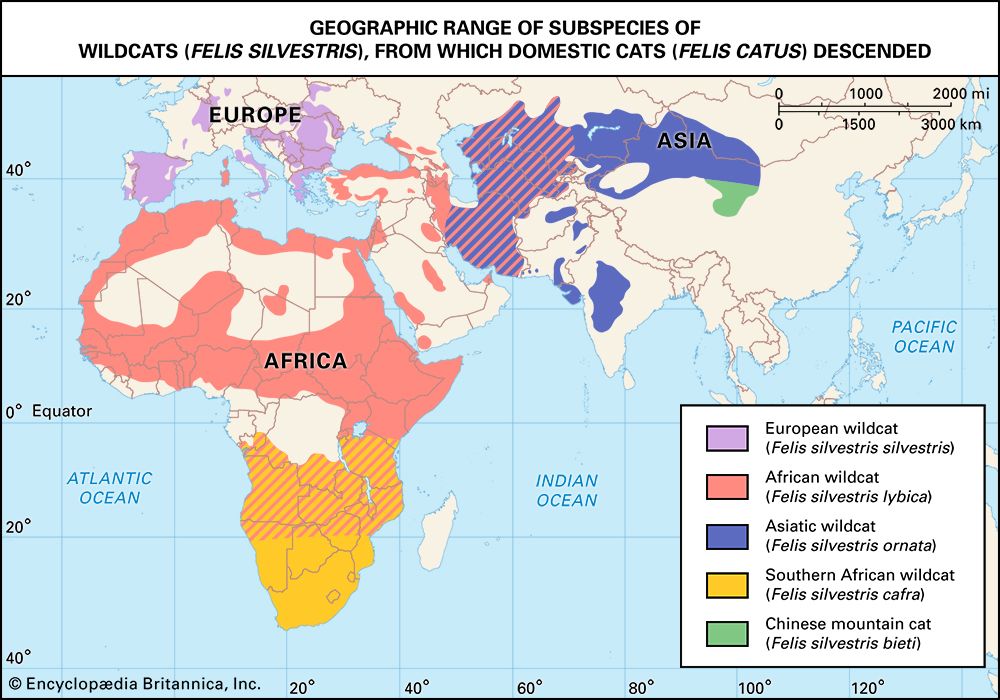
The species Felis silvestris includes several distinct subspecies, such as the European wildcat (Felis silvestris silvestris), the African wildcat (Felis silvestris lybica), and the Asian wildcat (Felis silvestris ornata). While the term “wildcat” is sometimes used colloquially to refer to feral domestic cats or other small wild felids like the bobcat, the scientific classification specifically identifies Felis silvestris as a distinct member of the genus Felis.254
What is the average lifespan of a wildcat in the wild versus in captivity?
The provided search results do not contain information regarding the average lifespan of the wildcat (Felis silvestris). The data provided only covers the life expectancy of tigers and the Canada lynx.
Sorry, the Britannica knowledge base does not contain this information.
What are the key physical characteristics that distinguish wildcats from domestic cats?
While the wildcat (Felis silvestris) and the domestic cat are closely related—and even capable of interbreeding—they possess distinct physical characteristics that set them apart.
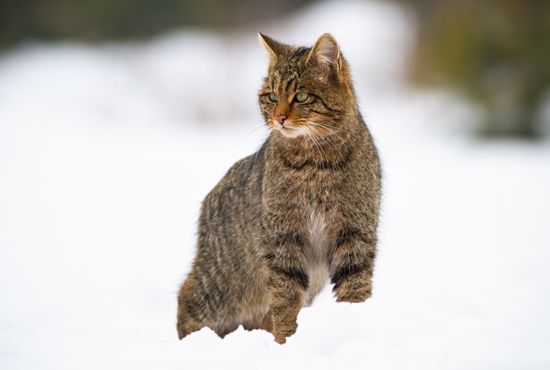
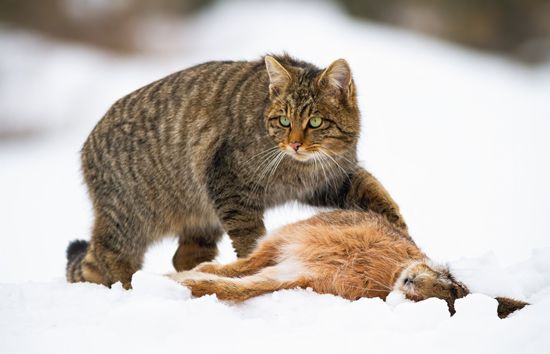
The European wildcat (Felis silvestris silvestris) is generally larger and more robust than the domestic cat. Key physical differences include:
- Body Structure: Wildcats have longer legs and a larger, flatter head compared to their domestic counterparts.2
- Tail: A defining feature of the European wildcat is its full, relatively short tail that ends in a rounded, blunt tip, rather than the pointed tip typically seen in domestic cats. Additionally, the wildcat’s tail is marked by distinct black rings.2
- Coat Pattern: They exhibit a yellowish-gray coat featuring a striped tabby pattern with dark bands.2
Similarly, the African wildcat (Felis silvestris lybica), which is considered the ancestor of the modern house cat, is noted for being somewhat larger and stockier than the average domestic cat. Its coat is typically light or orange-brown with narrow dark stripes. Historically, the wildcat has been described as being stronger and more ferocious than the domestic cat, though these differences are often attributed to their respective environments and lifestyles.84
Sources
- cat - Domestication — Encyclopædia Britannica
- wildcat — Encyclopædia Britannica
- cat - Colors and patterns — Encyclopædia Britannica
- African wildcat — Encyclopædia Britannica
- feline - Evolution and classification — Encyclopædia Britannica
- How long do tigers live? — Encyclopædia Britannica
- Canada lynx - Reproduction and development — Encyclopædia Britannica
- Encyclopædia Britannica First Edition: Cats — Encyclopædia Britannica
Published on · 3 min read