Great Man-Made River
The Great Man-Made River (GMR) project in Libya has faced significant challenges since its inception, primarily centered on the long-term sustainability of…
What challenges has the Great Man-Made River project faced since its inception?
The Great Man-Made River (GMR) project in Libya has faced significant challenges since its inception, primarily centered on the long-term sustainability of its water source.
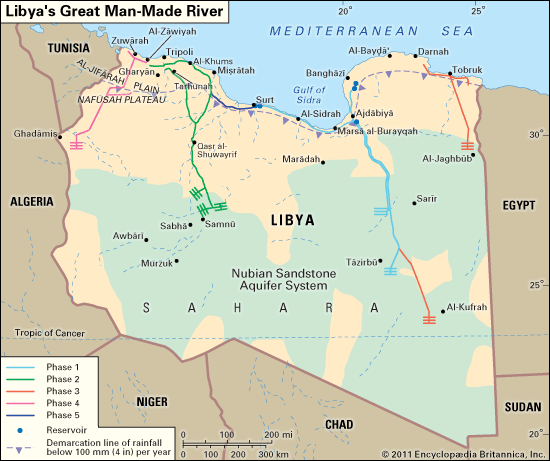
The project relies on the Nubian Sandstone Aquifer System, a vast reservoir of “fossil water” that is between 10,000 and 1,000,000 years old. Because this water is non-rechargeable, it is a finite resource. While some officials have claimed the supply could last for thousands of years, critics argue these projections are greatly overstated, with some suggesting the water may not last through the 21st century. If these underground supplies are depleted, the region will face severe water scarcity unless it develops sufficient desalination infrastructure to compensate for the loss.
Additionally, the project’s development has been subject to the broader political instability of the region, as evidenced by the disruption of planned phases during the 2011 revolt against the Qaddafi regime.
What is the Great Man-Made River project and why was it initiated in Libya?
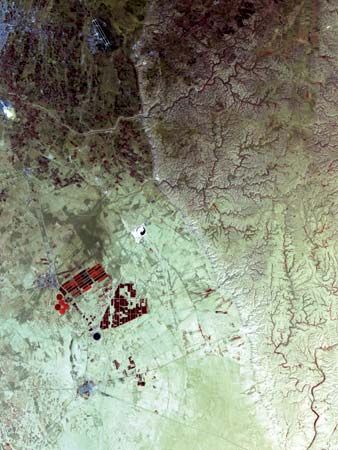
The Great Man-Made River (GMR) is a vast network of pipelines and aqueducts designed to transport high-quality fresh water from ancient underground aquifers in the Sahara to the coast of Libya. Often called the “Eighth Wonder of the World,” it is considered the largest irrigation project globally.1
The project was initiated to address severe water shortages in Libya’s northern populous cities and farming regions. Historically, these areas relied on desalination plants and local, rain-fed aquifers that were rapidly declining. The discovery of the Nubian Sandstone Aquifer System—a massive reservoir of “fossil water”—during oil exploration in the 1950s provided a solution. While the government initially considered desert-based agriculture, they shifted focus in the 1980s to creating a massive pipeline network to deliver this water to the coast for domestic, industrial, and agricultural use.1
What are the main water sources for the Great Man-Made River project?
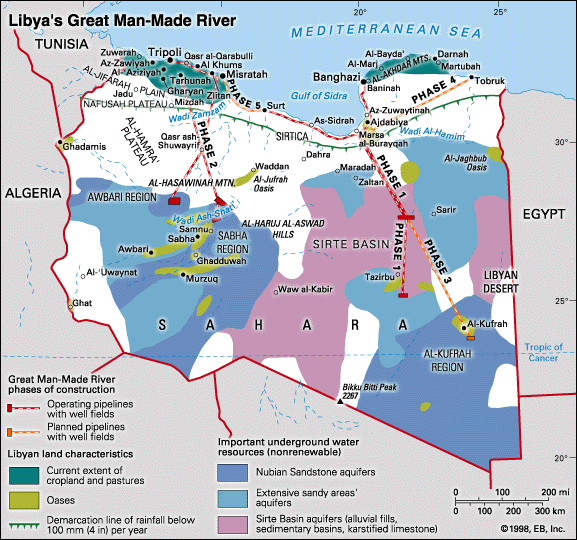
The Great Man-Made River project draws its water from ancient underground aquifers located deep beneath the Sahara in Libya.1
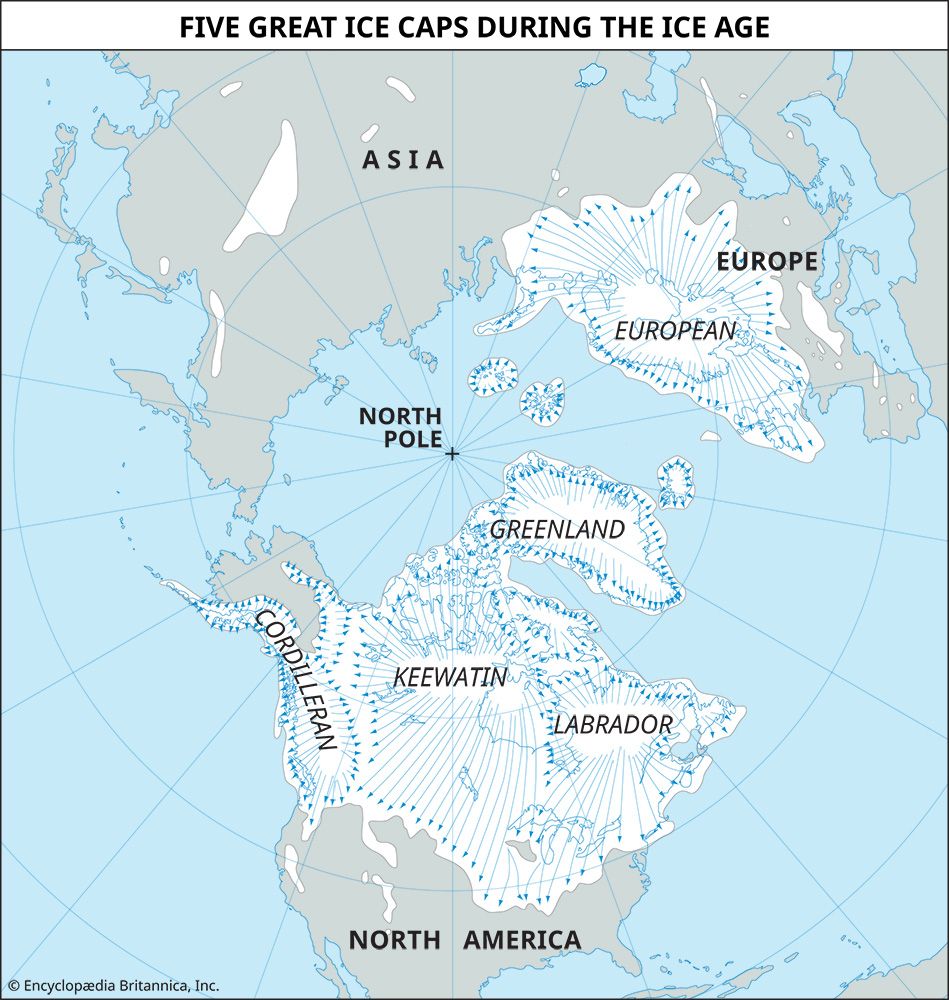
The primary source is the Nubian Sandstone Aquifer System, a massive reservoir of “fossil water” that is between 10,000 and 1,000,000 years old. This water percolated into the sandstone before the end of the last ice age, when the region experienced a more temperate climate. Because this system is not currently being recharged, it is considered a finite resource.15
To access these reserves, the project utilizes hundreds of water wells drilled into specific fields, including:
- Tāzirbū and Sarīr: These fields serve as the primary extraction points for the first phase (GMR 1) of the project, with water pumped from depths of approximately 500 meters (1,650 feet).1
- Jabal al-Ḥasāwinah: This region provides the water supply for the second phase (GMR 2), which serves Tripoli and other western coastal cities.1
- Al-Jaghbūb: This oasis serves as a source for the third phase (GMR 3), specifically supplying the city of Tobruk.1
What materials are used in the construction of the underground pipeline network?
The underground pipeline network for the Great Man-Made River project is constructed primarily using sections of steel-reinforced prestressed concrete.
These pipe sections, which were manufactured in two large factories within Libya, measure 4 meters (13 feet) in diameter and 7 meters (23 feet) in length. During installation, the joints between these sections were sealed using giant rubber O-rings and cement grout to ensure a secure, watertight connection. Additionally, the project utilizes open reservoirs at various distribution nodes, which are excavated from the local soil and rock and lined with asphalt to prevent leakage.1
Sources
- Great Man-Made River — Encyclopædia Britannica
- Libya - Drainage — Encyclopædia Britannica
- Yangtze River - Human impact on the environment — Encyclopædia Britannica
- Ganges River - Environmental issues — Encyclopædia Britannica
- aquifer — Encyclopædia Britannica
- Nile River - Physiography of Nile River — Encyclopædia Britannica
- water supply system - Materials — Encyclopædia Britannica
Published on · 3 min read