Guitarfish
A guitarfish is a type of fish belonging to the order Rhinobatiformes, which is closely related to rays. Depending on the classification system, they are…
What is guitarfish?
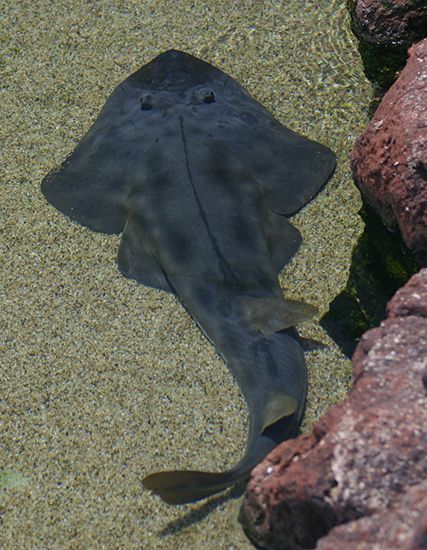
A guitarfish is a type of fish belonging to the order Rhinobatiformes, which is closely related to rays. Depending on the classification system, they are sometimes categorized as a suborder (Rhinobatoidei) within the order Batoidei.12
These creatures possess a unique physical appearance that bridges the gap between rays and sharks. Their forebody is flattened with pectoral fins fused to the sides of the head, while their hindbody resembles that of a shark, featuring two dorsal fins and a well-developed caudal fin.1
Guitarfish can grow up to 2 meters (6 feet) in length and are found in tropical and warm temperate waters globally. They typically inhabit shallow areas, where they move slowly and feed on small fish, crustaceans, and mollusks. Their reproduction is ovoviviparous.1
How do guitarfish differ from stingrays?
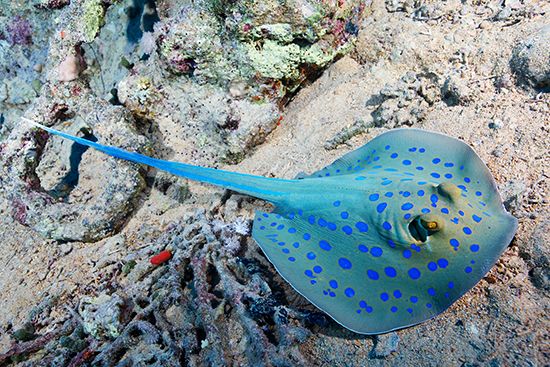
While guitarfish are closely related to rays, they differ significantly from stingrays in their body structure and defensive capabilities.
- Body Shape: Guitarfish possess a unique, intermediate morphology. They have a flattened forebody with pectoral fins fused to the head, but their hindbody resembles that of a shark, featuring two dorsal fins and a well-developed caudal fin. In contrast, stingrays (part of the suborder Myliobatoidei) are characterized by a flattened, disklike body and a long, slender, whiplike tail.12
- Defensive Features: Stingrays are distinguished by a long, whiplike tail that typically bears one or more sharp, saw-edged, venomous spines capable of inflicting serious wounds. Guitarfish lack these specialized venomous barbed spines.21
- Classification: Guitarfish are often classified as a distinct order (Rhinobatiformes), whereas stingrays are a specific group within the order Batoidei.12
What does it mean for a fish to be ovoviviparous?
For a fish, being ovoviviparous means that the female retains fertilized eggs within her body until they hatch, at which point she gives birth to live young.34
Unlike viviparous species, where the developing embryo receives direct nourishment from the mother (often through a placenta), an ovoviviparous embryo relies entirely on the yolk present within its egg for nutrition. In this reproductive strategy, the mother provides the developing young with physical protection, shelter, and oxygen, but she does not provide additional nutrients or excrete metabolic wastes for the embryo.546
This method is a form of live-bearing that offers a survival advantage by reducing the vulnerability of the offspring to predators compared to species that lay eggs externally. Because the young are born at a larger size, they are often better equipped for independent existence immediately upon birth.45
What are some other examples of cartilaginous fish?
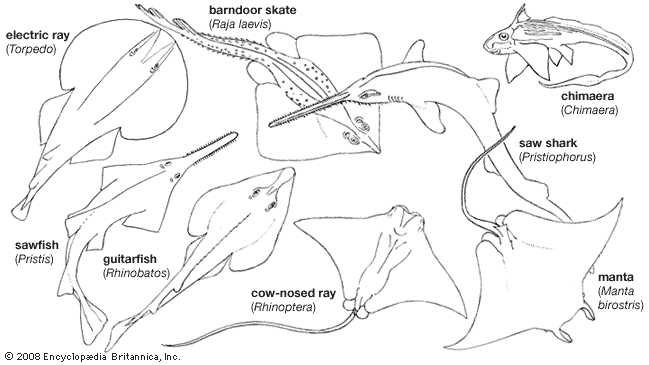
Cartilaginous fishes, which belong to the class Chondrichthyes, are a diverse group characterized by skeletons made of cartilage rather than true bone. Beyond the well-known sharks and rays, this class includes several other fascinating groups:78
- Chimaeras: Also known as ratfishes, rabbit fishes, or elephant fishes, these are distinct from sharks and rays and are placed in the subclass Holocephali. Unlike their relatives, they have a single external gill opening on each side of the body, covered by a flap. They are often found in deep or cold waters and possess unique features like a supplemental clasping organ in males called a tentaculum.98
- Skates: While they share a flattened body shape with rays, skates belong to the suborder Rajoidei. A key difference is their reproductive strategy: unlike most rays, which give birth to live young, skates produce large, oblong eggs encased in leathery shells, often referred to as “mermaid’s purses”.10
- Sawfishes: These are sharklike rays belonging to the family Pristidae. They are easily identified by their elongated, flattened snouts that form a long blade edged with strong teeth, which they use for digging and feeding.210
Sources
- guitarfish — Encyclopædia Britannica
- ray — Encyclopædia Britannica
- Viviparity — Encyclopædia Britannica
- Reproductive behaviour - Fishes — Encyclopædia Britannica
- Animal reproductive system - Provisions for the developing embryo — Encyclopædia Britannica
- How do fish reproduce? — Encyclopædia Britannica
- chondrichthyan — Encyclopædia Britannica
- chimaera — Encyclopædia Britannica
- shark — Encyclopædia Britannica
- sawfish — Encyclopædia Britannica
- fish - Annotated classification — Encyclopædia Britannica
Published on · 3 min read