Sawfish
Sawfish populations face severe threats that have led the International Union for Conservation of Nature (IUCN) to classify all five species as endangered…
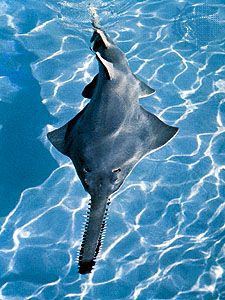
What are some of the biggest threats to sawfish populations today?
Sawfish populations face severe threats that have led the International Union for Conservation of Nature (IUCN) to classify all five species as endangered species. The primary pressures driving their decline include:1
- Commercial Exploitation: Despite a 2007 ban on international trade, sawfish parts remain highly sought after. Their fins are prized in the shark fin trade, while their toothed rostrums (saws) are sold as souvenirs, religious items, or traditional remedies. Additionally, they are fished in some regions for food, oil, and skin.21
- Incidental Capture: Sawfish are frequently threatened by accidental entanglement in commercial fishing gear.2
- Habitat Loss and Degradation: As bottom dwellers that frequent bays, estuaries, and rivers, they are highly vulnerable to habitat degradation.12
- Industrial Expansion: Activities such as offshore oil and gas exploration and the general expansion of commercial fishing operations further encroach upon their remaining environments.2
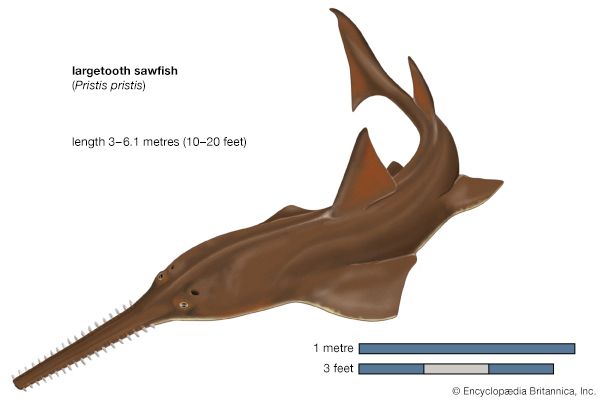
How do sawfish use their distinctive saw-like rostrum in their daily lives?
The sawfish’s distinctive rostrum, or “saw,” is a versatile tool that plays a critical role in its daily survival. Constituting up to one-third of the animal’s total length, this elongated snout is used for several essential activities:
- Feeding and Hunting: Sawfish use their rostrums to dig through the substrate to uncover bottom-dwelling animals. When hunting, they lash the saw about to kill or maim schooling fish, making them easier to capture.1
- Sensory Detection: The rostrum is equipped with specialized sensory organs called ampullae of Lorenzini. These electroreceptors allow the sawfish to detect the minute electrical potentials generated by the muscle contractions of prey, even when those prey are buried in sand or mud.134
- Navigation: In addition to detecting prey, these electroreceptors can sense Earth’s magnetic field, which assists the sawfish in migration.1
While these structures are formidable, they are primarily functional tools for feeding and environmental awareness rather than weapons of aggression toward humans.1
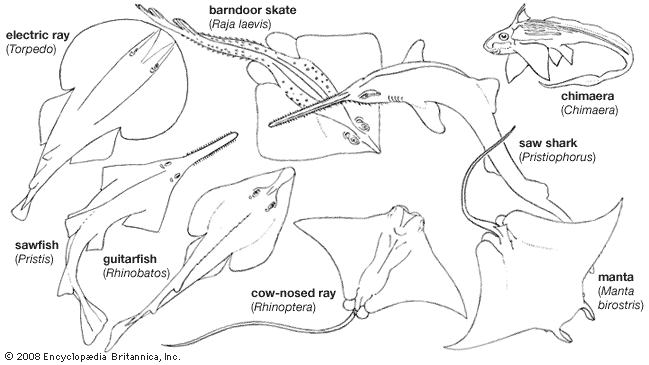
What role do sawfish play in their ecosystem, and how does their decline impact other marine species?
Sawfish (family Pristidae) are specialized bottom-dwelling rays that occupy a unique ecological niche in shallow tropical and subtropical waters, including bays, estuaries, and rivers.1
As predators, they utilize their elongated, tooth-edged rostrums to dig for bottom-dwelling animals and to stun or maim schooling fish. By acting as both a predator of small fish and a disturber of the substrate, they help regulate the populations of their prey and influence the physical structure of the benthic environment.12
The decline of sawfish—all five species of which are classified as endangered species by the IUCN—threatens to disrupt these ecological interactions. While the specific cascading effects of their removal on other marine species are not detailed in the available data, the loss of such specialized predators generally risks destabilizing the food webs they inhabit. Their disappearance is primarily driven by human activities, including commercial fishing, habitat degradation, and the illegal trade of their parts.15
How do sawfish reproduce, and what challenges do they face in maintaining their population?
Sawfish are ovoviviparous animals, meaning their eggs develop and hatch within the female’s body, resulting in live births. A typical litter consists of about eight young. These rays reach sexual maturity at age 10 and have a lifespan of 25–30 years. Notably, the smalltooth sawfish has demonstrated the ability to reproduce via parthenogenesis, a process where an unfertilized egg develops into an embryo, making them one of the few vertebrate groups capable of this in the wild.1
Despite these reproductive strategies, all five sawfish species are classified as endangered species by the IUCN, with several considered critically endangered. They face significant survival challenges, including:1
- Human Exploitation: They are targeted for their oil, skins, and fins, which are highly valued in the shark fin trade.12
- Incidental Threats: They frequently suffer from accidental entanglement in fishing gear.2
- Environmental Pressures: Habitat degradation, the expansion of commercial fishing, and offshore oil and gas exploration further threaten their populations.2
Sources
- sawfish — Encyclopædia Britannica
- 10 Critically Endangered Animals of India - Narrow sawfish ( Anoxypristis cuspidata ) — Encyclopædia Britannica
- Electroreception — Encyclopædia Britannica
- Mechanoreception - Ampullary lateral-line organs ( electroreceptors ) — Encyclopædia Britannica
- chondrichthyan - Sharks — Encyclopædia Britannica
Published on · 3 min read