Shark
Sharks possess a highly sophisticated sensory system that allows them to thrive as predators. While their sense of smell is often the primary tool for…
How do sharks’ senses, like electroreception, help them hunt and navigate?
Sharks possess a highly sophisticated sensory system that allows them to thrive as predators. While their sense of smell is often the primary tool for locating prey from a distance, they rely on a suite of integrated senses to hunt and navigate effectively.123
A key component of this system is electroreception, facilitated by specialized organs called the ampullae of Lorenzini. These organs consist of a network of gel-filled canals located primarily on the shark’s head and snout. They are incredibly sensitive, capable of detecting the weak bioelectric fields generated by the muscles and gills of prey, even when the prey is buried under sand. This ability is particularly vital for hunting in murky or dark waters where vision is limited, often serving as the final sensory input used to guide a shark toward its target just before capture.1453
In addition to electroreception, sharks utilize:
- Lateral line system: Detects low-frequency vibrations and pressure changes in the water.12
- Hearing: Highly sensitive to low-frequency sounds, aiding in long-distance orientation.13
- Vision: Adapted for various light conditions to help distinguish the size and shape of objects.13

What are some of the most common shark species, and where are they typically found?
There are more than 530 living species of sharks, ranging from harmless plankton-feeders to apex predators found in diverse marine environments worldwide. Below are some of the most common and notable species and their typical habitats:6
- White Shark: These apex predators are primarily found in productive temperate coastal waters, such as off the coasts of the United States, Chile, Japan, Australia, New Zealand, southern Africa, and the Mediterranean. While they are often associated with these feeding grounds, some individuals travel long distances across open oceans.768
- Bull Shark: Known for their ability to enter fresh water, these sharks inhabit shallow coastal lagoons, estuaries, and harbors in tropical and subtropical regions. They have been documented far up major river systems, including the Amazon and the Zambezi.9
- Tiger Shark: These are found worldwide in warm oceans, ranging from nearshore coastal waters to the open sea.10
- Hammerhead Shark: These distinctive sharks are widely distributed in tropical and temperate marine waters, typically near coasts and above continental shelves.11
- Sand Tiger Shark: These frequent inshore habitats in tropical and temperate oceans worldwide, including the Atlantic, Mediterranean, Indian, and Pacific oceans.12

How do different shark species vary in size, from the smallest to the largest?
Shark species exhibit a vast range in size, from small, specialized hunters to the largest fish in the ocean. This variation is often linked to their ecological roles and feeding strategies.
Size Extremes
- The Largest: The whale shark (Rhincodon typus) is the largest living fish, capable of reaching lengths of about 18 metres (59 feet). Other giants include the basking shark, which can grow to 14 metres (46 feet), and the megamouth shark. These species are filter feeders that strain plankton from the water.15616
- The Smallest: While many sharks are large, others are quite small. For example, some species within the carcharhinid family, such as certain reef-dwelling sharks, are significantly smaller, with some species measuring as little as 1.5 metres (4.9 feet) in length.17
Size Variation Among Predatory Species
Predatory sharks also show significant size diversity based on their hunting habits:
- Large Predators: The white shark is a formidable predator that can reach 6 metres (20 feet) in length.6
- Mid-sized Species: Many common sharks, such as the bull shark and lemon shark, typically grow to about 3.5 metres (11.5 feet).17
- Sand Sharks: Species in the sand tiger shark family range from approximately 2.2 to 4.5 metres (7.2 to 14.8 feet) depending on the specific species.5
Because larger sharks often prey on smaller ones, many species practice size-based segregation to survive, often traveling in groups composed of individuals of similar size.316
What are the key characteristics that distinguish sharks from other fish?
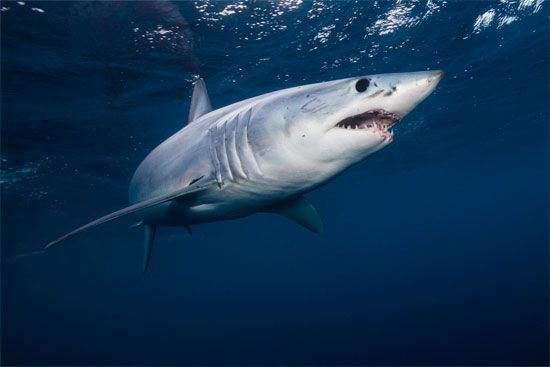
Sharks belong to the class Chondrichthyes, a group of cartilaginous fishes that possess several distinct anatomical features that differentiate them from bony fishes:
- Skeleton: Unlike bony fish, the shark skeleton is composed entirely of cartilage rather than true bone, though it may be calcified in certain areas like the vertebrae.18
- Gills: Sharks have five to seven external gill clefts on each side of the head, which are covered by flaps of skin. In contrast, bony fish typically have a single gill opening protected by a bony cover called an operculum.186
- Buoyancy: Sharks lack a swim bladder, the gas-filled organ used by most bony fish to maintain buoyancy. Consequently, sharks must rely on other mechanisms to control their depth.196
- Skin and Scales: Shark skin is covered in dermal denticles—structurally minute, tooth-like scales that do not grow throughout the animal’s life. Instead, new scales form between existing ones as the shark grows.18
- Teeth: Shark teeth are not firmly attached to the jaw but are embedded in a fibrous membrane. They are arranged in rows and are continuously replaced as they become worn or lost.18
- Reproduction: Sharks utilize internal fertilization, with males using specialized pelvic fin structures called claspers to transfer sperm to the female.1820
Sources
- chondrichthyan - Senses — Encyclopædia Britannica
- ampulla of Lorenzini — Encyclopædia Britannica
- chondrichthyan - Sharks — Encyclopædia Britannica
- Electroreception — Encyclopædia Britannica
- shark - Shark behaviour — Encyclopædia Britannica
- shark - Description and habits — Encyclopædia Britannica
- bull shark — Encyclopædia Britannica
- hammerhead shark — Encyclopædia Britannica
- chondrichthyan - Danger to human life — Encyclopædia Britannica
- white shark - Distribution — Encyclopædia Britannica
- shark — Encyclopædia Britannica
- tiger shark — Encyclopædia Britannica
- sand tiger shark — Encyclopædia Britannica
- white shark - Social behavior — Encyclopædia Britannica
- whale shark — Encyclopædia Britannica
- sand shark — Encyclopædia Britannica
- carcharhinid — Encyclopædia Britannica
- chondrichthyan - Distinguishing features — Encyclopædia Britannica
- Chemoreception - Fish — Encyclopædia Britannica
- muscle - Jawed fishes — Encyclopædia Britannica
- swim bladder — Encyclopædia Britannica
- fish - The respiratory system — Encyclopædia Britannica
Published on · 4 min read