Great Auk
The great auk (Pinguinus impennis) was a flightless seabird whose inability to fly significantly contributed to its vulnerability and eventual extinction in…
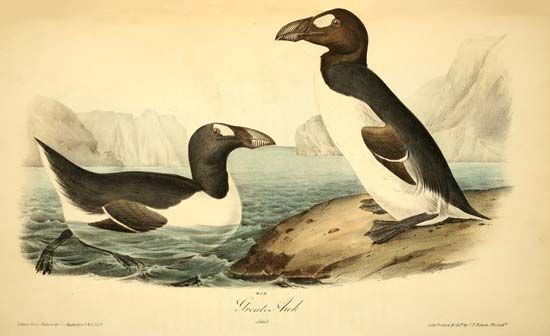
How did the great auk’s inability to fly affect its survival?
The great auk (Pinguinus impennis) was a flightless seabird whose inability to fly significantly contributed to its vulnerability and eventual extinction in 1844. Because the birds could not fly, they were unable to escape from human predators when they gathered in large, accessible colonies on rocky islands in the North Atlantic.12
This physical limitation made them “utterly defenseless” against hunters. Sailors and other exploiters took advantage of this by driving the birds up planks and directly into the holds of vessels to be slaughtered for food, bait, and the feather trade. Their inability to take flight meant they could not retreat to safer areas, leaving them entirely exposed to the “rapacious” and unthinking exploitation that decimated their populations.123
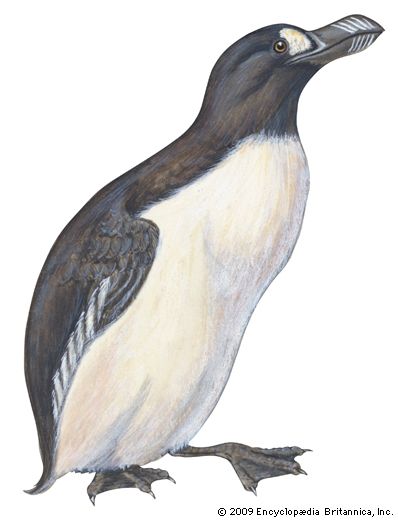
Where did the great auk live, and what was its habitat like?
The great auk (Pinguinus impennis) was a flightless seabird that inhabited the Arctic, subarctic, and north temperate regions of the North Atlantic.14
Habitat and Distribution
The great auk was highly specialized for a life at sea, relying entirely on the ocean for its diet of fish, crustaceans, mollusks, and plankton. Its habitat requirements included:4
- Breeding Grounds: These birds nested in large, dense colonies on rocky islands. Known breeding locations included St. Kilda, the Faroe Islands, Iceland, and Funk Island off the coast of Newfoundland.1
- Geographic Range: While their breeding was restricted to specific rocky islands, subfossil remains indicate that their historical range extended as far south as Florida, Spain, and Italy.1
- Nesting Environment: Like other members of the Alcidae family, they preferred nesting on cliff ledges and in rock crevices adjacent to the sea.4
Standing erect on land, the great auk was physically adapted for swimming underwater rather than flight, making it a creature defined by its deep connection to the North Atlantic marine environment.14
When did the great auk become extinct, and what were the main factors leading to its extinction?
The great auk (Pinguinus impennis) became extinct in 1844, with the last known specimens killed in June of that year on Eldey island, Iceland.13
The extinction of this flightless seabird was primarily driven by human exploitation. Key factors included:
- Direct Exploitation: Great auks were hunted in enormous numbers for food and bait. Because they were flightless and gathered in large, accessible colonies on rocky islands, they were “utterly defenseless” against human predators.13
- Methods of Capture: Sailors frequently exploited the birds’ inability to fly by driving them up planks and slaughtering them directly into the holds of vessels.13
- Commercial Trade: Beyond their use as food and bait, the birds were later targeted for the feather trade, which further decimated their populations.2
- Museum Collection: The final known individuals were killed specifically to be preserved for museum collections, marking the end of the species.13
While environmental changes occurred during the Little Ice Age, the species’ demise is most directly linked to this unthinking and rapacious human exploitation.23
How has the extinction of the great auk impacted scientific understanding of seabird conservation?
The extinction of the great auk served as a profound wake-up call for the scientific community and the public regarding the vulnerability of colonial nesting birds. Its rapid disappearance due to rapacious human exploitation demonstrated that even abundant species could be driven to extinction when their breeding grounds are targeted without restraint.13
This loss helped catalyze a shift in conservation ethics. The realization that unregulated harvesting—whether for food, bait, or the feather trade—could permanently erase a species contributed to the rise of organized public opinion and the formation of groups like the Audubon societies. These movements were instrumental in securing legal protections for other vulnerable species, such as gulls and terns, which faced similar threats in the late 19th century.3
Ultimately, the great auk’s fate underscored the necessity of managing natural resources with regard for the future of colonies, a principle now central to modern ecology and wildlife management.3
Sources
- Great auk — Encyclopædia Britannica
- 6 Animals We Ate Into Extinction — Encyclopædia Britannica
- Charadriiform - Importance to humans — Encyclopædia Britannica
- Auk — Encyclopædia Britannica
- Little Ice Age — Encyclopædia Britannica
Published on · 3 min read