Halfbeak
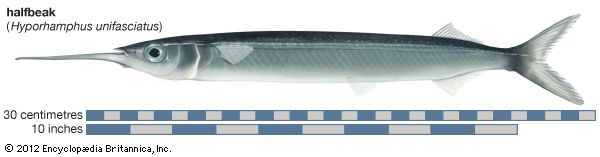
A halfbeak is any of approximately 70 species of marine and freshwater fish belonging to the family Hemiramphidae.
What is halfbeak?
A halfbeak is any of approximately 70 species of marine and freshwater fish belonging to the family Hemiramphidae.1
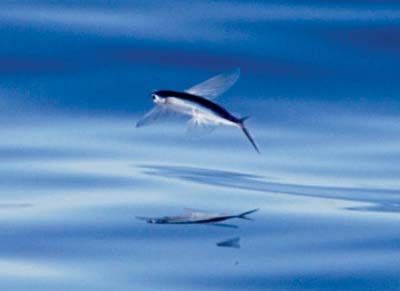
These fish are characterized by their distinct, asymmetrical jaws: the upper jaw is short and triangular, while the lower jaw is elongated, slim, and beaklike. Generally slender and silvery in appearance, they can reach lengths of up to 45 cm (18 inches). Halfbeaks are known for their ability to skip across the water’s surface to evade predators, and certain species are capable of making short, gliding flights similar to those of the related flying fish. While most halfbeaks are egg layers, some species are known to bear live young.12
How do halfbeaks use their unique jaws to feed?
The provided search results do not contain information regarding how halfbeaks specifically use their unique jaw structure to feed. While the sources describe the physical appearance of the halfbeak and the general function of jaws in vertebrates, they do not detail the feeding mechanics of this specific family.
What makes halfbeaks similar to flying fish?
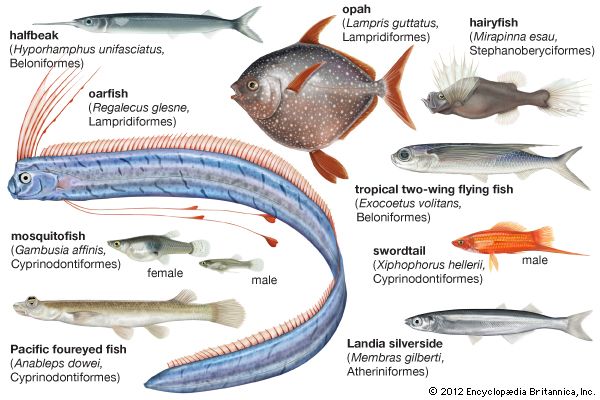
Halfbeaks are closely related to flying fish, and they share several key similarities in their biology and behavior:
- Surface-Dwelling Habit: Both are surface-dwelling fish of the open ocean that have evolved to escape predators by leaping or skipping across the water’s surface.16
- Locomotion: The origin of the “flying” habit seen in flying fish can be traced through their relatives, including halfbeaks. Both groups possess an asymmetrical tail fin, where the lower lobe is longer than the upper lobe; this allows the fish to use the lower lobe to “scull” against the water to gain speed and propel themselves while the rest of their body is airborne.6
- Evolutionary Classification: Both belong to the order Atheriniformes. Depending on the classification system used, they are sometimes grouped together within the family Exocoetidae, or halfbeaks are placed in their own distinct family, Hemiramphidae.172
- Physical Adaptations: While flying fish have evolved highly specialized, winglike pectoral and pelvic fins for gliding, halfbeaks represent a stage in this evolutionary trajectory, demonstrating the ability to make short, gliding flights similar to their more specialized relatives.16
How do halfbeaks protect themselves from predators?
Halfbeaks protect themselves primarily through their agility at the water’s surface. When threatened by predators, these fish are capable of skipping across the surface of the water to escape danger. Furthermore, some species of halfbeaks have evolved the ability to perform short, gliding flights, a behavior that mirrors the more specialized defensive maneuvers of their relatives, the flying fish.1
Sources
- halfbeak — Encyclopædia Britannica
- halfbeak — Merriam-Webster
- Gymnophiona - Annotated classification — Encyclopædia Britannica
- scorpion - Distinguishing taxonomic features — Encyclopædia Britannica
- jaw — Encyclopædia Britannica
- atheriniform - Annotated classification — Encyclopædia Britannica
- atheriniform - Natural history — Encyclopædia Britannica
- Locomotion - Soaring — Encyclopædia Britannica
Published on · 2 min read