Han River
The Han River in China, a major tributary of the Yangtze River, is fed by numerous streams that significantly influence its flow and management.
What are the main tributaries of the Han River, and how do they contribute to its flow?
The Han River in China, a major tributary of the Yangtze River, is fed by numerous streams that significantly influence its flow and management.
Key Tributaries
- Xun River: Identified as the largest tributary in the river’s upper reaches, it joins the Han from the north.1
- Baishui River: This is the largest tributary in the lower course, joining the Han at Xiangfan.1
- Dan River: A significant tributary that joins the Han at Jun Xian.1
- Tang and Bai Rivers: These rivers originate in the southwest and drain into the Han River after flowing through Hubei province.2
Contribution to Flow and Management
These tributaries contribute to the river’s volume, but their impact is often managed through infrastructure to mitigate the risk of flooding in the flat, low-lying regions of the lower course. For instance, a dam at the confluence with the Dan River stabilizes water flow and supports irrigation. Similarly, a large retention basin was constructed at the confluence with the Baishui River to accumulate floodwaters and regulate the Han’s flow.1
How has the Han River been represented in Korean art, literature, and popular culture?
The provided search results do not contain information regarding the representation of the Han River in Korean art, literature, or popular culture. The available data focuses on the river’s geography, its historical role as a transportation and strategic route during the Joseon dynasty, and its modern significance to the urban development of Seoul.
How did the Han River play a role during the Korean War?
During the Korean War, the Han River served as a critical geographic feature and defensive barrier. Following the North Korean invasion in June 1950 and the subsequent fall of Seoul on June 28, remnants of the South Korean army (ROKA) established a defensive line south of the river to prevent a total collapse of their forces.1
The river remained a focal point of military movement throughout the conflict:
- Strategic Maneuvers: As the war progressed, the river valley became a site of significant troop movements. In January 1951, after the Chinese Third Offensive resulted in the loss of Seoul, United Nations Command forces under Lieutenant General Matthew B. Ridgway pushed back to the Han River valley to regroup and counterattack.5
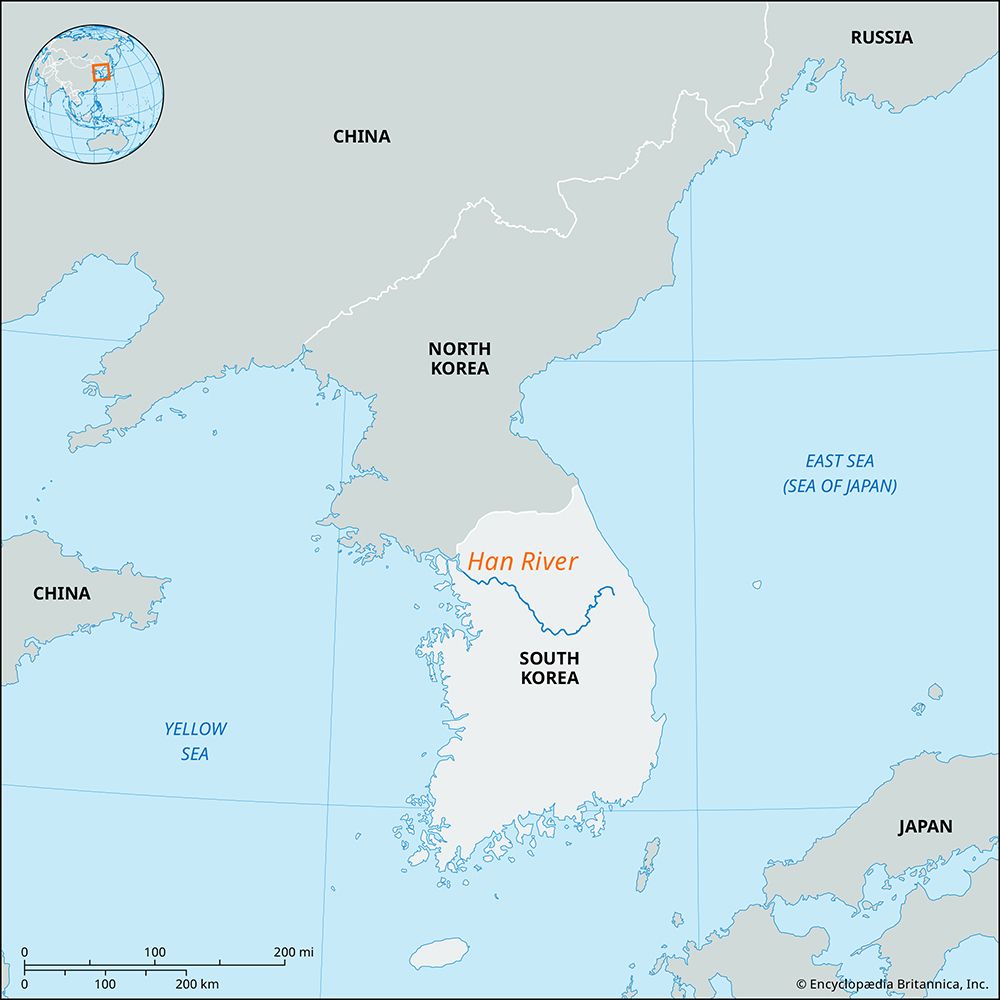
- Demarcation: Following the stalemate and the eventual armistice, the Han River’s mouth on the west coast became the starting point for the demilitarized zone (DMZ), which stretches across the peninsula to the east coast.6
How does the Han River contribute to South Korea’s water resources and hydroelectric power generation?
The Han River in South Korea is a vital resource for the nation, providing essential water supplies for both industrial and general use to the cities located along its course.1
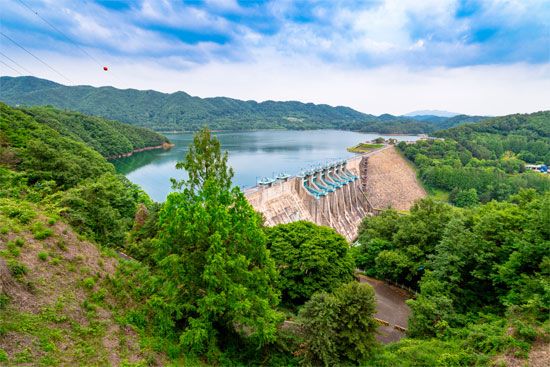
To support energy needs, the river’s upper course, situated in the mountainous regions, is utilized for hydroelectric power generation. Furthermore, the development of multipurpose dams in the late 20th century—specifically at Yeongwol, Chungju, Soyang, and Yeoju—has significantly enhanced the river’s capacity to manage water resources and generate electricity.1
Please note that your query regarding the Han River refers to the South Korean waterway; the search results also provided information on a separate river of the same name in China, which is a major tributary of the Yangtze River and serves different regional irrigation and power needs.2
Sources
- Han River — Encyclopædia Britannica
- Han River — Encyclopædia Britannica
- Henan - Drainage — Encyclopædia Britannica
- Seoul - City site — Encyclopædia Britannica
- Korean War - South to Pusan — Encyclopædia Britannica
- Korean War - Back to the 38th parallel — Encyclopædia Britannica
- 38th parallel — Encyclopædia Britannica
Published on · 3 min read