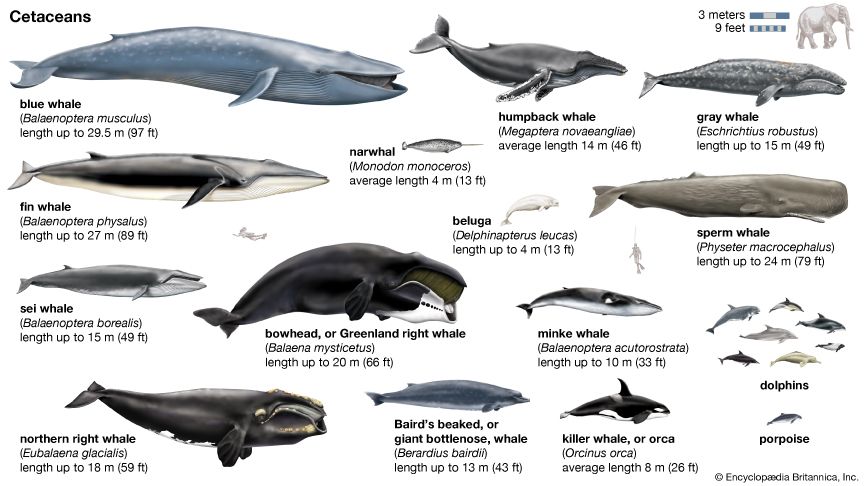
Killer Whale
Killer whales (Orcinus orca) are classified as mammals because they possess the defining biological characteristics of the class Mammalia. Despite their…
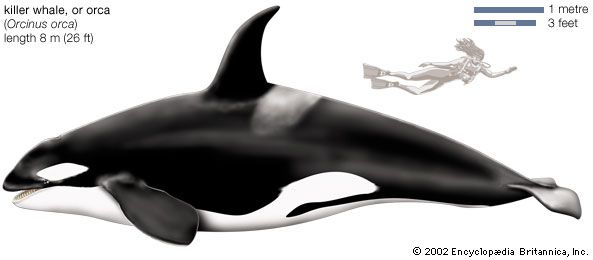
What are the defining characteristics of killer whales that classify them as mammals?
Killer whales (Orcinus orca) are classified as mammals because they possess the defining biological characteristics of the class Mammalia. Despite their aquatic lifestyle, they share several key traits with terrestrial mammals:12
- Respiration: They breathe air and must surface regularly to do so, exhaling through a blowhole.2
- Reproduction: They are viviparous, meaning they give birth to live young rather than laying eggs.12
- Nourishment: Mothers possess mammary glands and suckle their young with nutrient-rich milk.12
- Thermoregulation: They are warm-blooded and maintain their body temperature despite the thermal conductivity of the ocean.2
- Hair: While hair is largely absent in adult whales, it is present during their fetal stage and persists as isolated whiskers near the mouth and blowhole in some species.12
These features, combined with their internal anatomy—such as a muscular diaphragm and a specific middle ear structure—firmly establish their classification within the mammalian group.1
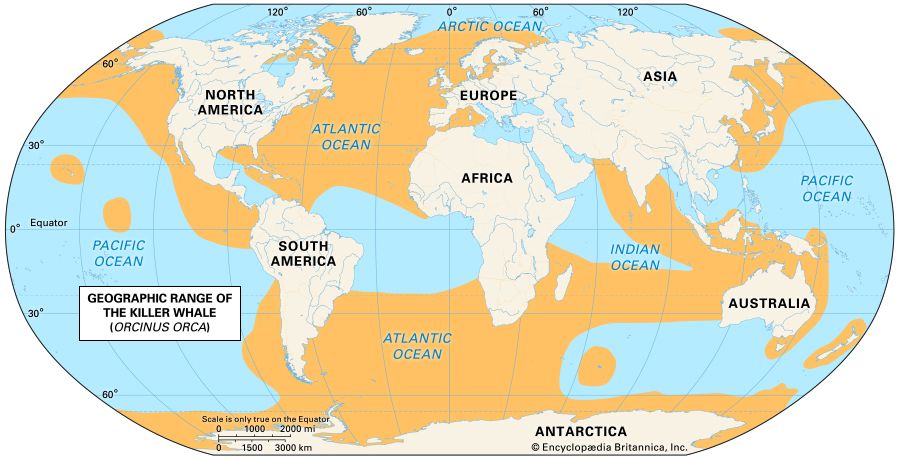
How do killer whales communicate and use echolocation?
Killer whales (Orcinus orca), like other toothed whales, rely on sophisticated sound production to navigate, hunt, and communicate within their social pods.56
Sound Production
Unlike baleen whales, which use their larynx to sing, toothed whales produce sound by passing air through nasal passages located beneath the blowhole. They utilize vibrating tissues known as phonic lips to generate high-pitched clicks, whistles, and pulsed calls. These sounds are then focused through the melon, a fatty organ on the forehead that acts as an acoustic lens, projecting the sound into the water.5
Echolocation
Killer whales use echolocation to perceive their environment, particularly for feeding and navigation. By emitting high-frequency clicks—often reaching up to 150 kilohertz—they can detect objects and prey. When these sound waves strike an object, they bounce back as echoes, which are received by the whale through an acoustic window in the lower jaw and transmitted to the inner ear. This process allows them to determine the size, distance, and properties of targets.6752

What are the primary prey species for killer whales, and how do their hunting techniques vary?
Killer whales (Orcinus orca) are highly adaptable carnivores with diets that vary significantly depending on their population and geographic location. Their primary prey species include fish—most notably salmon—as well as seals, sea lions, squids, penguins, porpoises, and even other whales.28
Hunting Techniques
Killer whales are active hunters that use their teeth to grasp and hold prey rather than chew it. Their hunting strategies are often specialized based on their social structure and target species:89
- Cooperative Hunting: Killer whales frequently hunt in groups, or pods, to herd prey and concentrate them into a smaller volume, making them easier to capture.9
- Acoustic Stun: Biologists believe that some toothed whales, including killer whales, may use high-energy bursts of sound to stun their prey before consuming them.9
- Physical Force: When prey is too large to be swallowed whole, killer whales use their immense jaw strength to rip it into smaller, manageable chunks. For example, they have been observed grabbing seals and shaking them violently until the bodies come apart.9
What adaptations do killer whales have for living in marine environments?
Killer whales (Orcinus orca) possess several specialized adaptations that allow them to thrive in diverse marine environments, from polar regions to the equator.10
Thermoregulation and Body Structure
To survive in cold water, which conducts heat much faster than air, killer whales utilize a thick layer of blubber—a fat-rich dermis that acts as insulation. They also employ countercurrent blood exchange, a mechanism that allows them to either conserve heat by warming blood returning to the heart or dissipate excess heat by shunting blood to the surface of the skin. Their streamlined body shape and reduced external appendages further facilitate efficient locomotion through water.211
Diving and Circulation
Like other cetaceans, killer whales have evolved to handle the pressures of deep diving. They possess elastic chest cavities that prevent lung collapse and specialized reservoirs of oxygenated blood called the rete mirabile. These networks allow the whale to isolate circulation to skeletal muscles during dives, prioritizing oxygen delivery to the heart and brain.212
Sensory Adaptations
Killer whales have converted their ears to a fully aquatic system. The external ear opening is reduced to a minute size, and sound vibrations are transmitted through the tissues of the head to the inner ear, enabling them to use echolocation for navigation and hunting.11
Sources
- mammal — Encyclopædia Britannica
- killer whale — Encyclopædia Britannica
- whale — Encyclopædia Britannica
- killer whale — Merriam-Webster
- cetacean - Sound production and communication — Encyclopædia Britannica
- whale vocalization — Encyclopædia Britannica
- seawater - Acoustic properties — Encyclopædia Britannica
- What do whales eat? — Encyclopædia Britannica
- cetacean - Feeding — Encyclopædia Britannica
- cetacean - Circulation and thermoregulation — Encyclopædia Britannica
- Biosphere - Salinity — Encyclopædia Britannica
- chondrichthyan - Salt and water balance — Encyclopædia Britannica
- sound reception - Marine mammals — Encyclopædia Britannica
- thoracic squeeze — Encyclopædia Britannica
- cetacean - Breathing and diving — Encyclopædia Britannica
Published on · 4 min read