Homo Heidelbergensis
Homo heidelbergensis is associated with the Acheulean industry, a tradition of stone toolmaking that spanned a significant portion of the Paleolithic Period.…
What types of tools and technology were associated with Homo heidelbergensis?
Homo heidelbergensis is associated with the Acheulean industry, a tradition of stone toolmaking that spanned a significant portion of the Paleolithic Period. This industry is characterized by the production of standardized, bifacial implements, most notably hand axes and cleavers.123
As toolmaking techniques evolved, these implements became increasingly refined. While early tools were often produced using a stone-on-stone technique, later advancements involved the use of bone or wood “hammers” to create sharper, straighter edges and more symmetrical forms. In addition to these primary bifaces, the tool kits of this period included various flake tools, such as side-scrapers and knives, which were essential for tasks like butchering, scraping, and working wood, bone, or horn.1234
Furthermore, evidence suggests that H. heidelbergensis utilized fire, which likely played a role in food preparation and potentially in the modification of natural materials, such as hardening wooden spear points.54
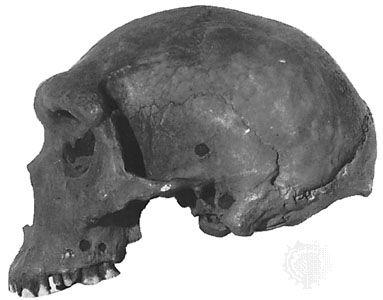
What are the key physical characteristics of Homo heidelbergensis?
Homo heidelbergensis was an archaic human species characterized by a blend of primitive and more modern features. Key physical traits include:
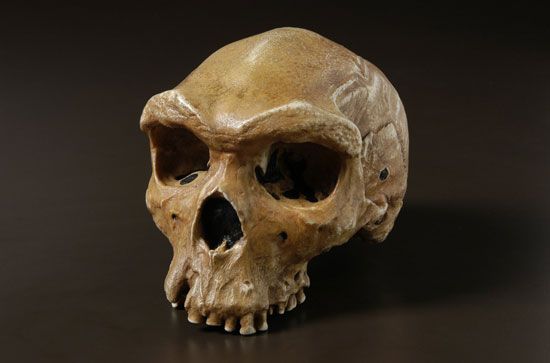
- Skull and Braincase: These individuals possessed a long, low braincase with thick vault bones, similar to H. erectus. However, their braincases were generally larger than those of H. erectus. As the brain expanded, the skull developed more modern features, including a broadened forehead, expanded sides (parietals), and a more rounded rear (occipital).10
- Brow Ridges: A defining feature of the craniums is the presence of massive brow ridges.10
- Jaw and Teeth: The Heidelberg jaw is notably thick, broad, and lacks a chin. Its length suggests the individual had a projecting lower face. Despite the massive size of the mandible, the teeth are surprisingly small.10
Unlike Neanderthals, H. heidelbergensis lacked the unique specializations that define that species, leading many researchers to view them as a common ancestor to both Neanderthals and modern H. sapiens.10
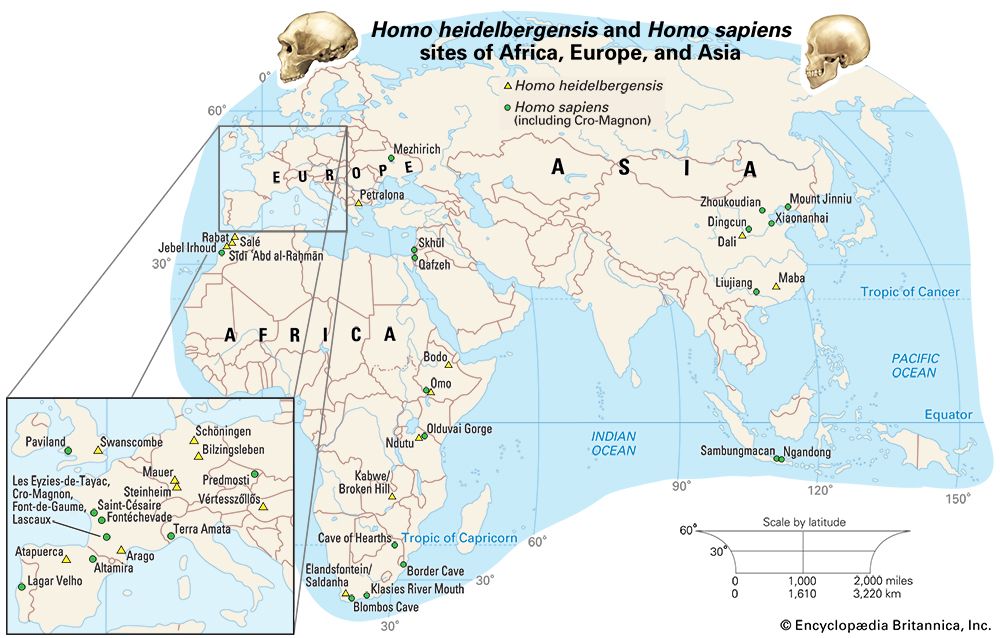
What is the evolutionary relationship between Homo heidelbergensis and modern humans?
Many researchers consider Homo heidelbergensis to be the common ancestor of both Neanderthals and modern humans. Within this taxonomic framework, the transition from H. heidelbergensis to modern H. sapiens is believed to have occurred in Africa prior to 300,000 years ago.10
The evolutionary path is complex, and paleoanthropologists hold varying views on the exact lineage. Some theories suggest H. heidelbergensis may have arisen from earlier species such as H. ergaster, H. erectus, or H. antecessor. While some experts propose that H. antecessor was a direct ancestor of H. neanderthalensis via H. heidelbergensis, others emphasize that the fossil record does not provide a definitive resolution for how H. sapiens emerged.12
Current scientific consensus, supported by genetic data, largely favors the “out of Africa” model, which posits that H. sapiens evolved in Africa before migrating to populate the rest of the world, replacing other archaic hominin populations.12
How does Homo heidelbergensis compare in size and strength to modern humans?
Homo heidelbergensis was a physically robust species compared to modern humans, reflecting a life of significant physical demands. While they shared the ability to walk upright efficiently, their skeletal structure differed from that of modern Homo sapiens in several key ways:
- Stature and Build: H. heidelbergensis possessed a stocky, robust build. Their pelvises were broad with ilia that flared out to the sides, a feature that helped stabilize the pelvis in a stocky bipedal frame and accommodated a wider birth canal.10
- Brain Size: These hominins had notably larger brains than their predecessors, with an estimated average capacity of approximately 1,200 grams (2.65 pounds). This is smaller than the average for modern humans (1,350 cubic cm), though modern human brain size varies significantly, typically ranging from 1,000 to 2,000 cubic cm.1013
- Skull and Jaw: Their skulls were characterized by thick vault bones and massive brow ridges. The jaw was exceptionally thick, broad, and lacked the chin development seen in modern humans.11
In contrast, modern humans are characterized by a more homogeneous morphology, including a lighter, less robust skeleton and the presence of a distinct chin.11
Sources
- Acheulean industry — Encyclopædia Britannica
- Stone Age - Lower Paleolithic — Encyclopædia Britannica
- human evolution - Reduction in tooth size — Encyclopædia Britannica
- human evolution - Refinements in hand structure — Encyclopædia Britannica
- Stone tool industry — Encyclopædia Britannica
- hand tool - The Acheulean industry — Encyclopædia Britannica
- Homo — Encyclopædia Britannica
- Homo erectus - Behavioral inferences — Encyclopædia Britannica
- Homo habilis - Behavioral inferences — Encyclopædia Britannica
- Homo heidelbergensis — Encyclopædia Britannica
- Steinheim skull — Encyclopædia Britannica
- human evolution - The emergence of Homo sapiens — Encyclopædia Britannica
- human evolution - The fossil evidence — Encyclopædia Britannica
- Homo erectus - Body structure — Encyclopædia Britannica
Published on · 3 min read