Steinheim Skull
The Steinheim skull is a significant human fossil discovered in 1933 near the Murr River in Germany. Dated to approximately 350,000 years ago, the specimen…
What is Steinheim skull?
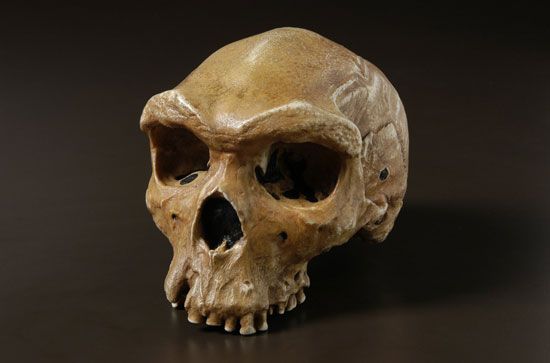
The Steinheim skull is a significant human fossil discovered in 1933 near the Murr River in Germany. Dated to approximately 350,000 years ago, the specimen was found alongside the remains of elephants and rhinoceroses.1
The skull features an estimated cranial capacity of 1,100 cc (67 cubic inches), a long, slightly flattened shape, moderately heavy browridges, and a rounded rear. Notably, these physical traits fall within the normal range of variation observed in modern humans. Scientists typically classify the Steinheim specimen as an archaic Homo sapiens or as Homo heidelbergensis.1
What is Homo heidelbergensis?
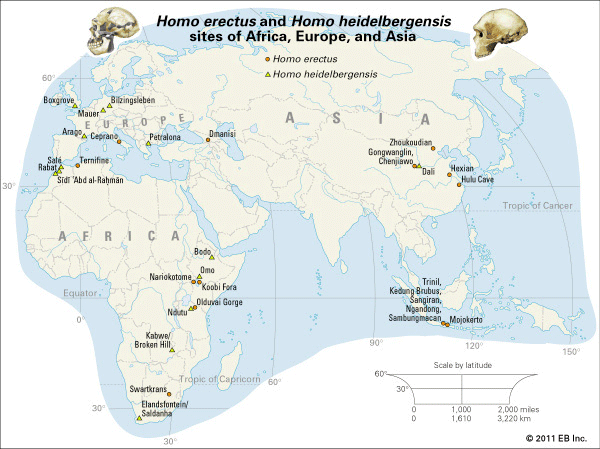
Homo heidelbergensis is an extinct species of archaic human that lived between approximately 600,000 and 200,000 years ago across Africa, Europe, and potentially Asia.2
The species was named after the Heidelberg jaw, a massive, chinless mandible discovered in 1907 near Heidelberg, Germany. While early classifications sometimes grouped these fossils with Homo erectus or archaic Homo sapiens, researchers now often categorize them as H. heidelbergensis to distinguish them from other hominin groups.23
Physically, these individuals possessed large braincases, thick vault bones, and massive brow ridges. Unlike H. erectus, their brains were larger, and their skulls exhibited modern features such as a broadened forehead and rounded rear. Many anthropologists consider H. heidelbergensis to be the common ancestor of both Neanderthals and modern humans, with the transition to H. sapiens likely occurring in Africa before 300,000 years ago.2
How do scientists determine the age of fossils?
Scientists determine the age of fossils using a combination of relative and absolute dating methods.
Relative Dating
Relative dating establishes the chronological order of fossils without providing a specific numerical age.
- Stratigraphy: Based on the law of superposition, this principle holds that in undisturbed deposits, the oldest layers are at the bottom, while younger layers accumulate on top.45
- Index Fossils: These are distinctive, abundant, and widely distributed fossils that represent a specific span of geologic time. They help scientists correlate rock strata across different geographic locations.6
- Cross Dating: Archaeologists can date undated sites by finding objects from a known culture or period within the same stratigraphic level.5
Absolute Dating
Absolute dating provides a numerical age, often through geochronology and the measurement of radioactive decay and the measurement of radioactive decay.57
- Radiometric Dating: This measures the decay of radioactive isotopes (such as uranium, potassium, or rubidium) into stable daughter elements. Because these isotopes decay at a constant, known rate, scientists can calculate the time elapsed since a rock or mineral formed.87
- Carbon-14 Dating: Used for organic materials like bones or wood, this method measures the residual amount of radiocarbon. It is effective for specimens up to approximately 50,000 years old.95
- Other Techniques: Methods such as dendrochronology (tree-ring dating) and thermoluminescence also provide absolute chronological data.5
What are the main differences between archaic and modern humans?
The distinction between archaic and modern humans is defined by significant differences in anatomy, cognitive behavior, and evolutionary history.
Anatomical Differences
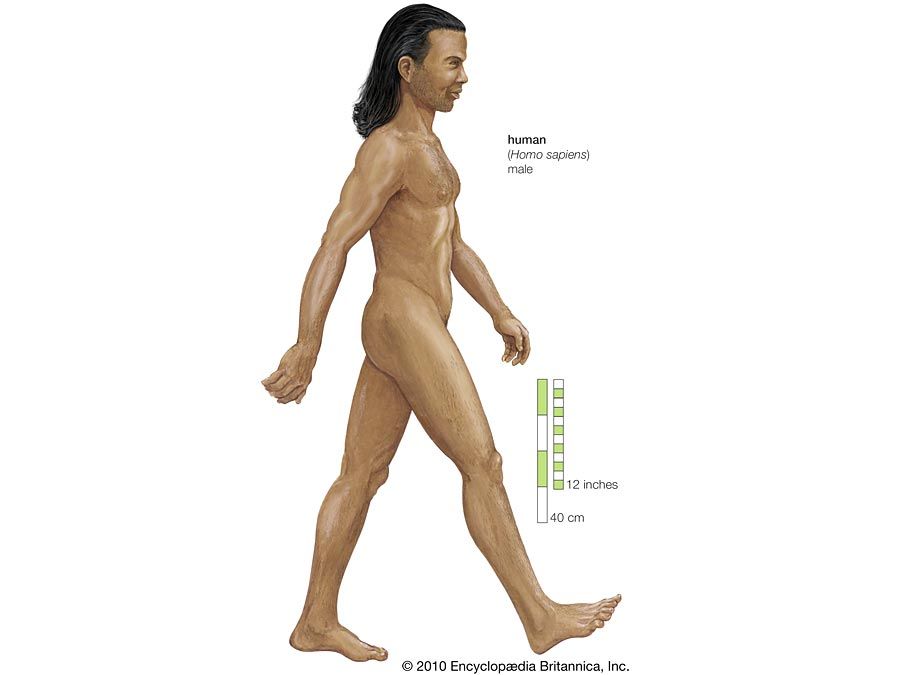
Modern humans (Homo sapiens) possess a distinct skeletal structure that sets them apart from archaic groups like Homo heidelbergensis and Neanderthals. Key features of modern humans include:
- Cranium: A high, rounded, and thin-boned braincase that lacks the massive brow ridges and long, low shape characteristic of archaic species.112
- Face and Jaw: A greatly reduced face without large air sinuses, topped by modest brow ridges divided into central and lateral halves. Modern humans also possess a complex, distinctive chin, a feature absent in other members of the human tribe.2
- Body Form: Generally more lightly built skeletons compared to the robust, stocky frames of archaic humans, such as the cold-adapted Neanderthals.122
Cognitive and Behavioral Differences
While archaic humans demonstrated technological capabilities—such as the use of fire, construction of shelters, and the creation of stone tools—modern humans exhibit a unique, unprecedented suite of symbolic behaviors.13
- Symbolic Thought: Modern humans are characterized by the production of art, musical instruments, complex burials, and personal adornment (such as beads and jewelry), which indicate a capacity for abstract, symbolic reasoning.13
- Technological Innovation: The arrival of modern humans is marked by a distinct acceleration in the tempo of innovation, including the development of blade-based tool technologies and the use of diverse materials like bone and antler.13
- Spatial Organization: Unlike the random distribution of detritus at archaic sites, modern human dwelling places show a deliberate, patterned use of space, with specific areas designated for different activities.13
Evolutionary Context
The “out-of-Africa” model, supported by genetic evidence, posits that H. sapiens emerged as an anatomically distinctive species in Africa between 315,000 and 160,000 years ago. While limited interbreeding occurred between modern humans and archaic groups like Neanderthals and Denisovans, modern humans eventually replaced these indigenous populations worldwide. Unlike the multiregional hypothesis, which suggests archaic populations evolved locally into modern humans, the current scientific consensus emphasizes that modern humans are a unique, homogeneous species with a single African origin.2141115
Sources
- Steinheim skull — Encyclopædia Britannica
- Homo heidelbergensis — Encyclopædia Britannica
- Heidelberg jaw — Encyclopædia Britannica
- index fossil — Encyclopædia Britannica
- dating: Top Questions — Encyclopædia Britannica
- stratigraphy — Encyclopædia Britannica
- carbon-14 dating — Encyclopædia Britannica
- dating - Principles of isotopic dating — Encyclopædia Britannica
- Archaeology - Dating — Encyclopædia Britannica
- Did you know? — Merriam-Webster
- Neanderthal - Craniofacial features — Encyclopædia Britannica
- Homo sapiens - Behavioral influences — Encyclopædia Britannica
- Homo sapiens - Bodily structure — Encyclopædia Britannica
- Human Ancestors — Encyclopædia Britannica
- Neanderthal - Neanderthal classification — Encyclopædia Britannica
- human evolution - Increasing brain size — Encyclopædia Britannica
- human evolution - The emergence of Homo sapiens — Encyclopædia Britannica
- Homo erectus - Theories of gradual change — Encyclopædia Britannica
Published on · 4 min read