Cottony-cushion Scale
The cottony-cushion scale (Icerya purchasi) is a scale insect and pest known for infesting citrus trees and various other plants, including pittosporum…
What is Cottony-cushion scale?
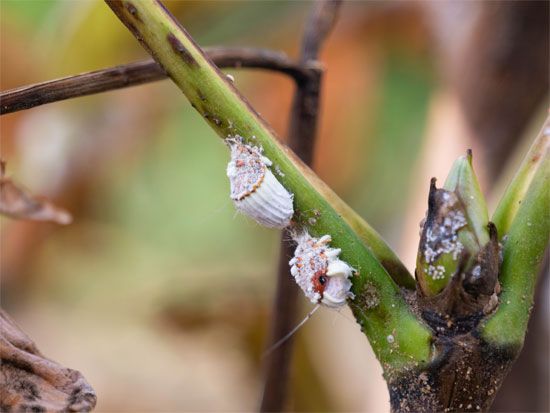
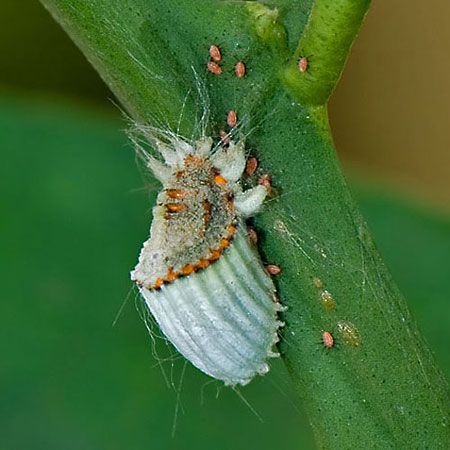
The cottony-cushion scale (Icerya purchasi) is a scale insect and pest known for infesting citrus trees and various other plants, including pittosporum, acacia, and willow. Originally from Australia, this insect is found worldwide and is characterized by the adult’s habit of laying bright red eggs within a distinctive, large white mass that protrudes from twigs.12
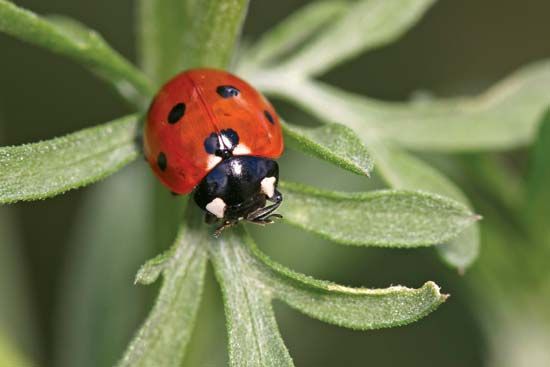
In the late 19th century, the cottony-cushion scale threatened the citrus industry in California after being introduced without its natural enemies. This infestation was famously brought under control through biological means: the introduction of the vedalia beetle (Rodolia cardinalis), a type of ladybird beetle native to Australia. This successful intervention remains a classic example of using natural predators to manage nonnative insect populations.13
What is biological pest control?
Biological control is the practice of managing or eliminating pest populations by utilizing their natural enemies, such as predators, parasites, or disease-causing organisms. Rather than relying solely on synthetic chemicals, this approach seeks to restore ecological balance by encouraging these natural agents to thrive or by introducing them into the environment.456
Common methods include:
- Predation and Parasitism: Introducing natural enemies, such as the vedalia beetle to control cottony-cushion scale or chalcid wasps to target mealybugs.46
- Microbial Agents: Using pathogens like Bacillus thuringiensis (Bt), a bacterium that produces toxins fatal to specific insect larvae.47
- Integrated Pest Management (IPM): A modern, environmentally responsible strategy that combines biological controls with other methods—such as crop rotation, pheromone traps, and the use of pest-resistant plant varieties—to minimize the need for chemical pesticides.68
While biological control is often more environmentally sound than chemical alternatives, it must be approached with caution. Poorly managed introductions can lead to invasive species that disrupt native ecosystems, as seen with the introduction of cane toads in Australia.4
How do ladybird beetles help protect crops?
Ladybird beetles, or ladybugs, are highly beneficial to agriculture because they act as voracious predators of common plant-damaging pests. Both the larvae and adult stages of most species feed on soft-bodied, plant-sucking insects, including aphids, scale insects, and mites.910
Their effectiveness as natural pest controllers is significant: for instance, a single larva of the convergent ladybug can consume roughly 300 aphids during its two-week development, while an adult female may devour several thousand aphids over her three-month lifespan. Because of this, they are frequently collected and sold to farmers and gardeners as a form of biological control. A historic success occurred when the vedalia beetle was introduced to North America to save citrus orchards from the cottony-cushion scale.910
It is important to note that while most are beneficial, a small number of species, such as the Mexican bean beetle, are herbivorous and can be destructive to crops.910
What are some other examples of invasive insect species?
In addition to the ladybird beetle species that are sometimes introduced for control, many other insects have become destructive invasive species when transported to new environments without their natural predators.113
Notable examples include:
- Emerald Ash Borer: A metallic green beetle native to East Asia that was introduced to North America in the 1990s. Its larvae bore into ash trees, creating tunnels that disrupt the tree’s vascular system and have caused the deaths of hundreds of millions of trees.12
- Asian Longhorned Beetle: Native to China and Korea, this beetle tunnels deep into the wood of living hardwood trees like maples and elms. It has established populations in North America and Europe, necessitating the removal of tens of thousands of trees to prevent its spread.13
- European Corn Borer: An accidentally introduced pest that causes significant damage to corn crops in the United States.11
- Colorado Potato Beetle: Originally a native insect of semidesert regions, it adapted to feed on potatoes after they were introduced to its range, leading to widespread agricultural destruction.11
- Red Imported Fire Ant: An aggressive, swarming species native to South America that has spread across parts of the United States, likely through shipments of soil and landscaping materials.14
Sources
- Cottony-cushion scale — Encyclopædia Britannica
- cottony-cushion scale — Merriam-Webster
- insect - Ecological factors — Encyclopædia Britannica
- Biological control — Encyclopædia Britannica
- biological control — Merriam-Webster
- Pest — Encyclopædia Britannica
- Agricultural technology - Biological controls — Encyclopædia Britannica
- Bacillus thuringiensis — Encyclopædia Britannica
- ladybug — Encyclopædia Britannica
- Coleoptera - As predators — Encyclopædia Britannica
- Emerald Ash Borer: At a Glance — Encyclopædia Britannica
- Asian longhorned beetle — Encyclopædia Britannica
- invasive species — Encyclopædia Britannica
- invasive species - A global problem — Encyclopædia Britannica
Published on · 3 min read