Horntail
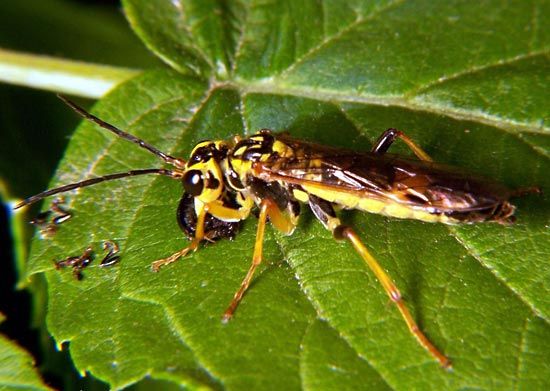
Horntails, members of the family Siricidae, have a limited impact on forests and wooden structures. Because female horntails typically target dead or dying…
How do horntail insects impact forests and wooden structures?
Horntails, members of the family Siricidae, have a limited impact on forests and wooden structures. Because female horntails typically target dead or dying trees to deposit their eggs, they are generally not considered economically destructive pests.1
The life cycle of the horntail involves the female using her ovipositor to drill into wood, where she introduces symbiotic fungi alongside her eggs. Once hatched, the larvae tunnel through the wood for approximately two years, feeding primarily on the fungi rather than the wood itself. While they are wood-boring insects, their preference for compromised timber means they rarely pose a significant threat to healthy forests or structural lumber.1
How do horntail insects use their ovipositor, and why is it sometimes mistaken for a stinger?
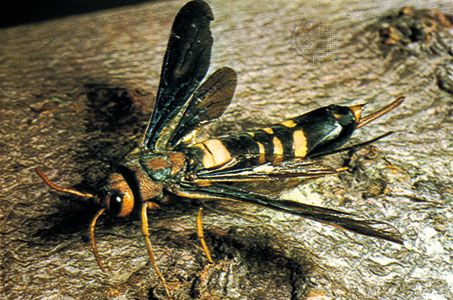
Female horntails possess a prominent, stout ovipositor that functions as a specialized drilling tool. They use this structure to bore holes into dead or dying trees, where they deposit their eggs along with symbiotic fungi that the larvae will later consume.12
The confusion regarding the ovipositor being a stinger arises from its appearance and the insect’s classification. Because horntails belong to the order Hymenoptera—a group that includes many stinging wasps and bees—observers often mistake the long, needle-like ovipositor for a weapon. However, the horntail is entirely harmless to humans; it lacks a venomous stinger, and the hornlike projection at the end of its abdomen is merely a physical characteristic for which the insect is named.1
What is the life cycle of a horntail insect?
The life cycle of a horntail (family Siricidae) is a multi-year process centered on the development of wood-boring larvae.
- Egg Deposition: The female uses her stout, hornlike ovipositor to drill into a dead or dying tree. During this process, she deposits her eggs along with symbiotic fungi into the wood.12
- Larval Stage: Once hatched, the larvae tunnel through the tree for approximately two years. Rather than consuming the wood itself, they feed on the symbiotic fungi introduced by the female during the egg-laying stage.1
- Pupation: After completing their development, the larvae undergo pupation within a cocoon constructed from silk and sawdust.1
This cycle allows the horntail to thrive in compromised timber, though they are generally not considered economically destructive to healthy forests or structures.1
Where are horntail insects typically found and what habitats do they prefer?
Horntail insects are found globally, with approximately 85 species belonging to the family Siricidae. Their distribution is closely tied to their specific habitat requirements, as they are wood-boring insects that rely on particular types of trees for their life cycle.1
These insects prefer habitats containing dead or dying trees, which serve as the essential site for egg-laying and larval development. Because the larvae feed on symbiotic fungi introduced by the female during the drilling process, the presence of suitable host trees is the primary factor in their habitat selection.1
For example:
- The pigeon tremex (Tremex columba) is the most common species found in North America.1
- Urocerus gigas is the most common species in Britain and specifically favors the wood of pine trees.1
Because they require decaying timber to complete their development, they are most frequently encountered in forested areas where such trees are available.1
Sources
- horntail — Encyclopædia Britannica
- Siricidae — Merriam-Webster
- horntail — Merriam-Webster
Published on · 2 min read