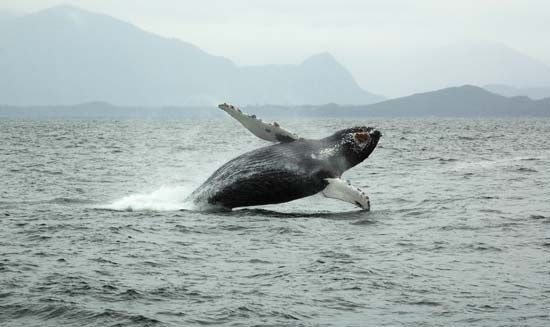
Humpback Whale
Humpback whales are the most vocal of all whales, producing a diverse array of sounds including moans, cries, groans, and snores. These vocalizations are…
How do humpback whales communicate and what is special about their songs?
Humpback whales are the most vocal of all whales, producing a diverse array of sounds including moans, cries, groans, and snores. These vocalizations are essential for communication, allowing individuals to share information regarding their location, identity, and emotional states.12
What makes their songs particularly special is their complexity and dynamic nature:
- Structure and Duration: Humpbacks string various sounds together into elaborate songs that can last between 5 and 35 minutes. Unlike toothed whales that use nasal passages, humpbacks use their larynx to produce these sounds by recycling air, allowing them to sing underwater without needing to inhale.13
- Social Evolution: These songs are not static; they evolve over time as pods listen to and incorporate patterns from other groups, creating regional dialects.23
- Courtship and Fitness: Songs play a central role in courtship. Males use these displays to assert dominance and attract mates, with the complexity of a song often serving as an indicator of a male’s health or experience.21
What are the distinguishing physical characteristics of humpback whales?
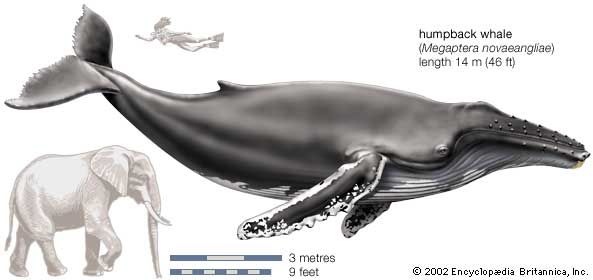
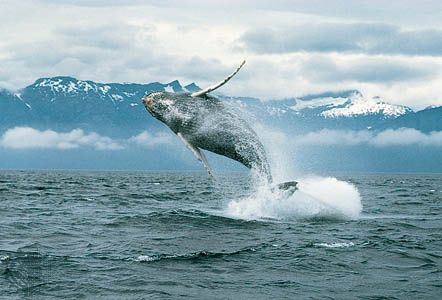
Humpback whales (Megaptera novaeangliae) possess several distinct physical features that set them apart from other baleen whales:
- Body Size and Coloration: These cetaceans typically measure between 12 and 16 metres (39 to 52 feet) in length and weigh approximately 36 metric tons. Their bodies are black on the upper surface with a variable amount of white on the underside.4
- Flippers: They are easily distinguished by their exceptionally long, narrow flippers, which measure about one-third of their total body length and feature a scalloped forward edge.4
- Head and Skin Features: Humpbacks have large, fleshy knobs—or tubercles—on their head, jaws, and body, each associated with one or two hairs. Additionally, they have approximately 30 broad ventral grooves running along their throat and chest.24
- Dorsal Fin: The dorsal fin is relatively small and positioned far back on the body.4
When beginning a deep dive, the whale is known for hunching its back and rolling forward, which often brings its tail out of the water.4
What is the migration pattern of humpback whales and why do they undertake such long journeys?
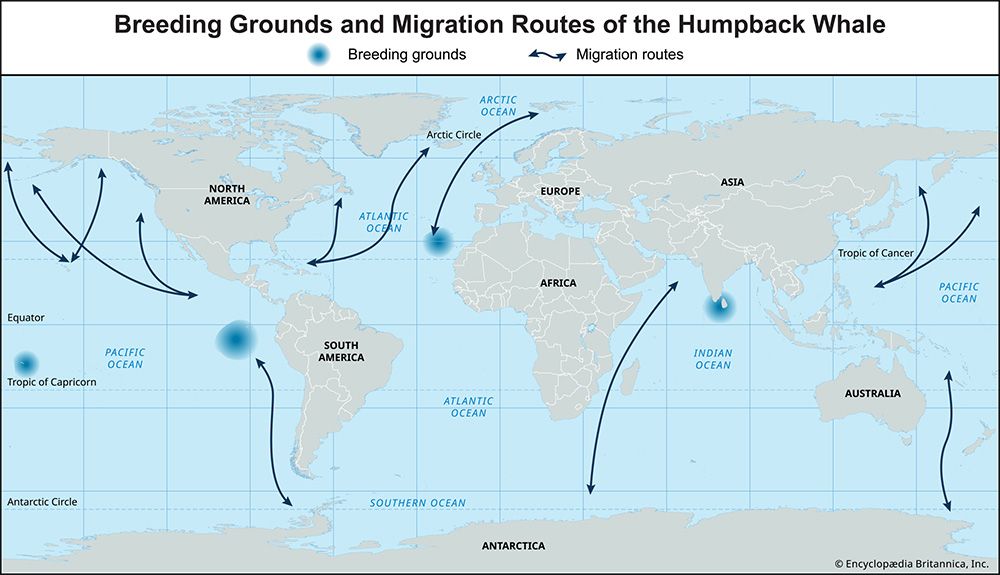
Humpback whales are highly migratory cetaceans that undertake extensive seasonal journeys between distinct polar and tropical regions.56
Migration Patterns
Humpbacks follow a predictable seasonal cycle:
- Summer: They inhabit high-latitude polar feeding grounds, where they take advantage of abundant food supplies such as krill and small fish6.6
- Winter: They migrate toward tropical or subtropical waters to breed and give birth.6
These populations are often divided into distinct groups that return to specific zones, though some interchange between regions can occur. While most migratory whales do not cross the Equator, researchers have documented rare instances of individuals traveling vast distances between ocean basins, such as a whale identified near the Antarctic Peninsula that was later sighted off the coast of Colombia.52
Reasons for Migration
The primary driver for these long-distance journeys is the optimization of survival and reproduction. By moving to polar waters in the summer, whales capitalize on high biological productivity to build up energy reserves. Conversely, moving to warmer, lower-latitude waters in the winter provides a more suitable environment for mating and calving.26
How do humpback whales compare in size to other whale species?
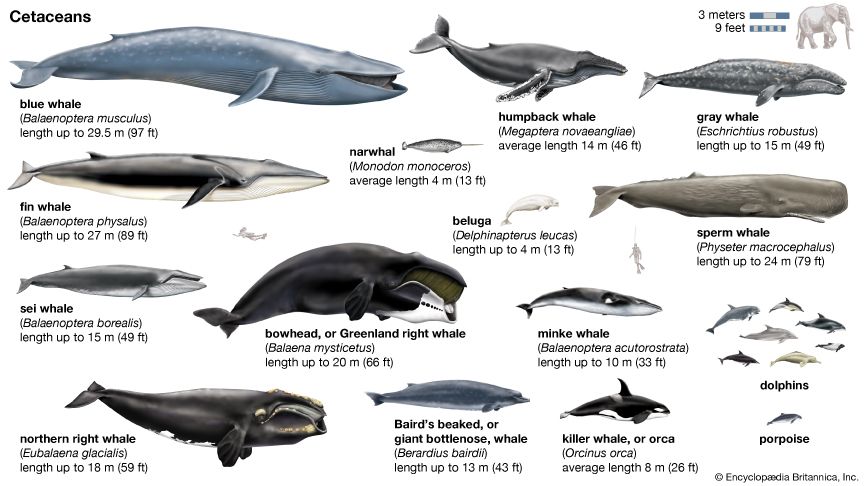
Humpback whales (Megaptera novaeangliae) are medium-sized members of the rorqual family, which also includes the largest animals on Earth. While they are impressive in their own right, they are significantly smaller than their close relative, the blue whale.
- Humpback Whales: These whales typically reach lengths of 12 to 16 metres (39 to 52 feet) and weigh approximately 36 metric tons.7
- Blue Whales: As the largest animals to have ever existed, blue whales are vastly larger, commonly reaching lengths of 25 to 26 metres (82 to 85 feet) and weighing between 100 and 150 metric tons, with some individuals documented at even greater sizes.28
To put this in perspective, a blue whale calf at the time of weaning—around eight months old—is already about 15 metres (50 feet) long and weighs roughly 25 metric tons, nearly reaching the size of an adult humpback whale. While humpbacks are smaller than blue whales, they remain among the largest creatures in the ocean, utilizing their size and unique baleen feeding strategies to thrive in diverse marine environments.27
Sources
- Why do whales sing? — Encyclopædia Britannica
- humpback whale — Encyclopædia Britannica
- whale vocalization — Encyclopædia Britannica
- humpback whale — Merriam-Webster
- Migration - Marine mammals — Encyclopædia Britannica
- cetacean - Distribution and migration — Encyclopædia Britannica
- 14 Questions About Aquatic Animals Answered - Which animal is both the biggest mammal and the largest living creature on Earth? — Encyclopædia Britannica
- What is the largest animal on Earth? — Encyclopædia Britannica
Published on · 4 min read