Hymenophyllaceae
The Hymenophyllaceae, commonly known as the filmy fern family, are a group of relatively primitive ferns characterized by several distinct features:
What are the key characteristics of plants in the Hymenophyllaceae family?
The Hymenophyllaceae, commonly known as the filmy fern family, are a group of relatively primitive ferns characterized by several distinct features:
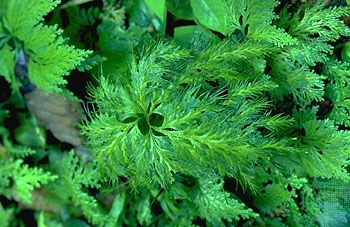
- Delicate Structure: They are mostly tiny, delicate plants that typically grow as epiphytes in rainforest environments.12
- Leaf Anatomy: Their leaves vary from undivided to highly dissected and are notable for having a lamina that is only one cell layer thick between the veins.12
- Reproductive Structures: The sori are located at the tips or margins of leaf segments and are enclosed in a protective, cup-shaped to tubular covering called an indusium. The sporangia are attached to a receptacle that may resemble a bristle.13
- Spores and Gametophytes: Their spores are globose and uniquely green and physiologically active when shed. The gametophyte stage is typically ribbon-shaped or filamentous and capable of vegetative reproduction via gemmae1.12
How do Hymenophyllaceae plants reproduce and disperse their spores?
Members of the Hymenophyllaceae family, or filmy ferns, employ both sexual and asexual reproductive strategies to propagate and disperse.
Sexual Reproduction
In their sexual life cycle, these ferns produce spores within sporangia, which are housed in specialized structures called sori located at the tips or margins of the leaf segments. These sori are protected by a cup-shaped or tubular covering known as an indusium. A unique characteristic of this family is that their spores are green and physiologically active at the time they are shed. Once released, these spores can germinate under suitable conditions to develop into gametophytes, which are typically ribbon-shaped or filamentous.145
Asexual Reproduction and Dispersal
Beyond sexual reproduction, many filmy ferns utilize vegetative propagation to expand their colonies. They produce specialized filaments known as gemmae, which are small vegetative offsets. These gemmae break off from the parent plant and are dispersed to new locations by:61
In some cases, such as the species Trichomanes intricatum, the plants exist exclusively as independent gametophytes that have lost the ability to produce sporophytes, relying entirely on these vegetative gemmae for survival and dispersal.1
How do Hymenophyllaceae plants differ from other fern families?
The Hymenophyllaceae, or filmy fern family, are distinguished from other fern families by several unique morphological and biological characteristics:
- Leaf Anatomy: Their leaves are exceptionally delicate, with a lamina that is typically only one cell layer thick between the veins, lacking the complex mesophyll layers found in most other ferns.1
- Soral Structure: Unlike many ferns that have uncovered sori or marginal leaf-fold protection, Hymenophyllaceae possess a specialized, cup-shaped or tubular indusium that encloses the sporangia. The receptacle holding the sporangia often extends beyond this indusium like a bristle.13
- Spore Physiology: A rare feature among ferns is that their spores are green and physiologically active at the time of shedding.1
- Gametophyte Specialization: Some members, such as Trichomanes intricatum, exhibit highly specialized, filamentous gametophytes that can persist independently of the sporophyte generation, sometimes reproducing entirely through vegetative gemmae in the absence of sexual reproduction.112
Are there any rare or endangered species within the Hymenophyllaceae family?
The Hymenophyllaceae family includes approximately 600 species, many of which are sensitive to environmental changes due to their delicate, single-cell-thick leaves. While the provided information does not list specific species currently classified as endangered on a global scale, it highlights the precarious existence of Trichomanes intricatum in the eastern United States.
Trichomanes intricatum is considered highly unusual because it exists exclusively as independent gametophytes. These plants have lost the ability to produce sporophytes, meaning they cannot complete their sexual life cycle in the wild. They survive as algaelike filaments in cool, shaded microclimates, relying entirely on asexual reproduction through gemmae. Because they are restricted to specific, isolated habitats and cannot reproduce sexually, they are inherently vulnerable to environmental disruption.1
Sources
- Hymenophyllaceae — Encyclopædia Britannica
- Fern - Annotated classification — Encyclopædia Britannica
- Hymenophyllaceae — Merriam-Webster
- Plant reproductive system - Ferns — Encyclopædia Britannica
- Fern - The indusium — Encyclopædia Britannica
- Fern - Vegetative reproduction — Encyclopædia Britannica
- Plant reproductive system - Variations in reproductive cycles — Encyclopædia Britannica
- Plant reproductive system - Psilopsids — Encyclopædia Britannica
- Fern - Hybridization — Encyclopædia Britannica
- Angiosperm - The gynoecium — Encyclopædia Britannica
- Hymenophyllum — Merriam-Webster
- Fern - Specialized forms — Encyclopædia Britannica
- Fern - Comparisons with leaves of other plant groups — Encyclopædia Britannica
- Fern - Tissues — Encyclopædia Britannica
- Fern - Ecology — Encyclopædia Britannica
- filmy fern — Merriam-Webster
Published on · 3 min read