Walking Fern
The walking fern is a fern belonging to the family Aspleniaceae. It typically refers to the species Asplenium rhizophyllum (also known as Camptosorus…
What is Walking fern?
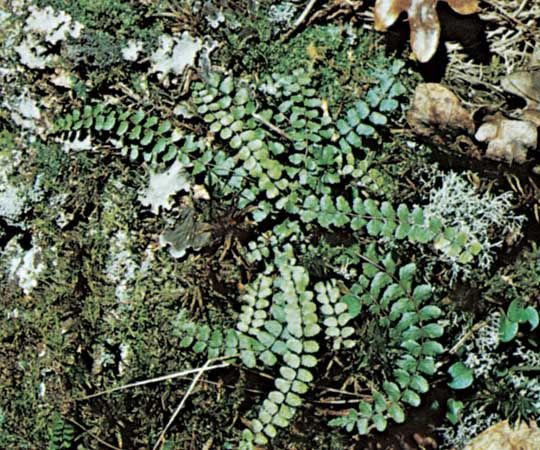
The walking fern is a fern belonging to the family Aspleniaceae. It typically refers to the species Asplenium rhizophyllum (also known as Camptosorus rhizophyllus) found in eastern North America, or A. sibiricum of eastern Asia.12
The plant earns its common name from its unique reproductive habit: new plantlets sprout wherever the elongated, arching tips of the parent plant’s leaves touch the ground, giving the appearance that the fern is “walking” or moving across the landscape.12
These hardy, evergreen plants feature undivided, leathery, triangular leaves that taper to a thin point. They are typically found in shady environments, particularly on limestone ledges and limey wooded areas, where they produce spore-bearing structures in clusters along their veins.1
How do ferns reproduce using spores?
Ferns reproduce through a process known as alternation of generations, which involves two distinct life stages: the asexual sporophyte and the sexual gametophyte.3
The Sporophyte Stage
The mature fern typically seen in nature is the sporophyte. It produces haploid spores within specialized organs called sporangia, which are often clustered on the undersides of leaves in groups known as sori. As the sporangia mature, they release these spores, which are then dispersed by wind.453
The Gametophyte Stage
When a spore lands in a suitable environment, it germinates to form a tiny, heart-shaped or ribbonlike sexual plant called a prothallium. This gametophyte produces male (antheridia) and female (archegonia) sex organs.453
Fertilization
For fertilization to occur, sperm must swim through water to reach an egg. Once the egg is fertilized, it forms a zygote, which develops into a new, independent sporophyte. As the young fern grows, the parental gametophyte typically withers and dies.345
What other plants have unique ways of spreading?
Beyond the “walking” habit of certain ferns, plants have evolved a remarkable array of strategies to disperse their seeds and propagate themselves. These methods generally fall into two categories: active dispersal of seeds and vegetative reproduction.
Seed Dispersal Strategies
Plants utilize various agents and mechanisms to ensure their offspring reach new environments:
- Explosive Mechanisms: Some species, such as the sandbox tree and squirting cucumber, use physical force or water pressure to launch seeds over significant distances.7
- Animal Interactions: Many plants rely on animals for transport. Some seeds are designed to stick to fur or feathers using hooks and barbs, while others are eaten and dispersed via digestion. Certain plants, like the Ceratocaryum argenteum, even use “fecal mimicry” to trick dung beetles into burying their seeds.7
- Wind and Water: Plants like the dandelion and maple use specialized structures to glide or spin on the wind. Meanwhile, coastal plants like the coconut palm use buoyant, water-resistant fruits to travel across oceans.879
Vegetative Propagation
Many plants bypass seeds entirely through vegetative reproduction, allowing them to spread rapidly by cloning themselves:1011
- Specialized Structures: Plants use organs like rhizomes (horizontal stems), tubers (fleshy underground stems), and runners (aerial stems) to expand their reach.1012
- Offshoots and Suckers: Many species produce lateral shoots or suckers from their roots or stems that eventually root to become independent plants.12
Why do some plants prefer limestone environments?
Plants that thrive in limestone environments are often referred to as calcicoles. Their preference for these areas is primarily driven by the chemical properties of limestone, which is a sedimentary rock composed mainly of calcium carbonate.1415
The primary reasons plants favor these environments include:
- pH Regulation: Limestone is alkaline, meaning it has a pH greater than 7. Many plants prefer these conditions because high acidity in soil increases the solubility of metals like aluminum and [manganese], which can be toxic to many species15. By “sweetening” or neutralizing acidic soil, limestone creates a more hospitable environment for growth.16
- Nutrient Availability: Limestone serves as a vital source of calcium and magnesium, which are essential plant nutrients. In humid regions, these nutrients are often leached from the soil by rainfall, making the presence of limestone particularly beneficial for maintaining soil fertility.17
- Disease Suppression: The alkalinity provided by limestone can help manage certain soil-borne pathogens. For example, clubroot in crucifers can be controlled by mixing lime into the soil to raise the pH to 7.2 or higher.18
Sources
- Walking fern — Encyclopædia Britannica
- walking fern — Merriam-Webster
- Fern - Life cycle — Encyclopædia Britannica
- Plant reproductive system - Ferns — Encyclopædia Britannica
- Fern - The sorus — Encyclopædia Britannica
- lower vascular plant - Reproduction — Encyclopædia Britannica
- horticulture - Vegetative propagation — Encyclopædia Britannica
- Seed dispersal - Hydrochory: dispersal by water — Encyclopædia Britannica
- Seed - Dispersal by wind — Encyclopædia Britannica
- Falling Far from the Tree: 7 Brilliant Ways Seeds and Fruits Are Dispersed — Encyclopædia Britannica
- horticulture - Vegetative structures — Encyclopædia Britannica
- Plant - Asexual reproduction — Encyclopædia Britannica
- Plant reproductive system - General features of asexual systems — Encyclopædia Britannica
- limestone — Encyclopædia Britannica
- pH — Encyclopædia Britannica
- Plant disease - Soil pH — Encyclopædia Britannica
- Agricultural technology - Liming — Encyclopædia Britannica
- calcicole — Merriam-Webster
Published on · 3 min read