Leopard Lizard
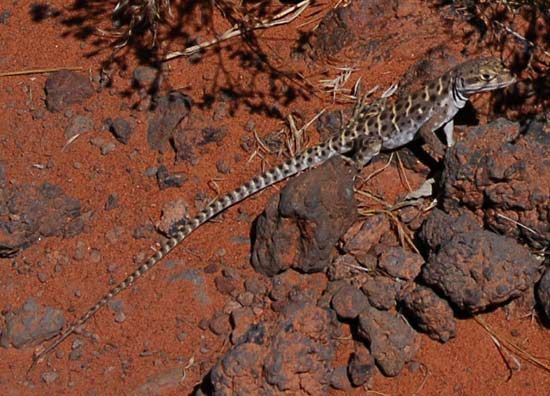
A leopard lizard is any of three species belonging to the genus Gambelia within the lizard family Crotaphytidae. These reptiles are primarily found in arid…
What is leopard lizard?
A leopard lizard is any of three species belonging to the genus Gambelia within the lizard family Crotaphytidae. These reptiles are primarily found in arid and semi-arid regions of the southwestern United States and Mexico.1
The three recognized species include:
- Long-nosed leopard lizard (G. wislizenii): A large, spotted lizard inhabiting the southwestern U.S. and northern Mexico.1
- Blunt-nosed leopard lizard (G. sila): Found exclusively in the deserts of central California.1
- Cope’s leopard lizard (G. copeii): Ranges from southern California into southern Baja California.1
Leopard lizards are opportunistic feeders, consuming insects, seeds, flowers, small mammals, and other lizards. Known for their agility, they can run rapidly on their hind feet when threatened in their open habitat. They reproduce by laying clutches of 2–10 white-shelled eggs and do not provide parental care.1
What are the main differences between the three species of leopard lizards?
The three species of leopard lizards in the genus Gambelia are primarily distinguished by their geographic distribution and specific physical characteristics:
- Long-nosed leopard lizard (G. wislizenii): This species is characterized by its large size and spotted appearance. It has the widest range of the three, inhabiting arid and semi-arid regions across the southwestern United States and northern Mexico.1
- Blunt-nosed leopard lizard (G. sila): As the name suggests, this species is distinguished by its snout shape. It has a much more restricted range, occurring exclusively within the deserts of central California.1
- Cope’s leopard lizard (G. copeii): This species occupies a distinct geographic range that extends from southern California down into southern Baja California, Mexico.1
While they share similar behaviors—such as running on their hind feet when disturbed, consuming a varied diet of insects and small vertebrates, and laying clutches of 2–10 eggs—their specific environmental niches and physical traits set them apart.1
How do leopard lizards adapt to living in arid desert environments?
Leopard lizards (Gambelia) have evolved several physiological and behavioral adaptations that allow them to thrive in the arid and semi-arid environments of the southwestern United States and Mexico.2
Thermal Regulation
As ectotherms, leopard lizards do not generate internal body heat. Instead, they rely on behavioral thermoregulation to maintain optimal temperatures for hunting and survival. They move between sun and shade or adjust their body orientation relative to the sun and wind to control heat absorption and loss. This energy-efficient lifestyle allows them to maintain a low metabolic rate, which is particularly advantageous in environments where food resources may be scarce.34
Water Conservation
Leopard lizards are well-adapted to arid conditions through efficient water management:
- Metabolic Efficiency: Because they have lower metabolic rates than birds or mammals, they require less water.1
- Excretion: Like other reptiles, they excrete uric acid, which allows them to eliminate nitrogenous wastes without losing large amounts of liquid.1
- Dietary Intake: As insectivores, they obtain a significant portion of their necessary water directly from the prey they consume.1
What are some other types of lizards found in the southwestern United States?
The southwestern United States is home to a diverse array of lizard species, many of which belong to the family Iguanidae. Beyond leopard lizards, several other notable types inhabit this arid region:
- Collared lizards: Known for their nimble nature and habit of running on their hind legs, these lizards are often found in rocky hillsides. Males are typically brightly colored, ranging from cobalt blue and green to tan and brown.6
- Gila monsters: These are one of only two species of venomous lizards in North America. They are stout-bodied, slow-moving predators with distinctive black and pink beadlike scales.7
- Horned toads: Characterized by their flattened bodies and daggerlike head spines, these lizards are specialized ant-eaters that often bury themselves in sand to hide from predators.8
- Side-blotched lizards: Members of the genus Uta, these are common, widespread climbers often found on bushes and rocks throughout the region.9
- Desert iguanas: These are among the many iguanid species that thrive in the harsh, arid environments of the American Southwest.10
Sources
- leopard lizard — Encyclopædia Britannica
- lizard - Water loss and other variables — Encyclopædia Britannica
- reptile - Thermal relationships — Encyclopædia Britannica
- Why are reptiles cold-blooded? — Encyclopædia Britannica
- lizard - Locomotion and limb adaptations — Encyclopædia Britannica
- collared lizard — Encyclopædia Britannica
- lizard - Annotated classification — Encyclopædia Britannica
- Gila monster — Encyclopædia Britannica
- iguana — Encyclopædia Britannica
- iguanid — Encyclopædia Britannica
- Uta — Encyclopædia Britannica
- horned toad — Encyclopædia Britannica
- North America - Deserts — Encyclopædia Britannica
- Sonoran Desert — Encyclopædia Britannica
Published on · 3 min read