IUCN Red List of Threatened Species
The IUCN Red List of Threatened Species serves as a globally accepted, science-based standard for measuring the conservation status of organisms. By…
How does the IUCN Red List help in prioritizing conservation efforts?
The IUCN Red List of Threatened Species serves as a globally accepted, science-based standard for measuring the conservation status of organisms. By utilizing five quantitative criteria—including population decline rates, geographic range, and population size—the list categorizes species based on their extinction risk.12
This data is instrumental in prioritizing conservation efforts in several ways:
- Informing Policy: While the list itself is not prescriptive, its rigorous data is used by governments and organizations to shape legislation, policy, and international conservation priorities.3
- Strategic Planning: Conservationists and protected area managers use the status data to identify critical sites and species that require dedicated recovery planning and action.3
- Trend Analysis: The database allows scientists to analyze how species status changes over time, helping them evaluate the effectiveness of various conservation measures and identify the primary threats driving population declines.13
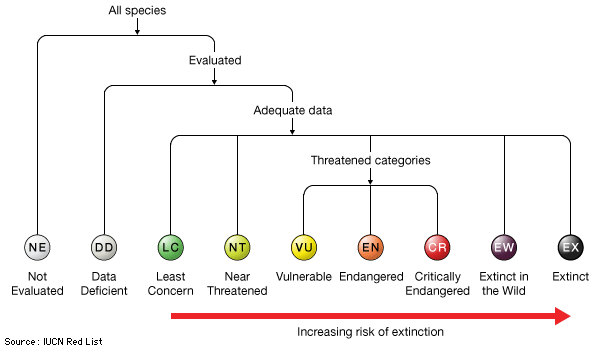
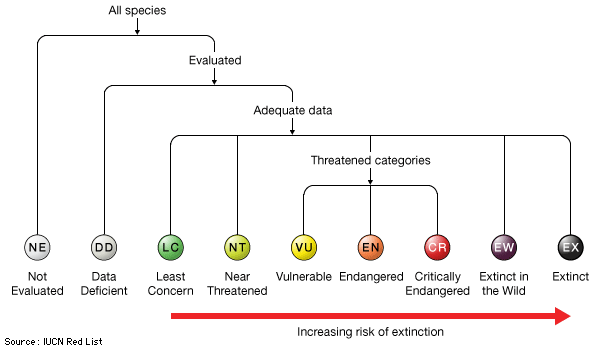
- Resource Allocation: By highlighting which species are most at risk—specifically those in the “threatened” categories (Critically Endangered, Endangered, and Vulnerable)—the list helps stakeholders focus their limited resources where they are most needed.13
How do governments and organizations use the IUCN Red List in policy-making?
Governments and conservation organizations utilize the IUCN Red List of Threatened Species as a foundational, science-based resource to guide their decision-making and environmental strategies. Because the list provides a globally accepted standard for measuring extinction risk, it serves as a critical tool for prioritizing species-protection efforts.14
Key ways these entities incorporate the data into policy-making include:
- Prioritization: By identifying species categorized as Critically Endangered, Endangered, or Vulnerable, governments and organizations can allocate limited resources toward the most urgent conservation needs.14
- Policy Development: The rigorous, quantitative data provided by the list helps inform the creation and implementation of national conservation legislation, policies, and management practices.2
- Trend Monitoring: Scientists and policymakers analyze the database to track changes in biodiversity over time. This allows them to evaluate the effectiveness of existing conservation measures and identify the specific threats driving population declines.14
- Strategic Planning: The information supports the development of broader environmental programs, such as those focused on forest preservation, ecosystem management, and climate change mitigation.2
What are some challenges in accurately assessing species for the IUCN Red List?
Accurately assessing species for the IUCN Red List of Threatened Species presents several significant challenges for the scientific community:
- Data Deficiencies: A primary obstacle is the lack of sufficient information regarding many organisms. When the available data related to a species’ risk of extinction is lacking, it is classified as Data Deficient (DD). In these cases, a complete, accurate assessment cannot be performed, meaning the species’ true conservation status remains unknown.12
- Scale of Biodiversity: There are nearly 1.9 million species described by science, yet only a fraction—approximately 157,000 by 2024—have been assessed using the IUCN criteria. This leaves a vast number of species categorized as Not Evaluated (NE), many of which may be in the process of becoming extinct without our knowledge.13
- Complexity of Criteria: Assessments require a rigorous, multi-faceted approach. Scientists cannot rely on a single metric; they must synthesize data across five quantitative criteria, including population trends, geographic range, and extinction probability. Ensuring the accuracy of these complex evaluations requires ongoing, time-intensive monitoring and periodic reassessment by thousands of experts worldwide.123
What is the IUCN Red List of Threatened Species and when was it established?
The IUCN Red List of Threatened Species is a globally recognized, objective assessment system used to classify the conservation status of plants, animals, and other organisms based on their probability of extinction.12
The International Union for Conservation of Nature (IUCN) unveiled this assessment system in 1994. It utilizes five quantitative criteria—such as population decline rates, geographic range, and population size—to categorize species into statuses ranging from “Least Concern” to “Extinct”. By 2024, more than 157,000 species had been evaluated, with the resulting data serving as a vital resource for governments and organizations to prioritize conservation efforts and monitor global biodiversity trends.12
Sources
- IUCN Red List of Threatened Species — Encyclopædia Britannica
- endangered species - IUCN Red List of Threatened Species — Encyclopædia Britannica
- endangered species - Species assessment and management — Encyclopædia Britannica
- International Union for Conservation of Nature — Encyclopædia Britannica
Published on · 3 min read