Lake Zaysan
Lake Zaysan is a freshwater lake situated in eastern Kazakhstan. It lies within a hollow between the Altai and Tarbagatay mountain ranges at an elevation of…
What is Lake Zaysan?
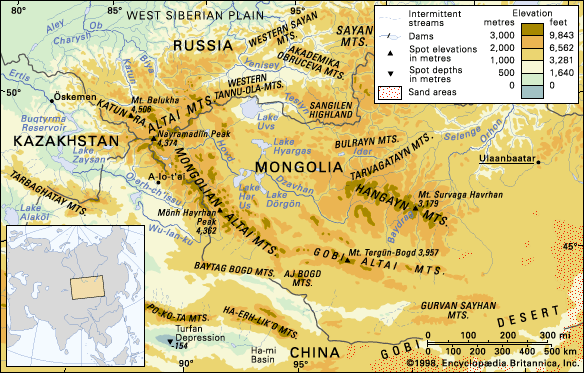
Lake Zaysan is a freshwater lake situated in eastern Kazakhstan. It lies within a hollow between the Altai and Tarbagatay mountain ranges at an elevation of 1,266 feet (386 metres).1
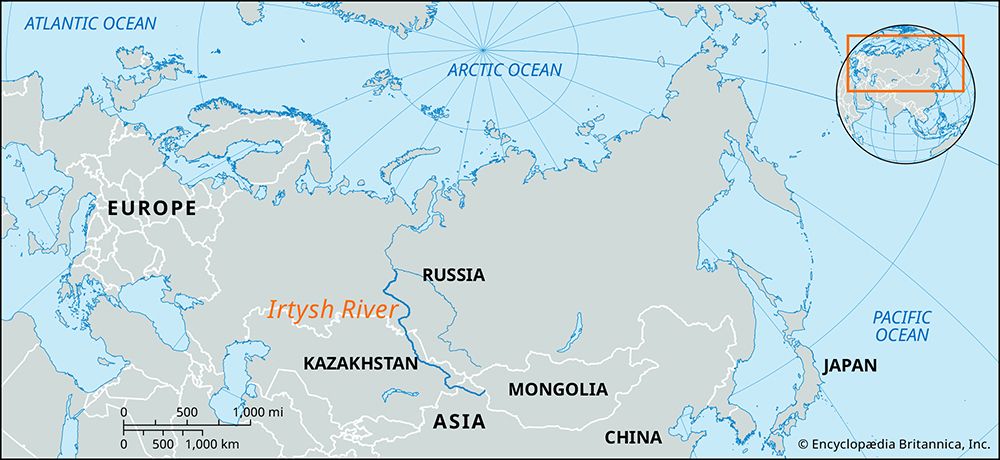
The lake is fed by the Irtysh (Ertis) River, which enters from the east. While it was historically 60 miles long and 20 miles wide, its water level has risen by 20 feet (6 metres) since it was incorporated into the Buqtyrma (Bukhtarma) Reservoir. Today, the lake serves as an important site for fishing—including species such as sturgeon, sterlet, and carp—and supports regional shipping services.1
What are the Altai Mountains like?
The Altai Mountains are a complex, jagged mountain system in Central Asia that stretches approximately 1,200 miles (2,000 km) across Russia, Mongolia, China, and Kazakhstan. The name derives from the Turkic-Mongolian word altan, meaning “golden”.2
Geography and Subdivisions
The system is divided into three main parts:
- Altai proper: Located in the Altay Republic of Russia, eastern Kazakhstan, and northern Xinjiang, China. It contains the range’s highest point, Mount Belukha, at 14,783 feet (4,506 metres).23
- Mongolian Altai: Extends southeast from Khuiten Peak along the border of Mongolia and China.3
- Gobi Altai: Dominates the southern portions of Mongolia, rising above the Gobi desert.23
Vegetation Zones
The region features four distinct ecological zones:
- Mountain subdesert: Found in the lower slopes of the Mongolian and Gobi Altai, characterized by drought- and salt-tolerant plants.4
- Mountain steppe: Features meadows and mixed-grass steppes.4
- Mountain forest: Dominates the Altai proper, primarily consisting of coniferous trees like larch, fir, and pine.4
- Alpine regions: Composed of subalpine shrubs, meadows, mosses, and bare rock.4
How do reservoirs change local ecosystems?
Reservoirs, while essential for water supply, irrigation, and hydroelectric power, fundamentally alter local ecosystems by transforming flowing river environments into static water bodies.56
Environmental Impacts
- Habitat Alteration: The creation of a reservoir often leads to the inundation of large areas, resulting in the loss of terrestrial habitats and the displacement of flora and fauna.56
- Disruption of Aquatic Life: Dams act as physical barriers that block the migration of spawning fish. While technologies like fish passes (ladders and locks) attempt to mitigate this, they are not always successful, leading to population declines in species such as salmon and sturgeon6.78
- Sedimentation and Erosion: Because reservoirs trap sediment, the water released downstream is often “sediment-starved.” This increases the water’s erosive capacity, which can degrade downstream riverbanks and alter the natural channel structure.57
- Water Quality and Loss: Reservoirs are subject to significant water loss through evaporation and seepage. Additionally, changes in flow regimes can negatively impact endangered species that rely on specific river conditions.57
While some reservoirs can serve as local biodiversity hubs, the large-scale transformation of landscapes often necessitates a careful balance between human utility and environmental preservation.69
What kind of fish live in the Irtysh River?
The Irtysh River supports a variety of fish species, particularly in the region associated with Lake Zaysan and the Buqtyrma Reservoir. Common fish found in these waters include:
These species are significant to the local fishing industry in the area where the river flows through eastern Kazakhstan.1
Sources
- Lake Zaysan — Encyclopædia Britannica
- Altai Mountains — Encyclopædia Britannica
- Altai Mountains - Physiography — Encyclopædia Britannica
- Altai Mountains - Plant life — Encyclopædia Britannica
- reservoir — Encyclopædia Britannica
- dam - Rise of environmental and economic concerns — Encyclopædia Britannica
- Yangtze River - Human impact on the environment — Encyclopædia Britannica
- water infrastructure in India - Reservoirs — Encyclopædia Britannica
- dam - Fish passes — Encyclopædia Britannica
- Irtysh River — Encyclopædia Britannica
Published on · 2 min read