Leafbird
A leafbird refers to any of approximately 10 species of small, grass-green birds belonging to the genus Chloropsis. These birds are typically found in…

What is Leafbird?
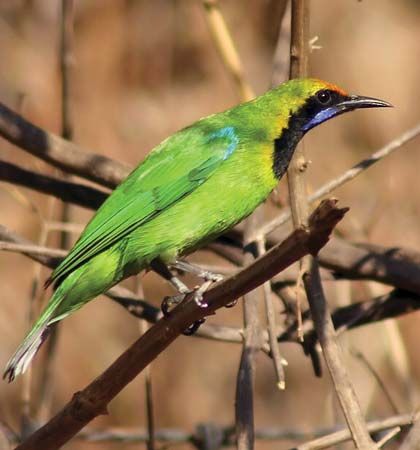
A leafbird refers to any of approximately 10 species of small, grass-green birds belonging to the genus Chloropsis. These birds are typically found in Southeast Asia and the Philippines, and they generally measure between 17 and 20 cm (6.5 to 8 inches) in length.1
While they are traditionally classified within the family Irenidae, some experts categorize them as part of the bulbul family (Pycnonotidae). Leafbirds inhabit the upper levels of the jungle canopy, where they primarily feed on nectar, insects, and berries. Known for their ability to mimic other sounds, they can also be quite aggressive toward other birds. One notable species, the golden-fronted leafbird, is frequently kept as a cage bird.1
What are some other birds found in the Southeast Asian jungle canopy?
The tropical rainforests of Southeast Asia support a vast array of bird life, with many species occupying specialized niches within the jungle canopy and undergrowth. Beyond leafbirds, several other groups are characteristic of these environments:
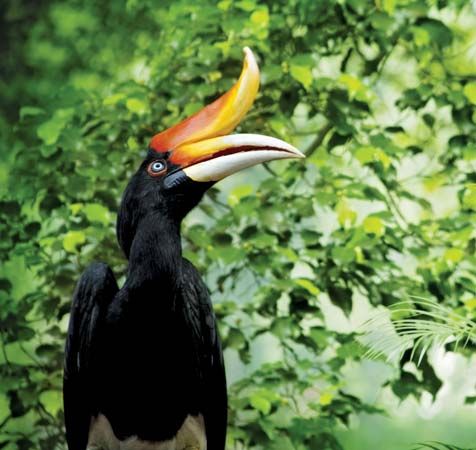
- Hornbills: These distinctive birds are highly developed in the Oriental region. They are known for their large bills, often topped with a bony casque, and their unique nesting behavior, where the female is often walled into a tree cavity for protection.23
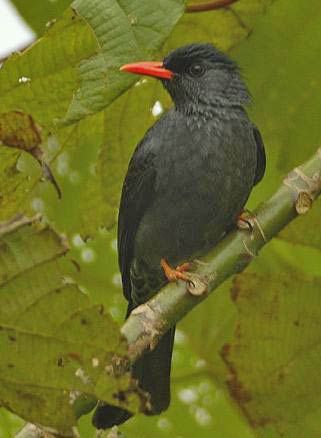
- Bulbuls: These active, noisy, and plain-colored birds are widely distributed across Asia. Species such as the finch-billed bulbul are found in Southeast Asia, and they are common inhabitants of the region’s forests.43
- Jungle Babblers: Belonging to the family Timaliidae, these songbirds are typically drab in appearance and prefer to skulk in the forest undergrowth. They are often detected by their distinct vocalizations rather than by sight.5
- Other Notable Species: The region also hosts a variety of woodpeckers, barbets (such as the coppersmith bird), broadbills, and various species of pheasants that thrive in the dense forest environments of Malaysia, Sumatra, and Borneo.3
How do birds use mimicry to survive in the wild?
Birds utilize mimicry as a sophisticated survival strategy, primarily through brood parasitism and complex vocal adaptations.
Brood Parasitism
Certain birds, such as the African whydahs, ensure the survival of their offspring by laying eggs in the nests of specific host species, typically small finchlike birds known as estrildids. To avoid detection by the host parents, the parasitic nestlings have evolved to perfectly match the host’s characteristics:
- Visual Mimicry: The nestlings replicate the specific patterns of spots and protuberances found on the host’s mouth, palate, and tongue. These patterns act as a “releaser” for feeding behavior; the host parents will ignore any nestling that does not display the correct, species-specific pattern.8
- Behavioral Mimicry: Young whydahs duplicate the begging calls and head movements of their host species. Furthermore, their juvenile plumage is identical to that of the host’s young, ensuring they are fed after fledging.8
Vocal Mimicry
Vocal mimicry serves as a critical species-isolating mechanism. Parasitic weaverbirds learn the songs of their host species during a critical development period. As adults, males use these learned vocalizations to attract females that were reared by the same foster species, effectively preventing hybridization and ensuring the continuation of the specific host-parasite relationship. While other birds, such as the mockingbird or lyrebird, are famous for their vocal imitations, these are often distinguished from the functional, survival-based mimicry systems found in brood parasites.89
What are the main differences between leafbirds and bulbuls?
It appears there is a misunderstanding in your query: a “bulb” is a botanical structure used by plants for food storage, not a type of bird. You likely intended to ask about the bulbul, a family of birds often compared to leafbirds.
Leafbirds and bulbuls are closely related, with some authorities even classifying leafbirds within the bulbul family (Pycnonotidae). However, they have distinct characteristics:
- Appearance: Leafbirds are typically short-legged and grass-green in color, measuring about 17 to 20 cm (6.5 to 8 inches) in length.
- Behavior: Leafbirds are known for being excellent mimics and are often observed to be aggressive toward other birds.
- Habitat and Diet: Both groups inhabit the jungle canopy. Leafbirds feed primarily on nectar, supplemented by insects and berries.
Because the provided information does not detail the specific behavioral or physical traits of the bulbul family beyond their taxonomic relationship to leafbirds, I cannot provide a comprehensive comparison of their differences.
Sources
- Leafbird — Encyclopædia Britannica
- Hornbill — Encyclopædia Britannica
- Bulbul — Encyclopædia Britannica
- Southeast Asia - Animal life — Encyclopædia Britannica
- Asia - Birds — Encyclopædia Britannica
- Jungle babbler — Encyclopædia Britannica
- biogeographic region - Malesian subkingdom — Encyclopædia Britannica
- mimicry - Parasitic weaverbirds — Encyclopædia Britannica
- Gruiform - Courtship — Encyclopædia Britannica
- Songbird — Encyclopædia Britannica
- mimicry - The importance of the signal receiver — Encyclopædia Britannica
- mimicry - The importance of mimicry to evolutionary theory — Encyclopædia Britannica
- Bulb — Encyclopædia Britannica
Published on · 3 min read